
🦷 When the Jaw Won’t Open
 ToothOps4 min read
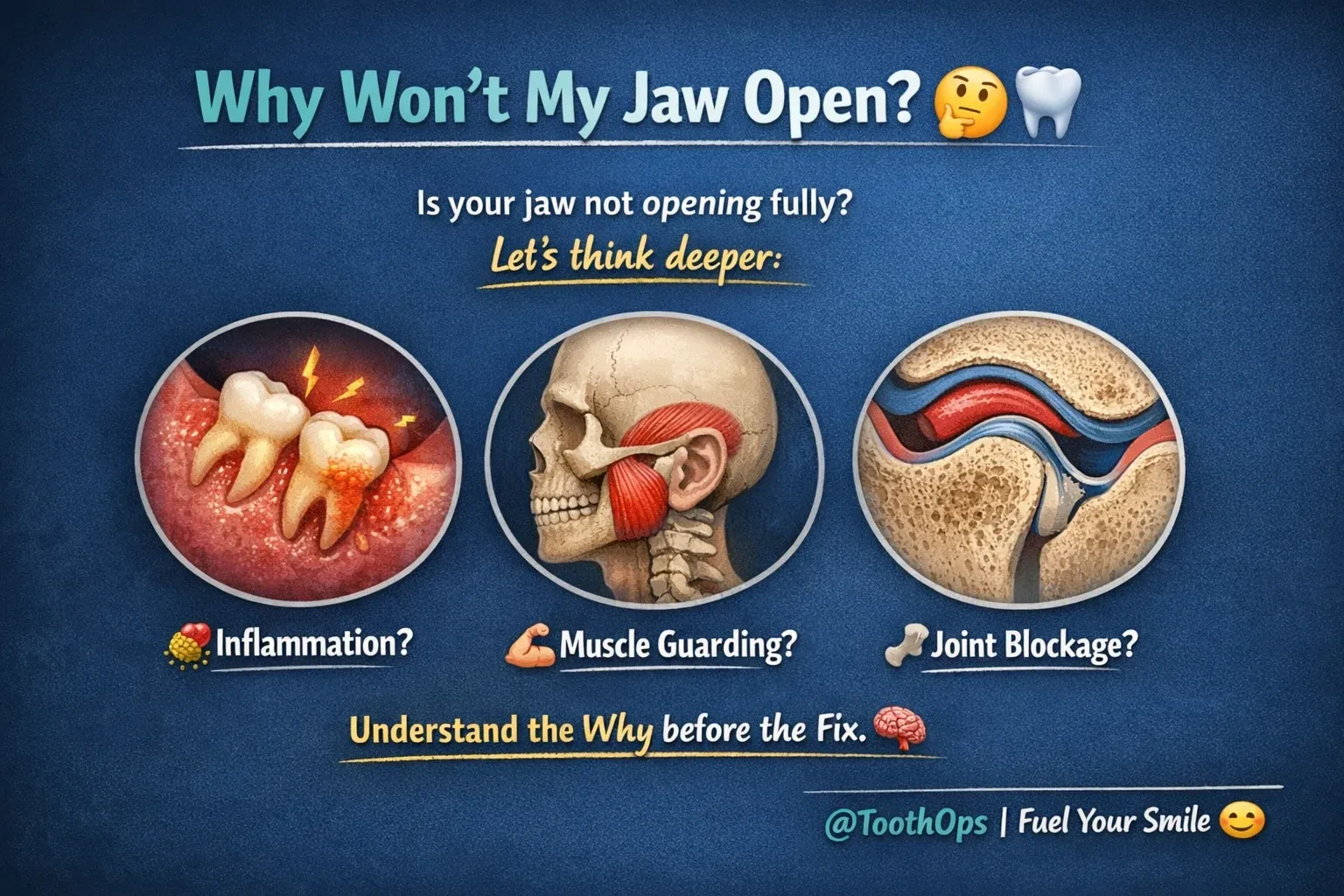
Understanding Mandibular Movement, Pain, and Protection
Jaw pain and limited mouth opening can feel alarming — especially when it appears suddenly.
But in dentistry, restricted mandibular movement is rarely random. It is most often the result of a predictable protective response involving joint mechanics, muscle behavior, inflammation, and the nervous system.
This post is designed to reduce confusion, not overwhelm — and to help you reason through why the jaw behaves the way it does.
🎯Clinical Reasoning
Limited jaw opening is not weakness — it’s protection.
1️⃣ How the Jaw Is Designed to Move
The mandible is the most mobile bone of the craniofacial skeleton, supporting chewing, speech, swallowing, and facial expression.
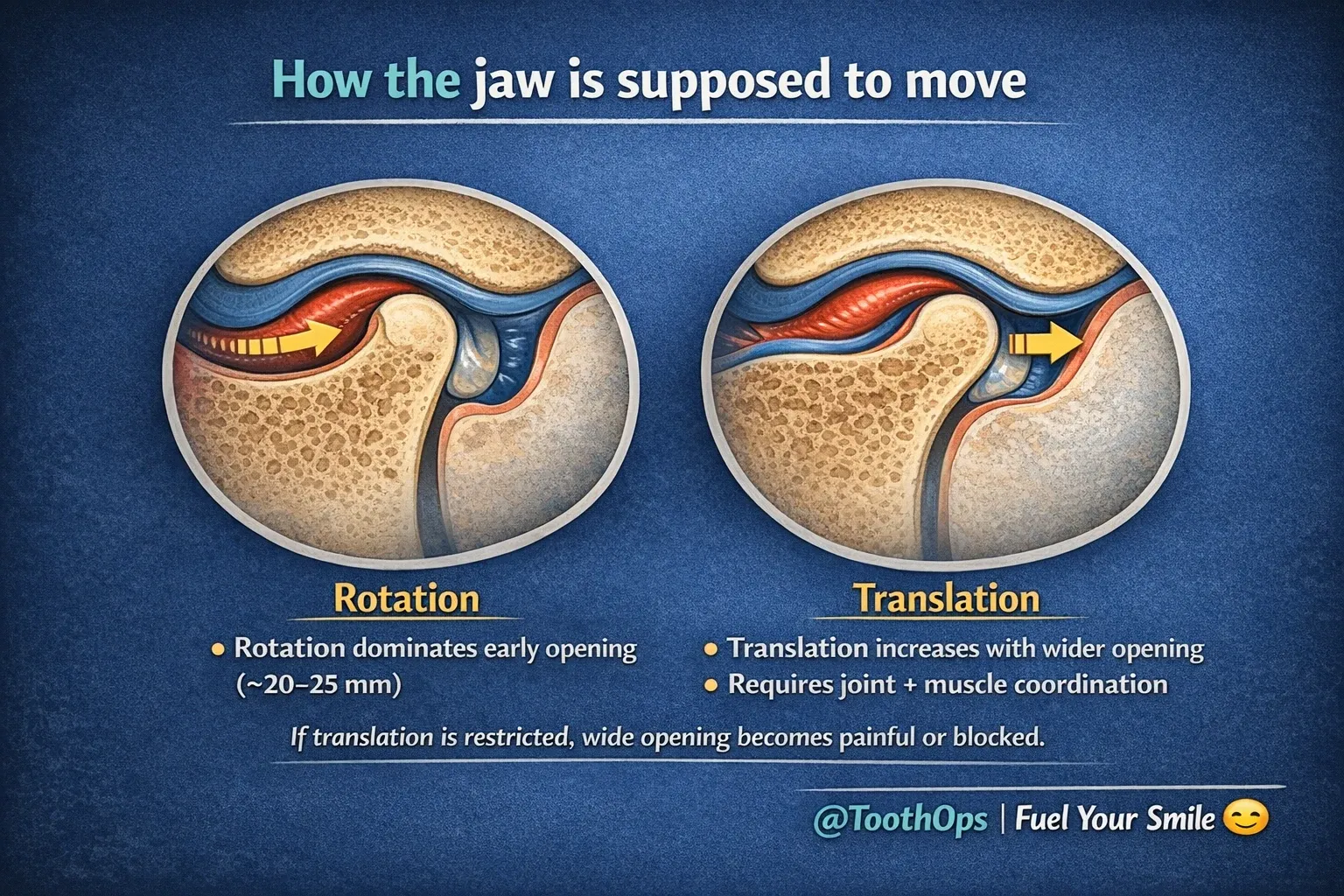
This mobility depends on the temporomandibular joints (TMJs) — specialized synovial joints that allow two coordinated types of motion:
- Rotation (hinge motion) → first ~20–25 mm of opening
- Translation (gliding motion) → wider opening as the condyle–disc complex moves forward along the articular eminence
If either phase is disrupted, the jaw may:
- Stop early
- Deviate to one side
- Feel “stuck”
- Become painful with movement
💡 Function fails when protection activates.
🧠 Analogy Box
Think of the TMJ like a hinge on a sliding track.If the hinge is inflamed or the track is blocked, the door won’t open fully — not because it’s broken, but because the system is protecting itself.
2️⃣ The Muscles: Power With a Safety Brake
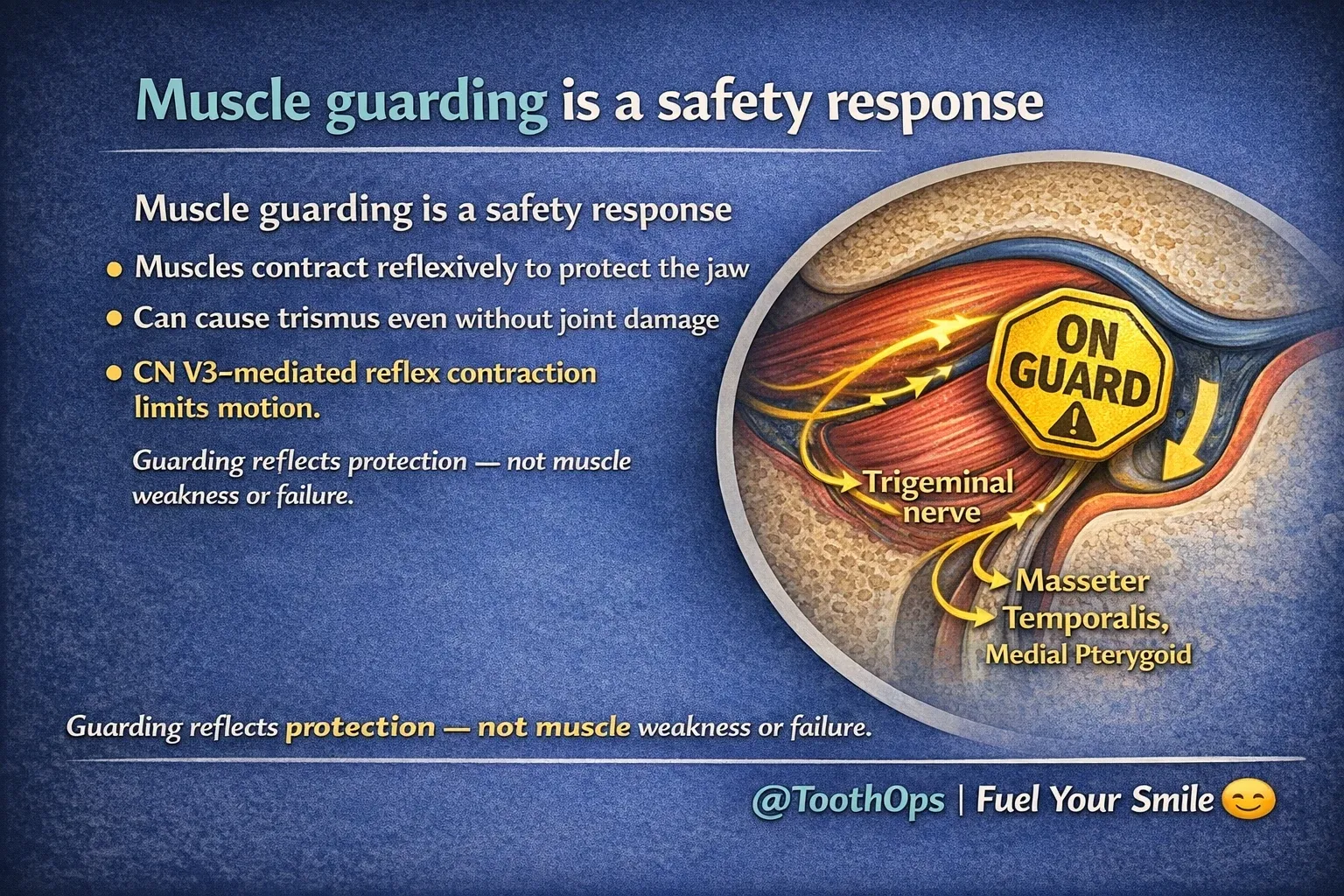
Jaw movement is powered by the muscles of mastication, all innervated by the mandibular branch of the trigeminal nerve (CN V3):
- Masseter & medial pterygoid → elevation and force
- Temporalis → elevation and retrusion
- Lateral pterygoid → disc stabilization, opening, protrusion
When pain or inflammation is detected, these muscles don’t “push through.”They guard — reflexively limiting movement to prevent further injury.
This protective response is well-described in classic orofacial pain and TMD literature (Okeson; NIH).
3️⃣ The Pain–Spasm–Dysfunction Cycle (Why It Persists)
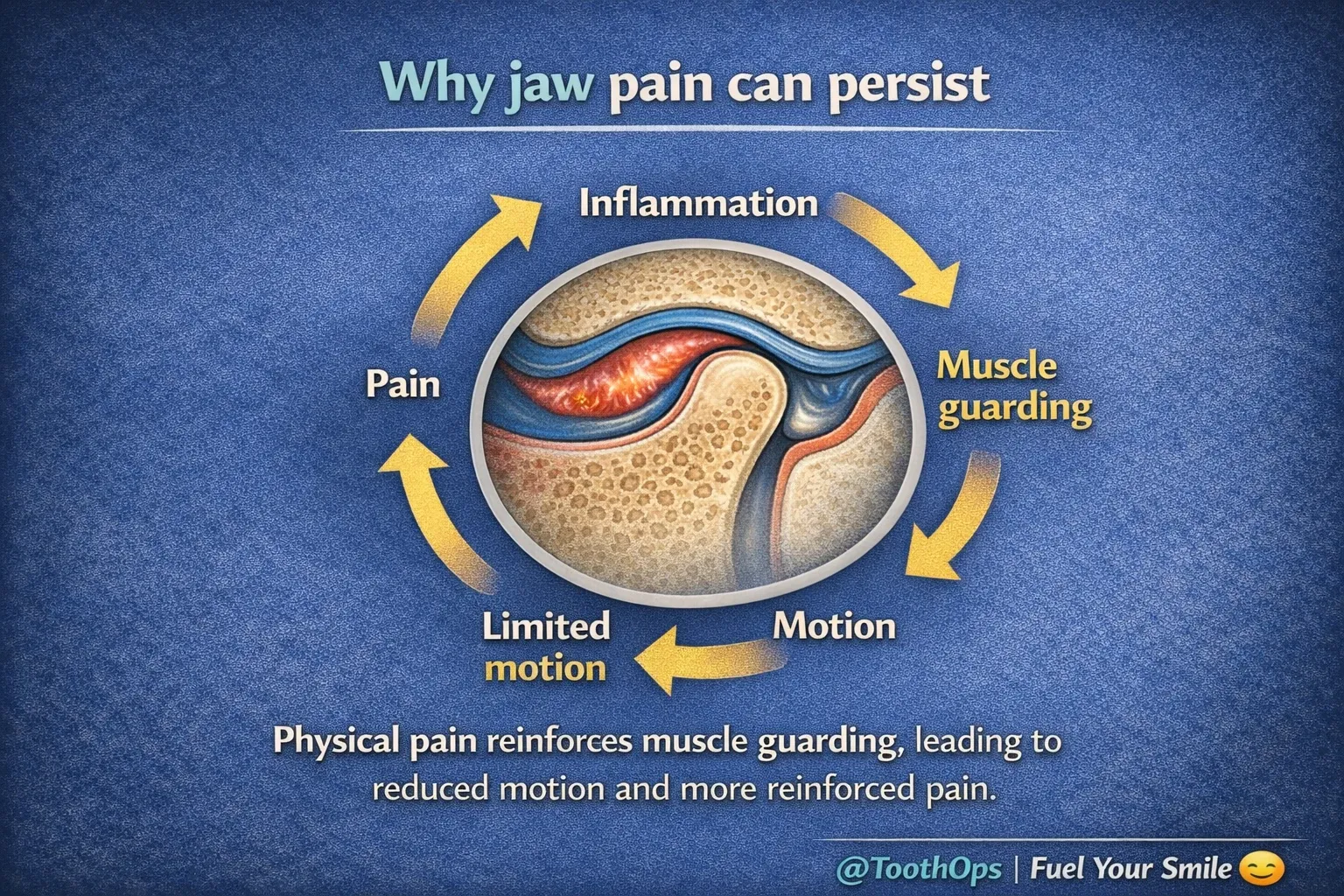
Mechanism → consequence → relevance
- Mechanism: Inflammatory mediators activate nociceptors carried by CN V3
- Consequence: Reflex muscle contraction + reduced blood flow (ischemia)
- Relevance: Sustained spasm limits opening and perpetuates pain
This creates the classic pain–spasm–dysfunction cycle, a cornerstone concept in temporomandibular disorder science.
💡 This is why “just resting the jaw” often doesn’t resolve the problem.
4️⃣ Temporomandibular Disorders (TMD): A Spectrum, Not a Single Diagnosis
TMD refers to a group of musculoskeletal and neuromuscular conditions, not one disease.
Common features include:
- Jaw or facial pain
- Muscle tenderness
- Clicking or crepitus
- Limited or asymmetric opening
- Fatigue with chewing
Two overlapping contributors:
- Myogenous (muscle-based): overuse, trigger points, guarding
- Arthrogenous (joint-based): disc displacement, synovitis, degeneration
Many patients experience both simultaneously, which explains the wide variability in presentation and severity.
5️⃣ When Inflammation Comes From Infection
Inflammation doesn’t only arise from joint wear or parafunction.
Local dental infections, especially in posterior regions, can:
- Stimulate trigeminal nociceptors
- Trigger protective muscle guarding
- Cause trismus (limited mouth opening)
- Produce referred pain to the ear, temple, or neck
💡 This is why jaw function and oral health are inseparable.
6️⃣ A Rare but Important Clinical Consideration
Although uncommon, systemic or bone-involving infections can affect jaw structures.
When this occurs, symptoms may mimic TMD, including:
- Jaw pain
- Swelling
- Trismus
- Progressive functional limitation
🧠 _Clinical reasoning matters:_Persistent, atypical, or systemically associated symptoms deserve evaluation beyond routine musculoskeletal explanations.
7️⃣ What Limited Jaw Opening Is — and Is Not
Limited mandibular opening is:
- A protective neuromuscular response
- Often reversible
- Frequently inflammation-driven
Limited mandibular opening is NOT:
- Automatically a TMJ disorder
- Always structural damage
- A sign that the jaw is “failing”
This distinction prevents over-diagnosis and supports calmer, more accurate care.
📊 Quick Clinical Reasoning Table
| Trigger | Primary Mechanism | Clinical Result |
|---|---|---|
| Muscle overuse | Sustained contraction → ischemia | Pain + limited opening |
| Joint inflammation | Increased intra-articular pressure | Painful translation |
| Local infection | CN V3 nociceptor activation | Trismus |
| Disc displacement | Mechanical obstruction | “Closed-lock” sensation |
💡 Pro Tip (for students & clinicians)
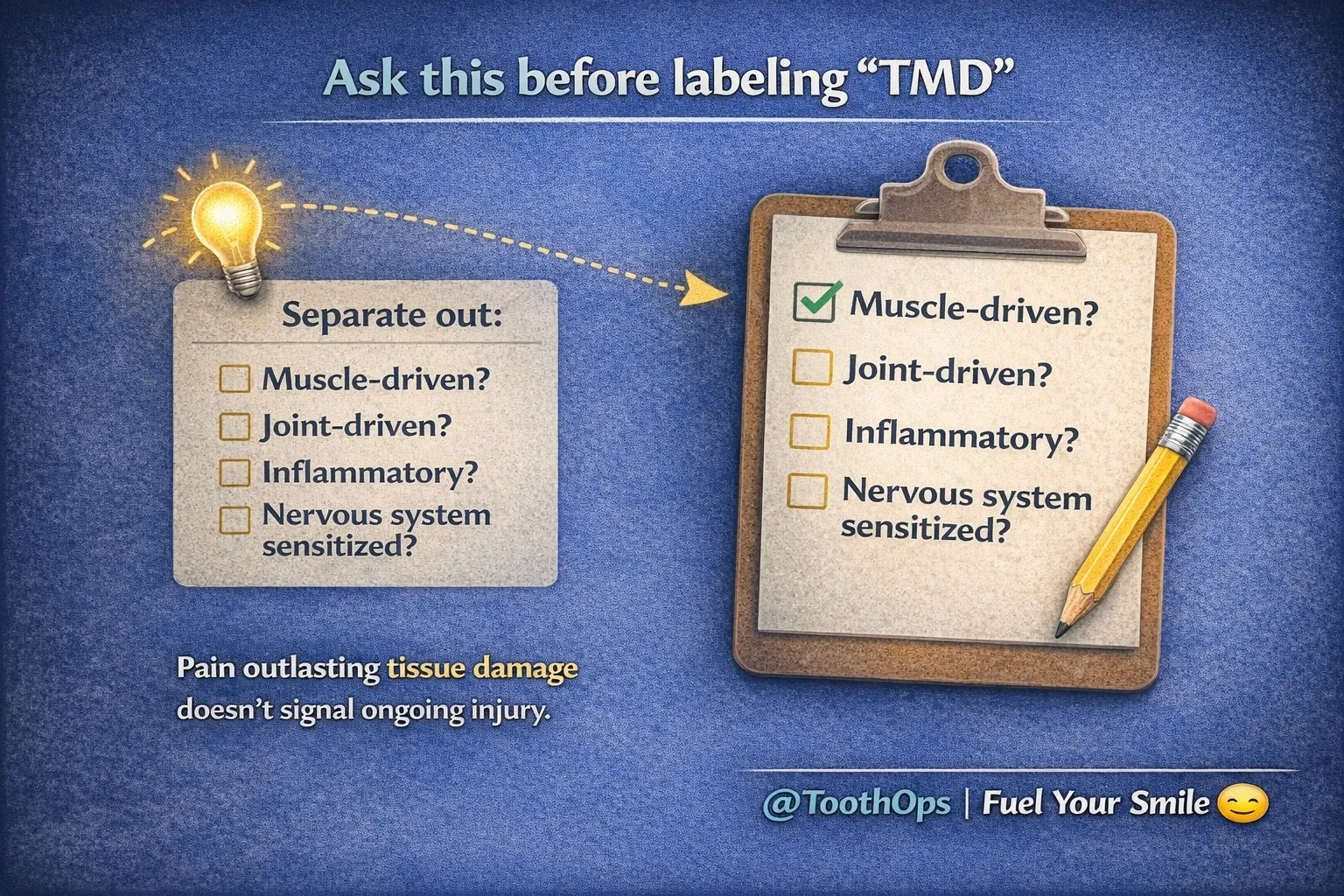
When evaluating limited opening, ask:
- Is this muscle-driven, joint-driven, or inflammatory?
- What would make the nervous system feel safe enough to allow motion again?
That mindset improves diagnosis, communication, and outcomes.
🌱 Final ToothOps Takeaway
Confidence in dentistry doesn’t come from memorizing symptoms.It comes from understanding mechanisms.
When you understand why the jaw protects itself, you replace fear with clarity — and clarity is the foundation of good clinical reasoning.
@ToothOps | Fuel Your Smile 😊Stay tuned for more insights and educational content in our blog.
Disclaimer: Content is for educational purposes only and not a substitute for medical or dental care.
© 2025 ToothOps | All Rights Reserved.