
🫁 Tuberculosis Treatment: Why It’s Long, Layered, and Exact
 ToothOps4 min read
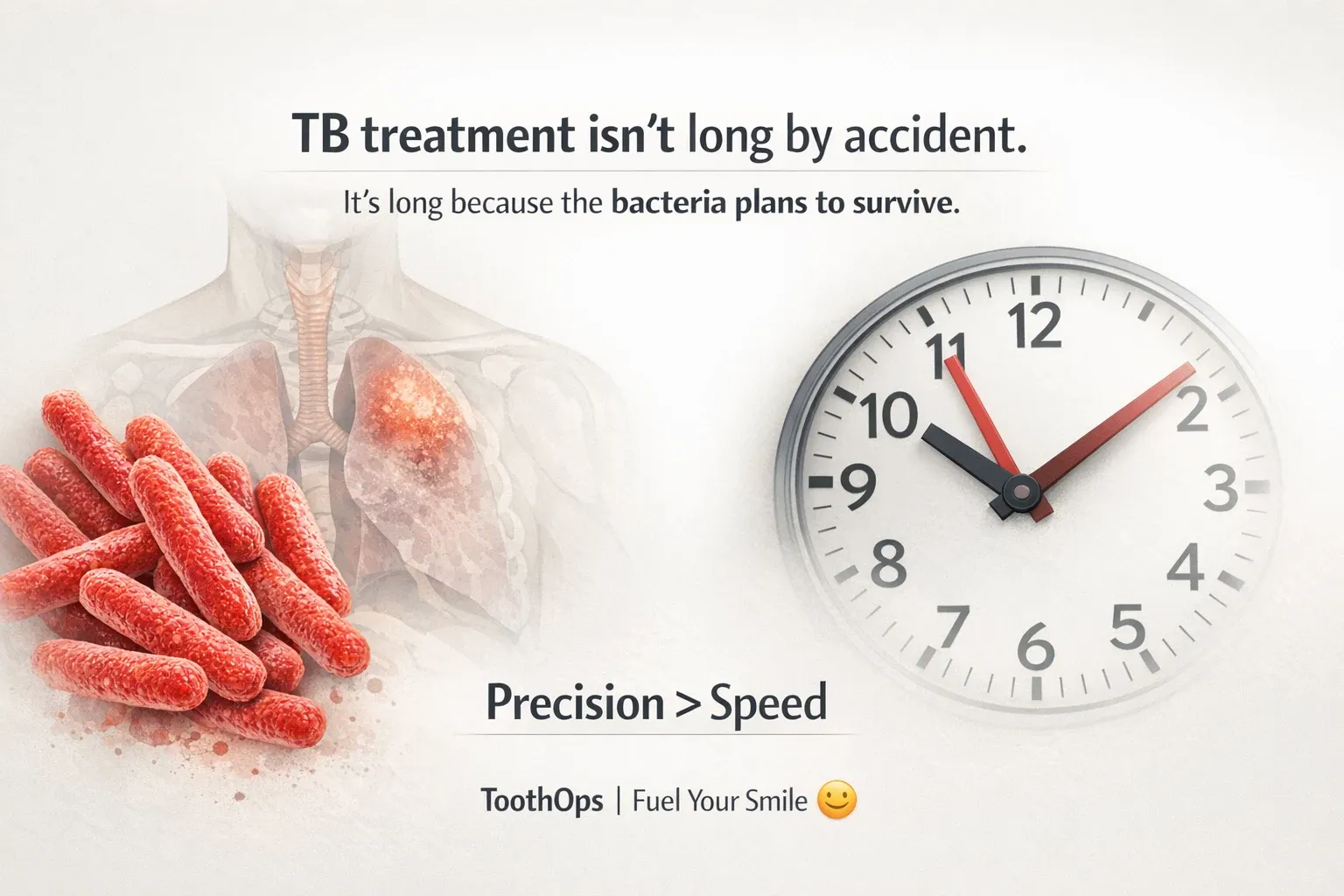
If tuberculosis could be treated like strep throat, it would be.
It isn’t — because Mycobacterium tuberculosis doesn’t play by the same rules as most bacteria. It hides, slows down, and survives shortcuts. TB treatment is built to anticipate that behavior, not react to it.
This post breaks down how clinicians think about TB treatment — and why every step exists.
🧠 Clinical Reasoning Breakdown
TB treatment works because it plans for bacterial survival, not just symptom relief.
1️⃣ Why TB Can’t Be Rushed
TB doesn’t fail treatment because the drugs are weak.It fails when the biology is underestimated.
Mycobacterium tuberculosis:
- Replicates slowly
- Persists inside immune cells
- Exists in active and dormant states at the same time
🧠 Analogy Treating TB is like clearing weeds with deep roots. Cutting what’s visible helps — but staying long enough prevents regrowth.
Mechanism → consequence → relevance
- Mechanism: Slow growth + dormant bacilli
- Consequence: Short courses miss survivors
- Relevance: Treatment must be prolonged and strategic
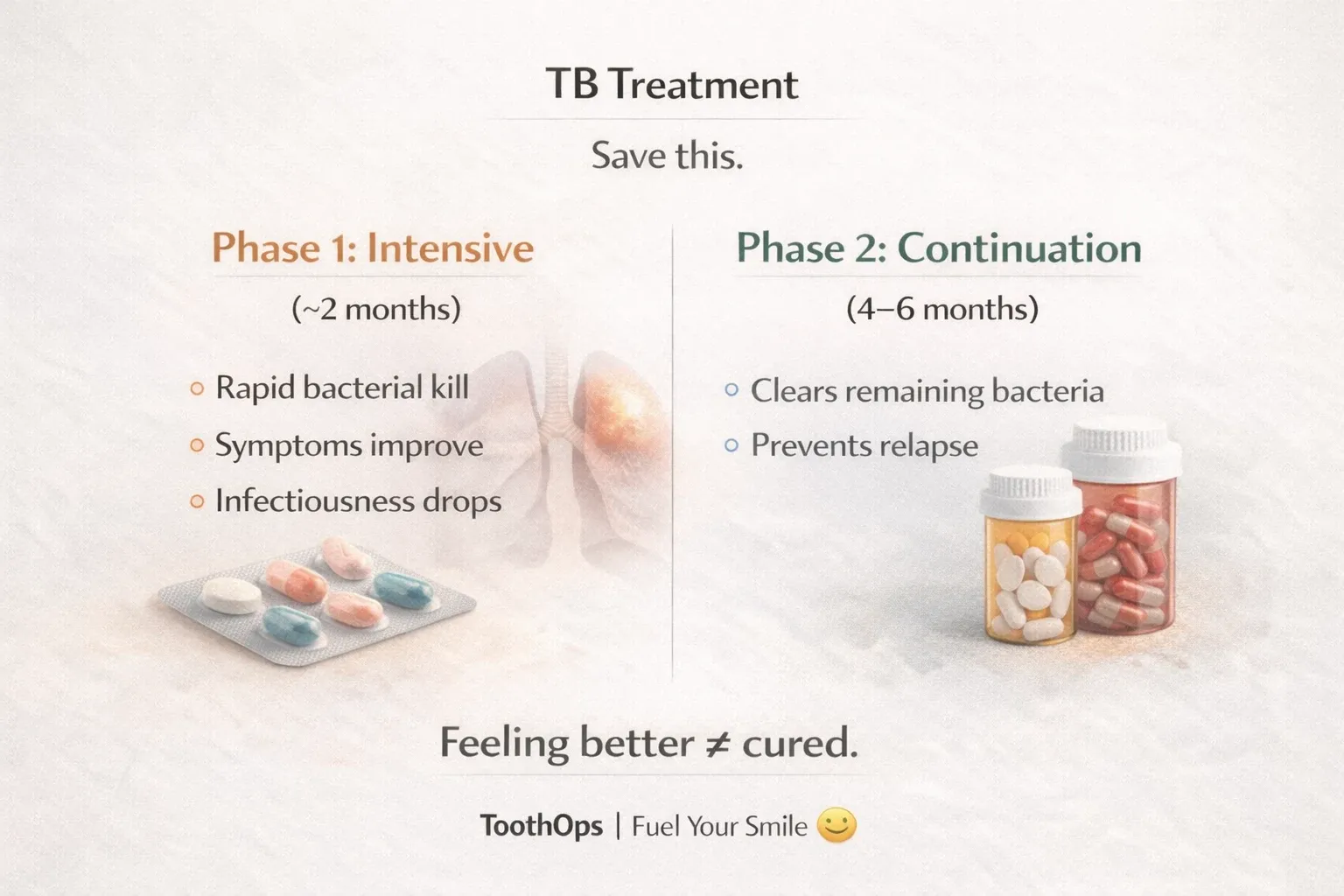
2️⃣ The Two Phases of Treatment (Each With a Job)
TB regimens aren’t long — they’re sequenced.
🔹 Intensive Phase (≈ 2 months)
What it does
- Rapidly lowers bacterial burden
- Improves symptoms
- Reduces infectiousness
How
- Four drugs with different targets:
- Isoniazid
- Rifampin
- Pyrazinamide
- Ethambutol
Most patients feel better here.That improvement is expected — and incomplete.
🔹 Continuation Phase (≈ 4–6 months)
What it does
- Eliminates remaining organisms
- Prevents relapse
How
- Isoniazid + Rifampin
- Duration adjusted for cavitary disease and microbiologic response
This phase is what separates temporary improvement from cure.
🔄 Pattern Interrupt: Why This Feels “Too Long”
If TB treatment feels excessive, it’s usually because we’re comparing it to the wrong infections.
TB doesn’t behave like most bacteria — and it punishes shortcuts.The length of treatment reflects biology, not caution.
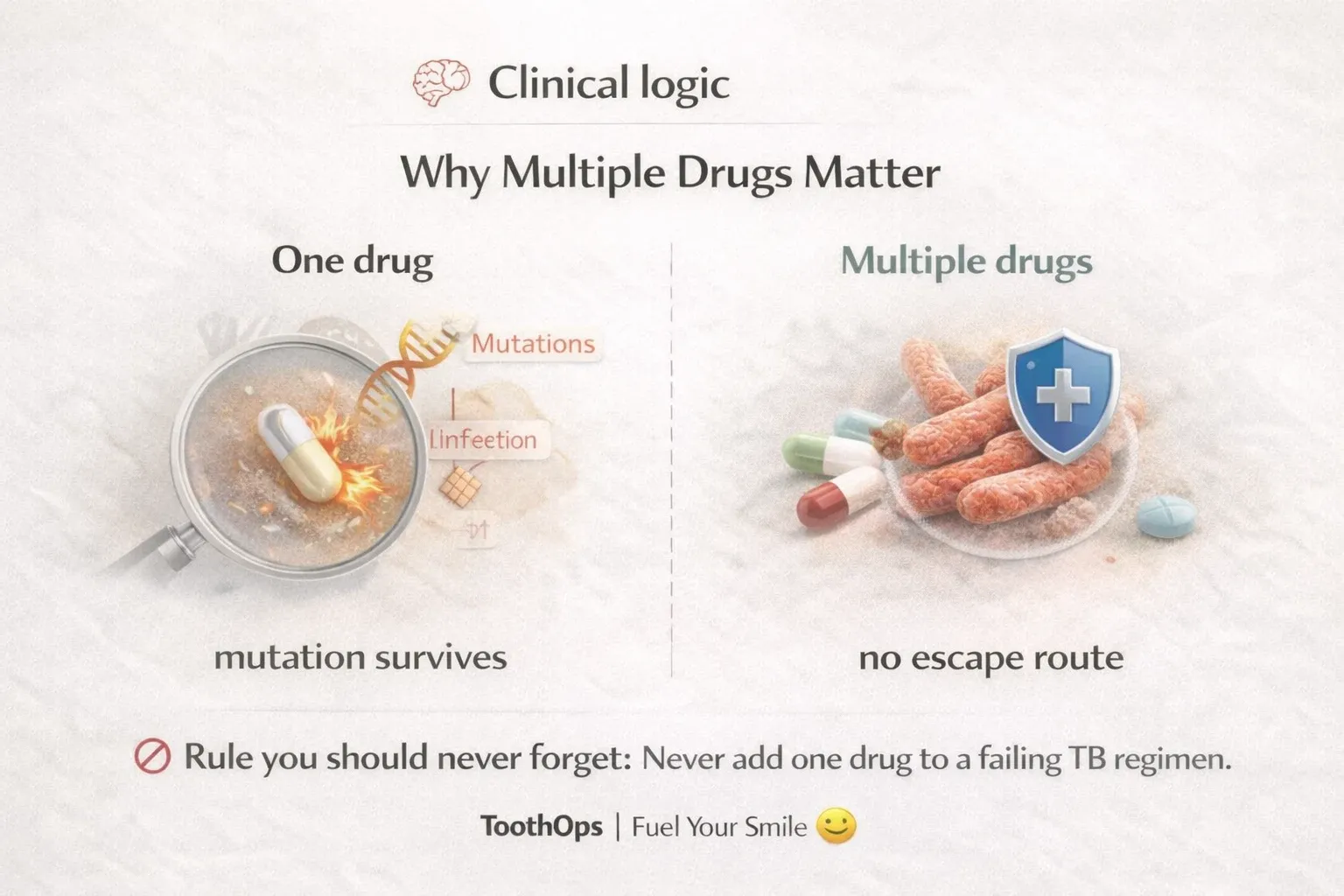
3️⃣ Why TB Is Never Treated With One Drug
TB is always treated with combinations — and this rule never changes.
Mechanism → consequence → relevance
- Mechanism: Random genetic mutations under drug pressure
- Consequence: Single-drug exposure selects resistant strains
- Relevance: Combination therapy preserves effectiveness
This principle is emphasized by global TB authorities like the World Health Organization and the Centers for Disease Control and Prevention.
One rule stands above all others:
Never add a single drug to a failing TB regimen.
📌 The TB Treatment Logic You’ll See on Exams and in Clinic
| Situation | What It Signals | What Happens Next |
|---|---|---|
| Symptoms improve early | Bacterial load dropping | Treatment continues |
| Sputum stays positive | Nonadherence or resistance | Reassessment |
| Culture positive at 4 months | Treatment failure | Expert-guided redesign |
| Relapse after stopping | Dormant bacilli survived | Extended therapy |
This table is worth bookmarking.
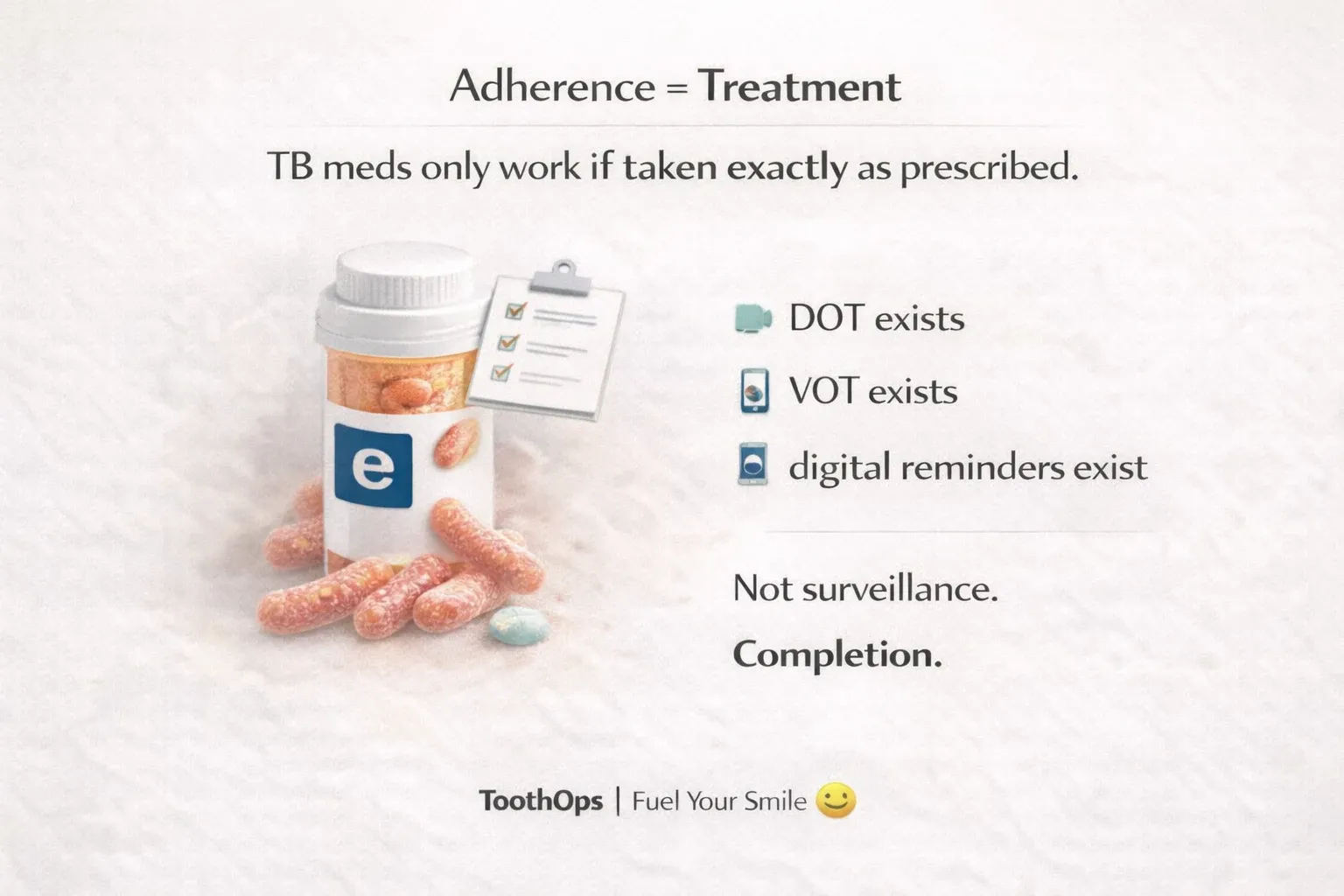
4️⃣ Adherence Is the Treatment
TB drugs only work when taken exactly as prescribed.
That’s why treatment often includes observation strategies:
Directly Observed Therapy (DOT)
- In-person confirmation
- Reduces resistance
- Resource-intensive
Video-Observed Therapy (VOT)
- Remote verification via smartphone
- Comparable outcomes
- Fewer logistical barriers
💡 The goal isn’t surveillance.It’s completion — because incomplete treatment fuels resistance.
Digital pillboxes and reminders support consistency where biology demands precision.
5️⃣ When Resistance Changes the Playbook
MDR-TB
- Resistant to isoniazid + rifampin
- Requires:
- ≥5 effective drugs
- Longer duration
- Specialist oversight
XDR-TB
- Additional resistance to fluoroquinolones ± injectables
- Managed with:
- All-oral regimens when possible
- Newer agents (e.g., bedaquiline, linezolid)
- Extended timelines
🧠 Resistance narrows options — it never shortens treatment.
6️⃣ Latent TB: Treating Risk Before Disease
Latent TB isn’t inactive — it’s contained.
- No symptoms
- Not contagious
- Still capable of reactivation
Preventive treatment targets:
- Risk of progression
- Age and immune status
- Medication tolerance
When completed, preventive therapy dramatically lowers lifetime risk of active TB.
7️⃣ What TB Treatment Is — and What It Isn’t
TB treatment is
- Structured
- Purposefully long
- Highly effective when completed
TB treatment is not
- Excessive
- Outdated
- Finished when symptoms improve
Modern regimens cure most drug-susceptible TB cases.
💡 Pro Tip (for students & clinicians)
When someone asks, “Why does this take so long?” Here’s the real answer:
“Because TB survives shortcuts.”
That single idea explains the entire regimen.
🌱 Final ToothOps Takeaway
TB treatment succeeds because it respects biology.
Precision beats speed.Completion beats early relief.
Future ToothOps posts will build on this same reasoning — resistance, adherence, and treatment design — across other infections too.
@ToothOps | Fuel Your Smile 😊Stay tuned for more insights and educational content in our blog.
Disclaimer: Content is for educational purposes only and not a substitute for medical or dental care.
© 2025 ToothOps | All Rights Reserved.