
🫁 Tuberculosis Diagnostics, Rebuilt
 ToothOps3 min read
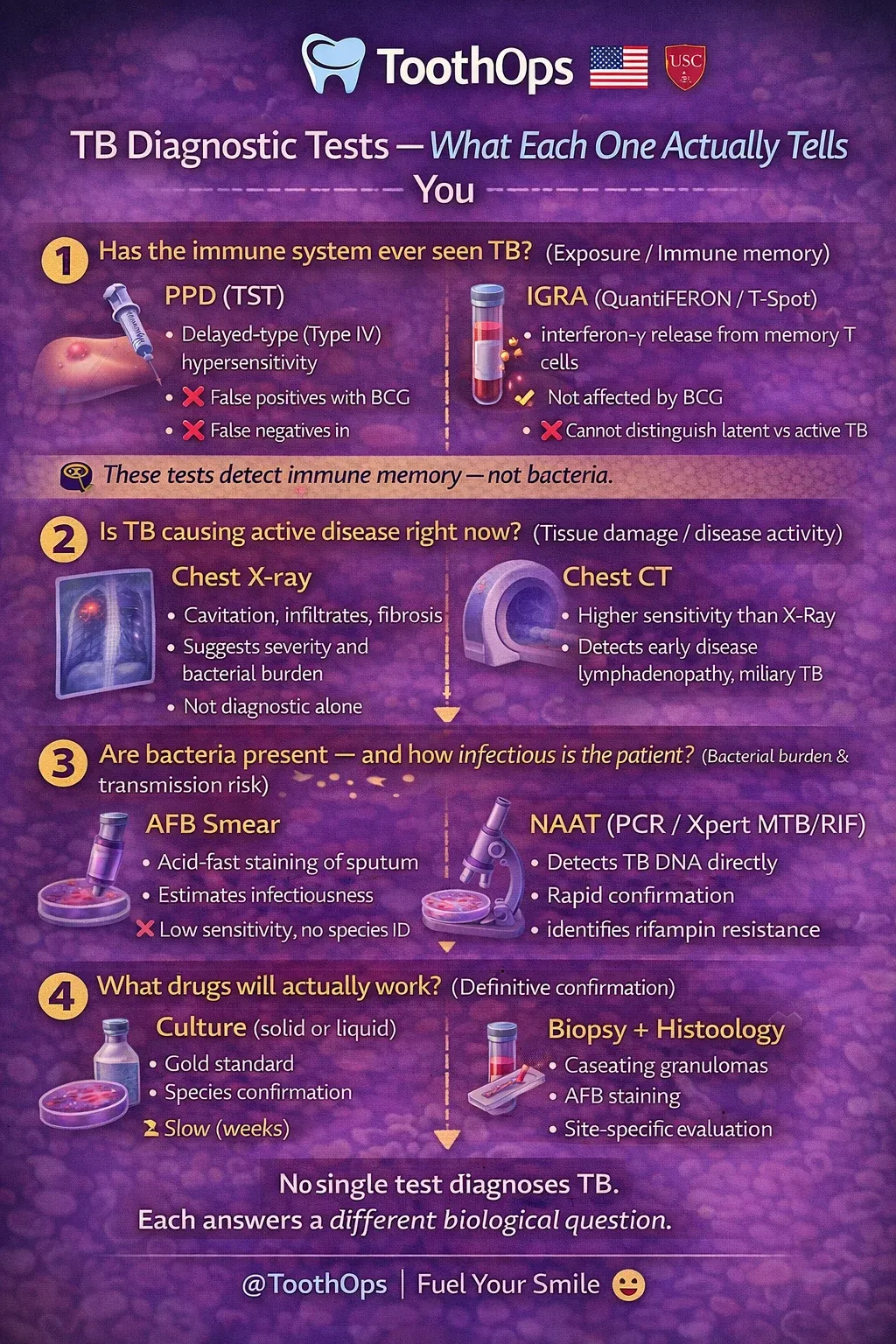
A Biology-First Guide to Screening, Disease, and Resistance
Tuberculosis (TB) is not diagnosed by “running all the tests.”
It’s diagnosed by asking the right biological question at the right time.
This is why TB diagnostics feel confusing:
- some tests detect immune memory
- some detect tissue damage
- some detect bacterial burden
- some detect genetic resistance
- none do all of it alone
This ToothOps guide rebuilds TB diagnostics from the biology upward, so every test makes sense — and stays memorable.
🎯 Clinical Reasoning
Core idea:
TB diagnostics are layered because the organism survives in layers.
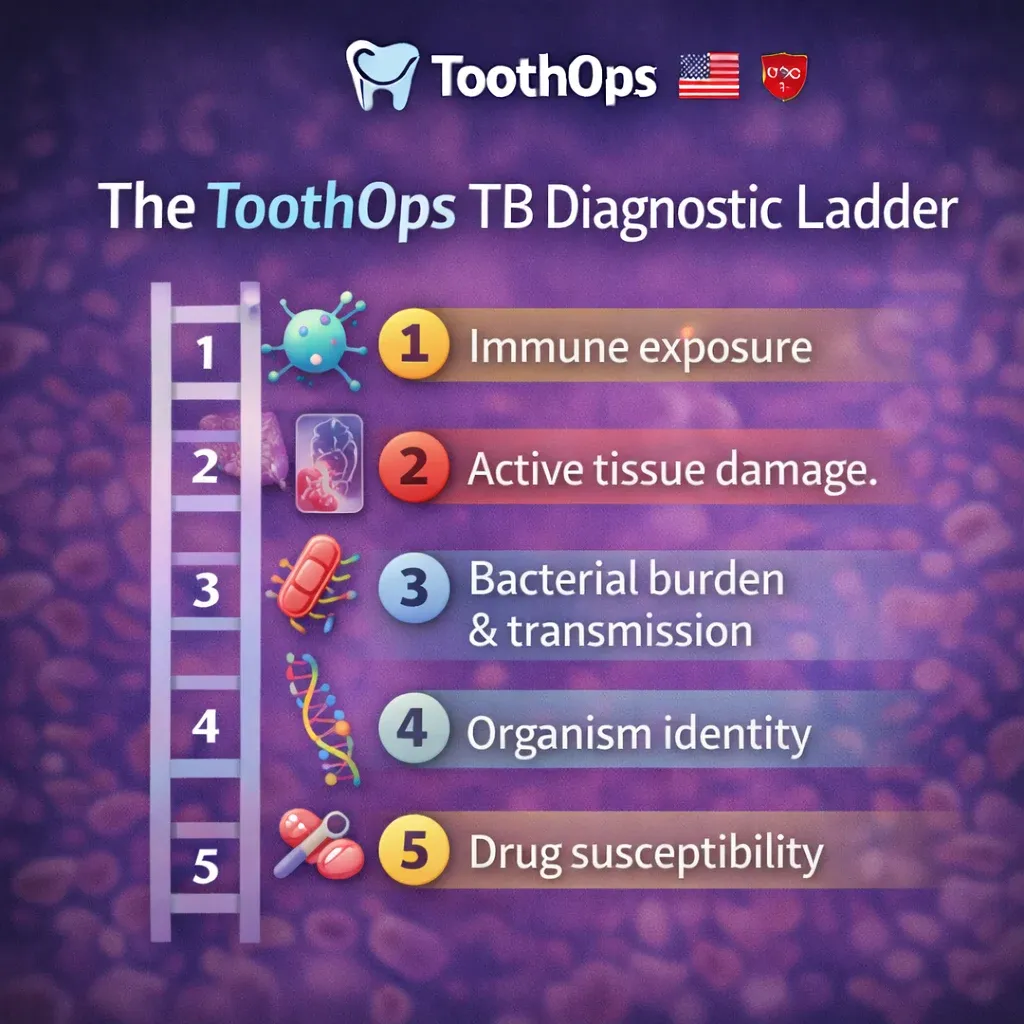
1️⃣ The ToothOps TB Diagnostic Ladder (Core Framework)
Before naming tests, identify the level of uncertainty:
- Immune exposure – has TB ever been encountered?
- Disease activity – is TB actively damaging tissue?
- Bacterial burden & transmission – how much organism is present?
- Organism identity – is this truly M. tuberculosis?
- Drug susceptibility – will standard therapy work?
🧠 Most diagnostic errors occur when one level is answered but assumed to apply to all five.
2️⃣ Immune-Based Tests: Detecting Exposure (Not Disease)
Interferon-γ Release Assays (IGRAs)
(QuantiFERON-TB Gold Plus, T-SPOT.TB)
Biology: Memory T-cells release interferon-γ after exposure to TB-specific antigens (ESAT-6, CFP-10).
What they answer well
- Has the immune system seen TB before?
What they cannot answer
- Is TB active?
- Is the patient infectious?
- How severe is disease?
🧠 Analogy IGRA = footprints in the sandIt proves contact, not current movement.
⚠️ High-yield nuance
- False negatives can occur in:
- immunosuppression
- advanced disease
- very early infection
3️⃣ Imaging: Where TB Becomes a Disease
Chest X-Ray (CXR)
Why imaging matters biologically
- TB favors oxygen-rich upper lobes
- Cavitation reflects immune-mediated tissue destruction
- Lymphadenopathy reflects lymphatic spread
What imaging adds
- Separates infection from active disease
- Correlates with bacterial burden and resistance risk
📌 Cavitary disease = higher organism load = higher mutation probability.
4️⃣ Acid-Fast Bacilli (AFB) Smear: Burden, Not Diagnosis
Why TB stains acid-fast
- Mycolic acids trap carbolfuchsin dye
- Reflects a lipid-rich, drug-resistant cell wall
What AFB smear tells you
- Approximate bacterial burden
- Transmission risk
- Isolation decisions
What it cannot do
- Confirm species
- Rule out TB if negative
- Detect resistance
| Smear | Meaning |
|---|---|
| 3+ / 4+ | High transmission |
| 1+ | Lower burden |
| Negative | TB still possible |
5️⃣ NAATs: DNA-Level Confirmation
Nucleic Acid Amplification Tests
Biology advantage
- Detects TB DNA directly
- Independent of bacterial viability
Clinical power
- Faster than culture
- More specific than smear
- Detects rifampin resistance early
🧠 Rifampin resistance ≈ surrogate marker for MDR-TB.
6️⃣ Culture: Definitive, but Slow
Why culture still matters
- Species confirmation
- Full drug susceptibility testing
- Epidemiologic tracking
Why it cannot stand alone
- Weeks to grow
- Too slow for isolation or initial therapy
🧠 Culture = verdictSmear/NAAT = triage
7️⃣ Drug Susceptibility Testing (DST): Protecting the Future
Biology of resistance
- TB does not gain resistance via plasmids
- Resistance arises from spontaneous chromosomal mutations
- High burden = higher mutation probability
DST types
- Molecular (fast, targeted)
- Phenotypic (slow, comprehensive)
📌 DST protects both the patient and the community.
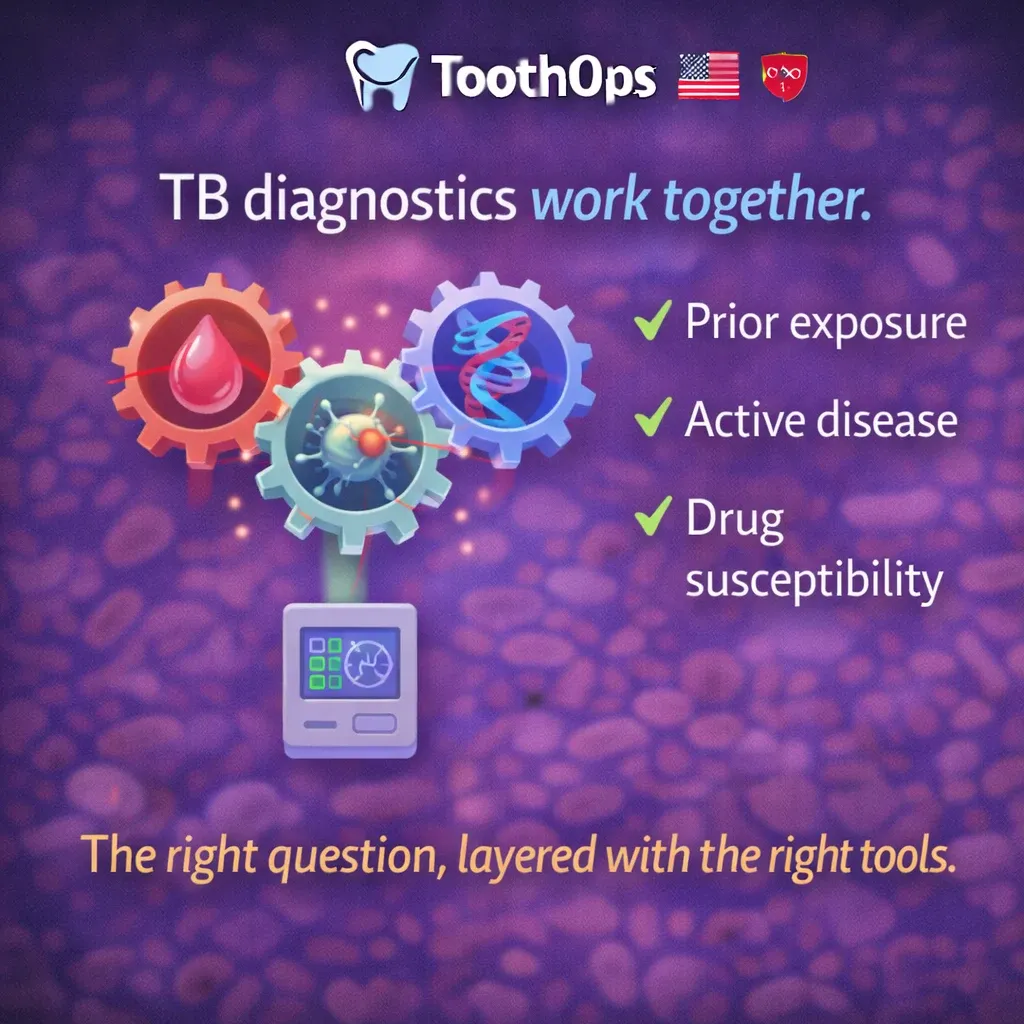
8️⃣ Why TB Diagnostics Must Be Combined
TB survives by:
- slow replication
- intracellular hiding
- dormancy
- thick lipid barriers
Diagnostics must therefore be:
✔ layered
✔ redundant
✔ biologically strategic
No test is wasted — each reduces a different uncertainty.
9️⃣ Common Diagnostic Traps (New Value)
❌ Treating IGRA as proof of active TB
❌ Assuming smear-negative = non-infectious
❌ Waiting for culture before acting
❌ Ignoring resistance risk in cavitary disease
✅ Strong clinicians think in biology first, tests second.
🌱 Final ToothOps Takeaway
TB diagnostics feel complex because the organism is complex.
When you understand the biology,every test earns its place — and clinical reasoning replaces confusion.
@ToothOps | Fuel Your Smile 😊 Stay tuned for more insights and educational content in our blog.Disclaimer: Content is for educational purposes only and not a substitute for medical or dental care.© 2025 ToothOps | All Rights Reserved.