
🧪 Why TB Treatment Uses Multiple Drugs — And Why Timing Matters
 ToothOps3 min read
A Clinical Reasoning Guide to Isoniazid, Rifampin, and Friends
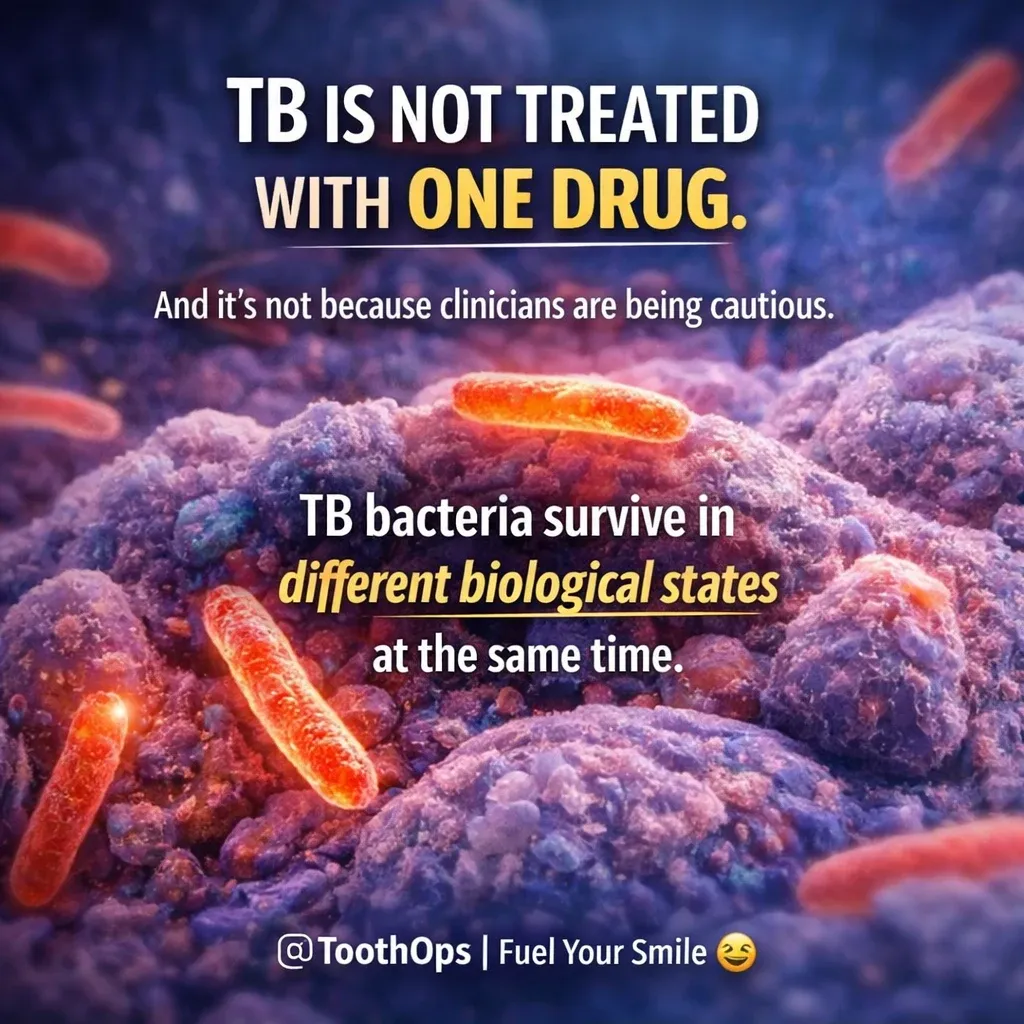
Tuberculosis is not treated with multiple medications because clinicians are being cautious.
It’s treated with multiple medications because the bacteria exist in different biological states at the same time — and each state requires a different strategy.
Once you understand that, TB treatment becomes logical instead of overwhelming.
🧠 The Master Mental Model (Save This)
TB treatment is designed around bacterial populations, not drug strength.
At any moment, Mycobacterium tuberculosis exists as:
- Rapidly dividing extracellular bacilli
- Slowly replicating organisms
- Dormant bacilli inside granulomas
- Intracellular organisms hiding inside macrophages
No single drug can eliminate all four populations reliably.
That’s why TB therapy is layered, phased, and prolonged.
1️⃣ What Happens If You Use Only One Drug?
Using monotherapy does three things:
- Kills susceptible bacteria
- Leaves resistant mutants alive
- Selects for drug-resistant TB
This is not a failure of the medication — it’s evolution under pressure.
💡 Clinical rule:
TB drugs fail when bacteria are allowed to adapt.
Combination therapy removes escape routes.
2️⃣ Isoniazid: Attacking the Cell Wall Where TB Is Weakest
What population it targets
- Actively dividing bacilli
- Intracellular and latent organisms
Why it’s chosen
- Inhibits mycolic acid synthesis
- Weakens the lipid-rich TB cell wall
- Penetrates macrophages and caseating granulomas
Why it matters clinically
- Effective early in disease
- Useful in latent TB
- One of the few drugs that reaches hidden bacterial reservoirs
🧠 Think of isoniazid as destabilizing TB’s long-term survival structure.
3️⃣ Rifampin: Shutting Down Replication Fast
What population it targets
- Rapidly replicating bacilli
- High bacterial burden states
- CNS TB (because of good penetration)
Why it’s essential
- Inhibits DNA-dependent RNA polymerase
- Stops transcription and replication
- Dramatically shortens treatment duration
Why it must be paired
- Resistance emerges quickly when used alone
⚠️ If rifampin is missing, TB treatment becomes longer, weaker, and riskier.
4️⃣ Why Pyrazinamide and Ethambutol Exist
Pyrazinamide
- Targets dormant organisms
- Works best in acidic environments (like granulomas)
- Provides a “sterilizing effect” early in therapy
Ethambutol
- Protects against early resistance
- Especially important before susceptibility results return
- Can be discontinued once resistance is ruled out
💡 These drugs aren’t “extras” — they’re insurance against survival.
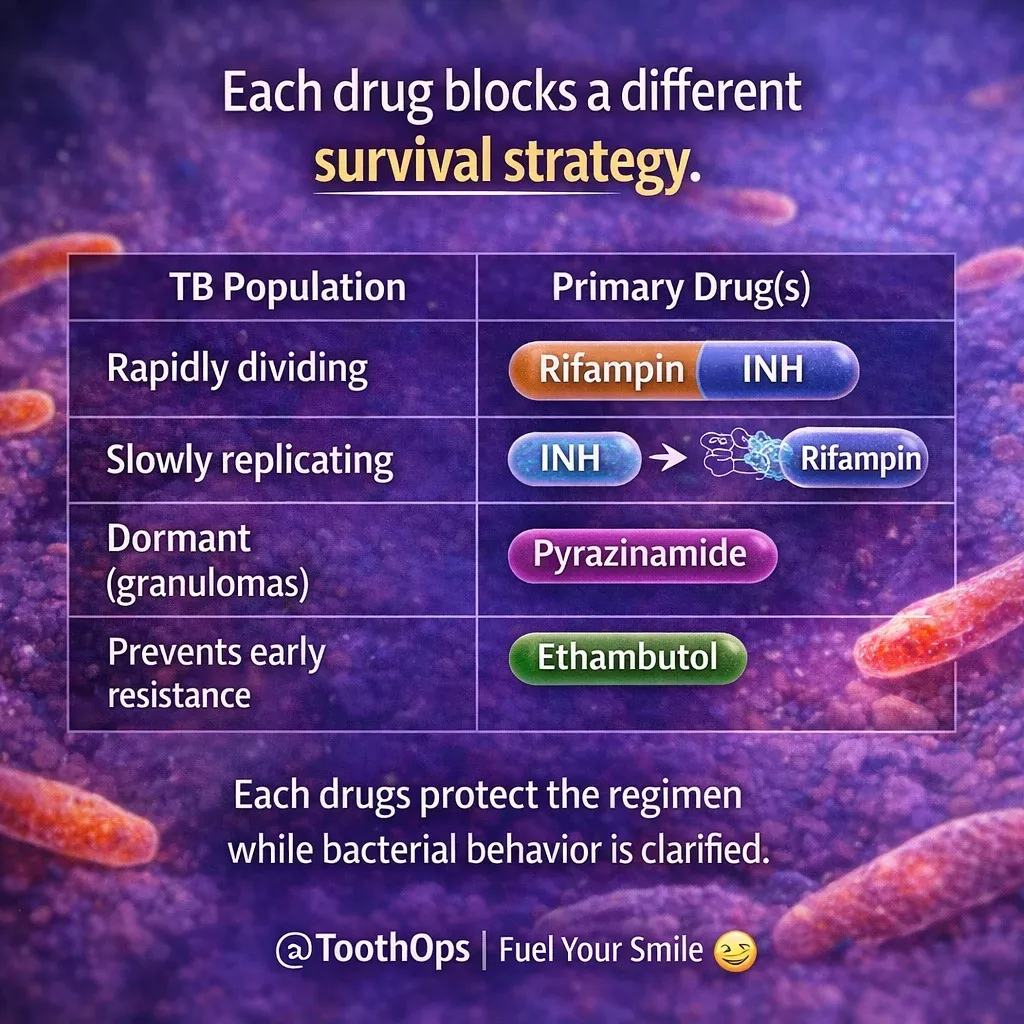
5️⃣ Mapping Drugs to TB Populations (High-Yield Table)
| TB Population | Primary Drugs |
|---|---|
| Rapidly dividing | Rifampin, Isoniazid |
| Slowly replicating | Isoniazid |
| Dormant (granulomas) | Pyrazinamide |
| Resistance-prone | Ethambutol (early) |
This table explains why all four drugs are needed initially.
6️⃣ Why TB Treatment Takes Months (Not Weeks)
TB grows slowly. Dormant organisms divide intermittently. Granulomas limit drug penetration.
Stopping treatment early:
- Leaves dormant bacteria alive
- Allows relapse months later
- Promotes resistance
🧠 Expert insight:
TB isn’t hard to suppress — it’s hard to eradicate.
7️⃣ When Regimens Change — And Why That’s Not Failure
Regimens are adjusted based on:
- Resistance testing
- Side effects
- Patient factors (pregnancy, liver disease, HIV)
- Latent vs active infection
Shorter or simpler regimens work only when bacterial burden is low.
8️⃣ Side Effects: Predictable, Not Random
Understanding mechanisms helps clinicians anticipate risk:
- Isoniazid → vitamin B6 depletion → neuropathy
- Rifampin → CYP450 induction → drug interactions
- Pyrazinamide → hyperuricemia
- Ethambutol → optic neuritis risk
💡 Monitoring exists because the drugs work, not because they’re unsafe.
9️⃣ Why This Matters in Dentistry (Often Overlooked)
Dentists should care because:
- Rifampin alters metabolism of many drugs
- Hepatotoxicity affects treatment planning
- TB history changes infection control decisions
- Oral symptoms may reflect systemic disease
This isn’t “medical-only” knowledge — it’s interprofessional competence.
🧠 If You Remember Nothing Else
TB therapy succeeds because each drug blocks a different survival strategy.
If you can explain:
- which population a drug targets
- why it’s used early or late
You’re no longer memorizing regimens — you’re reasoning clinically.
🌱 ToothOps Takeaway
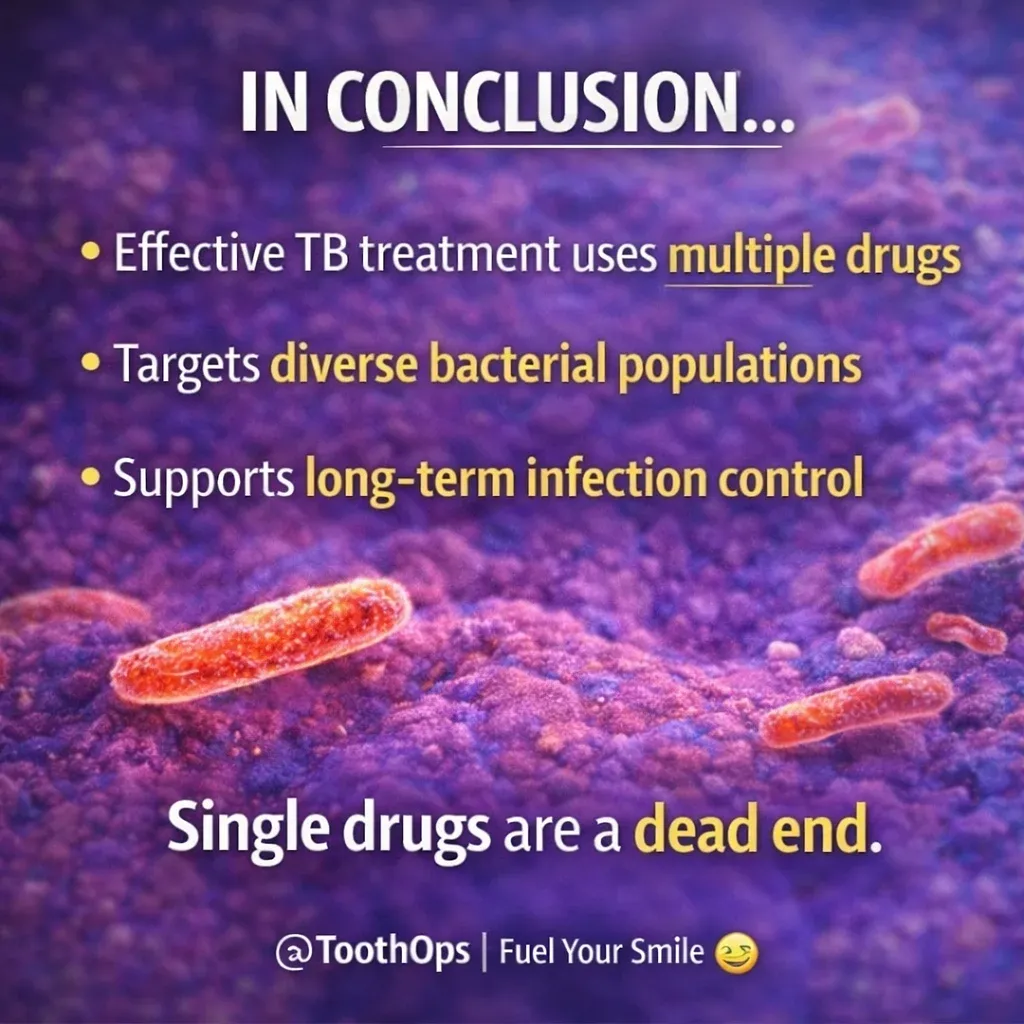
TB drugs don’t work because there are many of them.They work because they leave TB nowhere to hide.
Understanding that builds confidence — and confidence builds good care.
@ToothOps | Fuel Your Smile 😊 Stay tuned for more insights and educational content in our blog. Disclaimer: Content is for educational purposes only and not a substitute for medical or dental care.© 2025 ToothOps | All Rights Reserved.