
Why Your Mouth Heals Faster Than Your Skin
 ToothOps5 min read
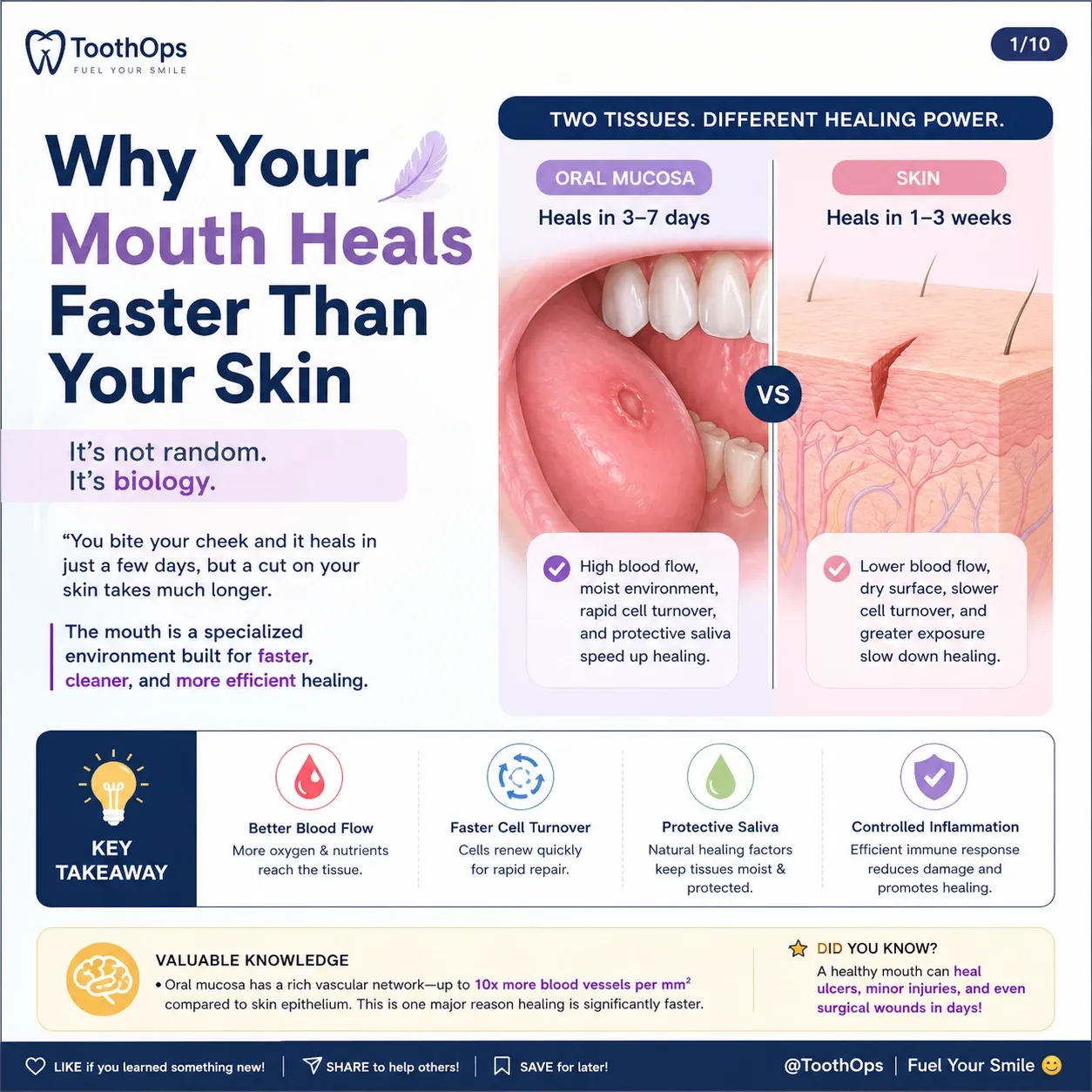
The Biology of Oral Healing — Blood Flow, Cells, Saliva, and Scar Control
🔥 Start Here: The Misconception
Most people assume:
👉 “The mouth should heal slower… it has more bacteria.”
That sounds logical.
But the reality is the opposite.
👉 The mouth often heals faster, cleaner, and with less scarring than skin.
That tension is the key insight:
👉 Healing speed is not about how “clean” a site is.
👉 It is about how the biological system is designed.
🧠 Core Rule
👉 Oral healing is fast because the mouth is optimized for moist, vascular, and controlled repair—not just wound closure.
🪶 The Simple Explanation
Your mouth already has:
🩸 strong blood flow
💧 constant moisture
🛡️ antimicrobial saliva
🧬 fast-moving epithelial cells
🔥 controlled inflammation
So instead of “reacting” to injury…
👉 the mouth is always prepared to repair.
⚙️ What “Healing” Actually Means
Healing is not one step.
It is a sequence:
| Phase | What Happens | Why It Matters |
|---|---|---|
| Hemostasis | Clot forms | Creates scaffold |
| Inflammation | Immune signaling | Cleans + coordinates |
| Proliferation | Tissue regrowth | Closes wound |
| Remodeling | Matrix reorganizes | Determines strength + scar |
🧠 Critical Insight
👉 Healing success depends on how well these phases transition, not just how they start.
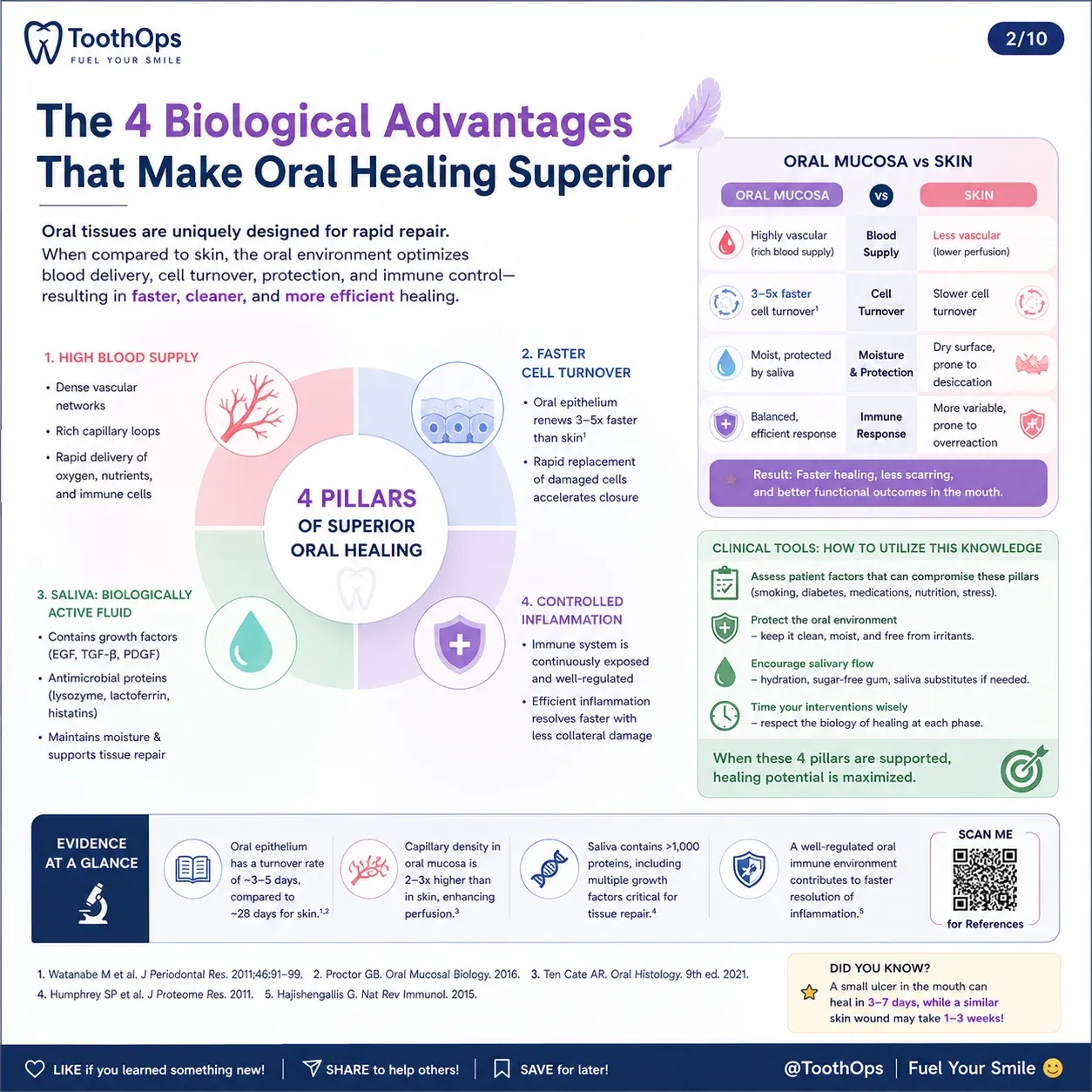
🩸 Mechanism 1: Blood Flow = Delivery System
Oral tissue is highly vascular.
That means faster delivery of:
🩸 oxygen
🧬 nutrients
🛡️ immune cells
📨 signaling molecules
🔁 Mechanism → Outcome
| Mechanism | Outcome |
|---|---|
| High perfusion | Faster repair |
| Oxygen delivery | Better cell function |
| Immune access | Faster defense |
🦷 Clinical Thinking
Ask:
👉 “Is this wound getting enough blood?”
Because poor healing often = poor delivery.
🧬 Mechanism 2: Epithelial Cells Move Fast
Oral epithelium is built for stress:
- chewing
- friction
- temperature
- bacteria
So when injury happens:
👉 cells migrate quickly to close the gap
🧠 Mechanism Detail
Steps:
- Cells detach
- Flatten
- Migrate
- Cover wound
👉 This is re-epithelialization
🧠 Core Insight
👉 Healing starts when cells move, not just when they divide.
💧 Mechanism 3: Saliva = Active Healing System
Saliva is not passive.
It contains:
🧪 enzymes
🛡️ antimicrobial proteins
🧬 growth-supporting factors
⚡ What Saliva Does
💧 keeps wound moist
🛡️ reduces bacteria
🧬 supports cell migration
🧠 Critical Insight
👉 Moist wounds heal faster than dry wounds.
The mouth is naturally optimized for this.
💬 Patient Translation
“Saliva helps protect and heal the area—it’s part of your body’s repair system.”
🛡️ Mechanism 4: Controlled Inflammation
Inflammation is necessary—but dangerous if excessive.
The mouth is constantly exposed to bacteria, so it develops:
👉 controlled immune responses
🧠 Why This Matters
| Too Much Inflammation | Controlled Inflammation |
|---|---|
| Tissue damage | Efficient repair |
| Delayed healing | Faster resolution |
🧠 ToothOps Insight
👉 The mouth doesn’t avoid inflammation.
👉 It manages it efficiently.
🧱 Mechanism 5: Extracellular Matrix (The Hidden Structure)
The extracellular matrix (ECM) is:
👉 the scaffold around cells
It controls:
- cell movement
- tissue strength
- scar formation
🧠 Key Concept
👉 Healing quality depends on how the matrix is rebuilt.
🧬 Myofibroblast Role
Myofibroblasts:
- contract tissue
- deposit collagen
⚠️ Critical Balance
| Too Much | Result |
|---|---|
| Myofibroblast activity | Scarring |
| Controlled activity | Clean healing |
🧬 Mechanism 6: Oral Fibroblasts Are Different
Oral fibroblasts:
👉 promote faster remodeling
👉 reduce excessive fibrosis
🧠 Deep Insight
👉 The mouth heals differently because the cells themselves behave differently
🧱 Mechanism 7: The Clot Is the First Scaffold
The clot is not just for stopping bleeding.
It is:
🧱 a structural base
📨 a signaling hub
🧬 a healing template
🧠 Mechanism Components
Clot contains:
- platelets
- fibrin
- growth factors
🦷 Clinical Example
Dry socket:
👉 clot lost early→ scaffold removed→ healing disrupted
📊 Pattern Recognition
| Observation | Mechanism | Clinical Meaning |
|---|---|---|
| Fast cheek healing | Rapid epithelial migration | Normal |
| Dry socket | Clot loss | Delayed healing |
| Smoker healing slow | Reduced blood flow | Impaired repair |
| Diabetes healing slow | Vascular + immune dysfunction | Higher risk |
🧠 Diagnostic Thinking Framework
When healing is slow, think:
- What happened first?→ injury, extraction, trauma
- What should happen next?→ clot formation, epithelial closure
- What failed?→ blood flow, cells, clot, inflammation
- Why did it fail?→ mechanism (oxygen, immune, scaffold)
⚠️ Critical Exceptions
👉 Normal healing environment can fail when:
- smoking
- diabetes
- radiation
- infection
- poor oral hygiene
🧠 High-Yield Insight
👉 Fast healing is the default.
👉 Slow healing always has a reason.
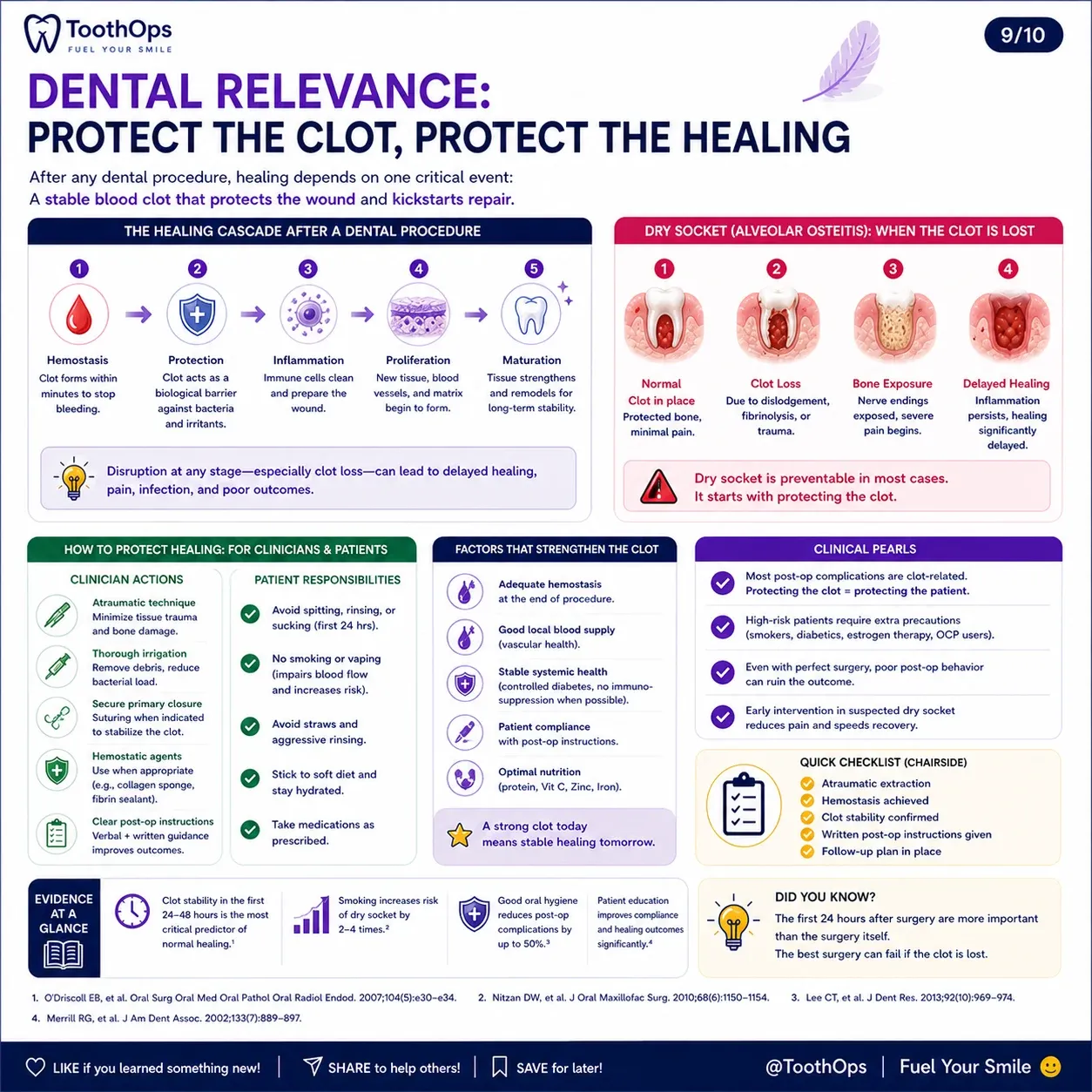
🦷 Clinical Application
For clinicians:
Protect:
- the clot
- blood supply
- moisture
Avoid:
- disruption
- dry environment
- unnecessary trauma
🧠 Decision Thinking
👉 “Is the environment supporting healing… or working against it?”
💬 Chairside Translation
“Your mouth heals faster than your skin because it has strong blood flow and protective saliva. We want to protect that environment so healing can happen properly.”
🧠 Signature ToothOps Insight
👉 Healing is not about closing the wound.It’s about creating the right environment for repair.
🎯 If You Only Remember One Thing
👉 The mouth heals faster because it maintains a moist, vascular, and controlled repair environment.
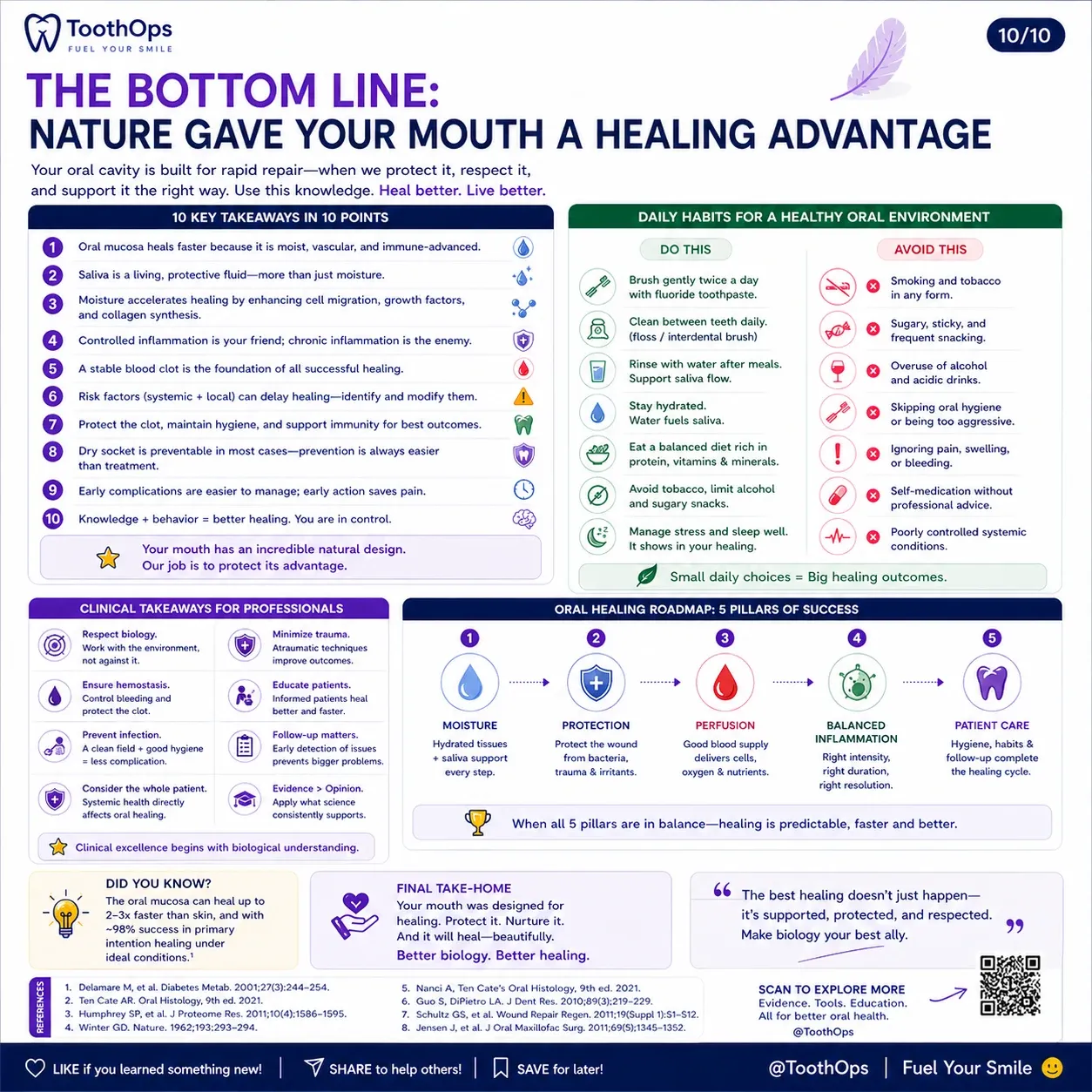
✨ Final Takeaway
The mouth heals faster not because it avoids challenges…
👉 but because it is designed to handle them efficiently.
🧠 Review Questions
Question 1
A patient develops severe pain 3 days after extraction.No clot is present.
👉 What failed?
A. Epithelial proliferation
B. Clot scaffold formation
C. Fibroblast migration
D. Inflammation initiation
Correct: B👉 The clot provides the initial scaffold.
Question 2
A smoker shows delayed oral healing.
👉 Primary mechanism?
A. Reduced epithelial migration
B. Reduced oxygen delivery
C. Increased saliva
D. Increased clot strength
Correct: B👉 Smoking reduces perfusion and oxygenation.
Question 3
A wound heals but forms thick scar tissue.
👉 Mechanism?
A. Low fibroblast activity
B. Excess myofibroblast contraction
C. Reduced clotting
D. Decreased inflammation
Correct: B
🧠 Final Internal Check
✔ Creates “aha” moment → YES
✔ Improves thinking → YES
✔ Clinically usable → YES
✔ Patient understandable → YES
@ToothOps | Fuel Your Smile 😊
Stay tuned for more insights and educational content in our blog.
Disclaimer: Content is for educational purposes only and not a substitute for medical or dental care.
© 2025 ToothOps | All Rights Reserved.