
🫁 Why the Immune System Doesn’t Eliminate TB (Tuberculosis) — It Contains It
 ToothOps4 min read
A board-level look at granulomas, restraint, and clinical reasoning
By ToothOps
❌ Common Misconception
“If the immune system is working properly, it should just kill Mycobacterium tuberculosis.”
✅ A Clearer Reality
In tuberculosis (TB), the immune system often chooses containment over elimination — and that choice is intentional.
Understanding why the body makes this decision transforms TB from a memorization-heavy topic into a logical pattern you’ll recognize across medicine, dentistry, and board-style questions.
1️⃣ The Core Problem: TB Is Built to Survive
Mechanism
Mycobacterium tuberculosis has a lipid-rich, mycolic-acid–containing cell wall that makes it:
- Acid-fast
- Resistant to many host defenses
- Capable of surviving inside macrophages
After inhalation, TB reaches the alveoli, where macrophages ingest the bacteria — but cannot reliably destroy it.
Instead of being eliminated, the organism persists.
📚 This intracellular survival strategy is well documented in NIH and CDC descriptions of TB pathogenesis.
2️⃣ The Immune System’s Strategic Pivot
Mechanism → Decision
When eradication fails, the immune system shifts its goal.
Rather than “kill,” the priority becomes:
Contain and prevent spread.
This response is coordinated by:
- CD4⁺ TH1 cells
- Interferon-gamma (IFN-γ)
- Activated macrophages
Together, these signals organize immune cells into a structured barrier around the pathogen.
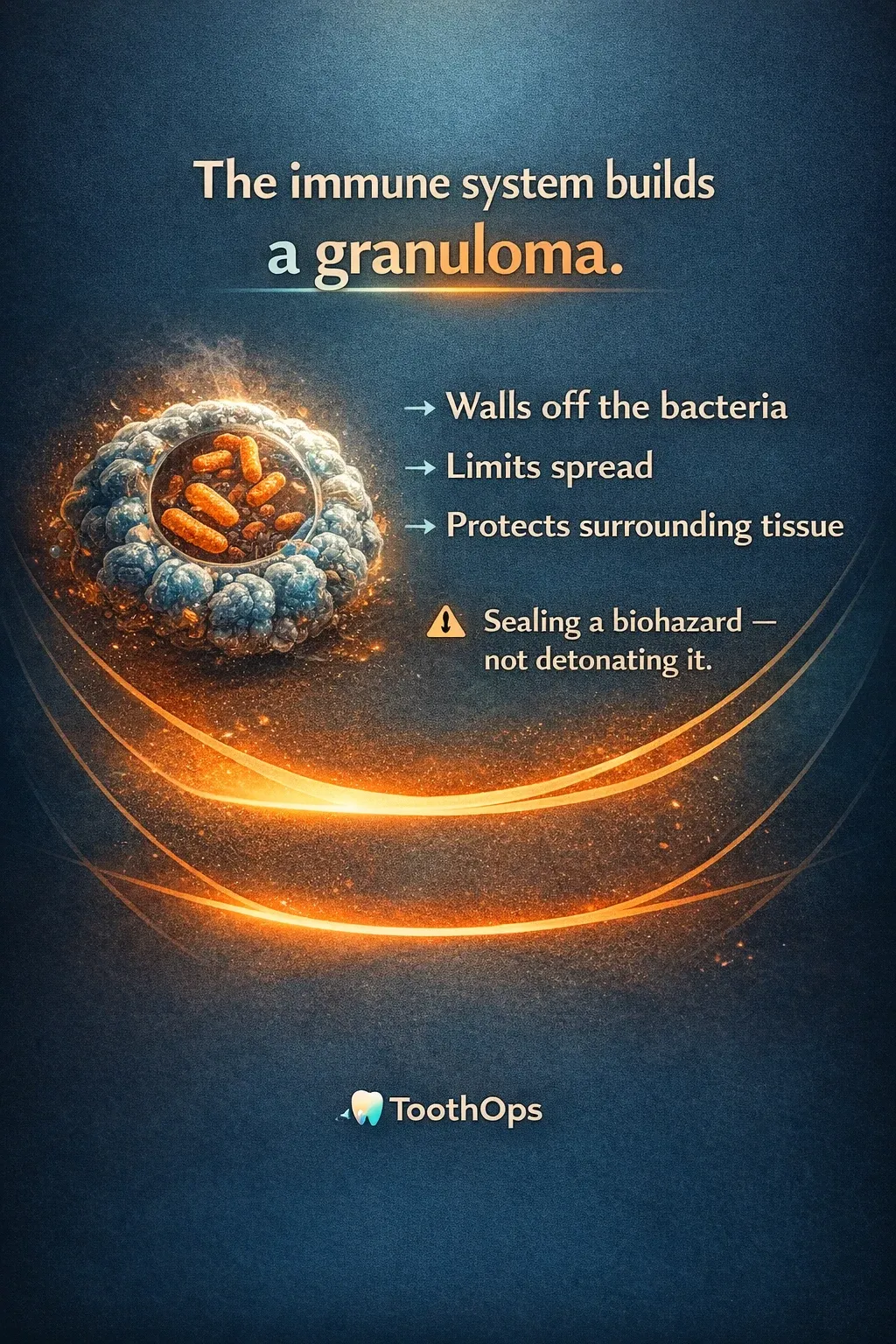
That structure is known as a granuloma.
🧠 Analogy
Think of a granuloma like a biohazard containment unit. If a chemical leak can’t be neutralized safely, you isolate it — not to fix it, but to protect everything around it.
⏱️ Timeline Insight
Granulomas do not form immediately.
After exposure:
- TB replicates inside macrophages before adaptive immunity is fully activated
- A TH1-mediated response typically develops 2–10 weeks later
- Granuloma formation marks partial immune control, not eradication
💡 Early infection → minimal immune control
Chronic or latent disease → organized containment
3️⃣ Why Antibodies Aren’t Enough
Mechanism clarification
TB is primarily an intracellular pathogen.
Antibodies are most effective against extracellular organisms.Because TB survives inside macrophages, antibodies alone cannot clear the infection.
Control depends on:
- CD4⁺ TH1 cells
- IFN-γ–mediated macrophage activation
- Type IV (delayed) hypersensitivity
💡 If antibodies are presented as the primary defense against TB, that answer is incorrect.
4️⃣ What a Granuloma Actually Is
Mechanism
A classic TB granuloma contains:
- Central caseous necrosis
- Epithelioid macrophages
- Multinucleated giant cells
- A peripheral rim of lymphocytes
This architecture:
- Limits bacterial spread
- Protects surrounding lung tissue
- Preserves overall respiratory function
But containment is not without trade-offs.
5️⃣ The Trade-Off: Protection and Damage
Consequence
Granulomas are not benign.
Chronic inflammation can lead to:
- Fibrosis
- Tissue destruction
- Cavitary lesions — especially in reactivation TB
This explains how TB can remain latent for years, then reappear when immune balance shifts.
📌 CDC and Mayo Clinic sources emphasize this balance between containment and collateral damage.
💡 Pro Tip
Granulomas are not a failure of immunity.They represent immune restraint — a calculated compromise.
6️⃣ When Containment Fails
Failure modes (high-yield for boards)
Granuloma stability depends on continuous immune signaling, particularly:
- TNF-α
- IFN-γ
Disruption of this balance can cause:
- Granuloma breakdown
- Reactivation TB
- Cavitation
- Increased transmissibility
This is why reactivation risk increases in:
- HIV
- Diabetes
- Malnutrition
- Patients receiving TNF-α inhibitors
💡 **Board cue:**TNF-α inhibition + pulmonary symptoms → always consider TB reactivation.
7️⃣ Why the PPD Test Works (and What It Really Measures)
Mechanism → Clinical relevance
The tuberculin skin test (PPD/TST) does not detect live bacteria.
It measures:
- Type IV (delayed) hypersensitivity
- A memory TH1 cell response to TB antigens
This explains:
- False positives with prior BCG vaccination
- False negatives in immunosuppressed or overwhelming disease
💡 Interpretation shortcut: A negative PPD does not rule out TB in immunocompromised patients.
🧠 How to Think Through TB Questions
When you see TB on an exam, ask:
- Where is the organism living?→ Inside macrophages = cell-mediated immunity
- What is the immune system prioritizing?→ Containment over elimination
- Is containment stable or failing?→ Think TNF-α, IFN-γ, immunosuppression
- What stage is being described?→ Early infection, latent TB, or reactivation
If your answer aligns with those four steps, you’re thinking like the exam — without memorizing lists.
The ToothOps Takeaway
Confidence in dentistry and medicine doesn’t come from memorizing more facts.
It comes from recognizing patterns of biological decision-making.
When you understand why the body chooses containment, TB stops feeling random — and starts feeling logical.
That’s clinical reasoning.
One calm reminder
You don’t need to know everything.You need to understand what the body is trying to protect.
📝 Excellent Questions to Check Your Understanding
These are thinking questions, not trick questions:
- Why would aggressive immune killing of TB potentially cause more harm than benefit?
- How would TB presentation differ in a patient on TNF-α inhibitors versus a healthy host?
- Why does a negative PPD not rule out TB in certain patients?
- How does the intracellular location of TB dictate which arm of immunity matters most?
- Where else in dentistry or medicine do you see the body choosing containment over perfection?
If you can answer those calmly, you’re board-ready.
@ToothOps | Fuel Your Smile 😊
Stay tuned for more insights and educational content in our blog.
Disclaimer: Content is for educational purposes only and not a substitute for medical or dental care.© 2025 ToothOps | All Rights Reserved