
🦷Why Some Bleeding Happens Immediately — And Some Happens Later
 ToothOps4 min read
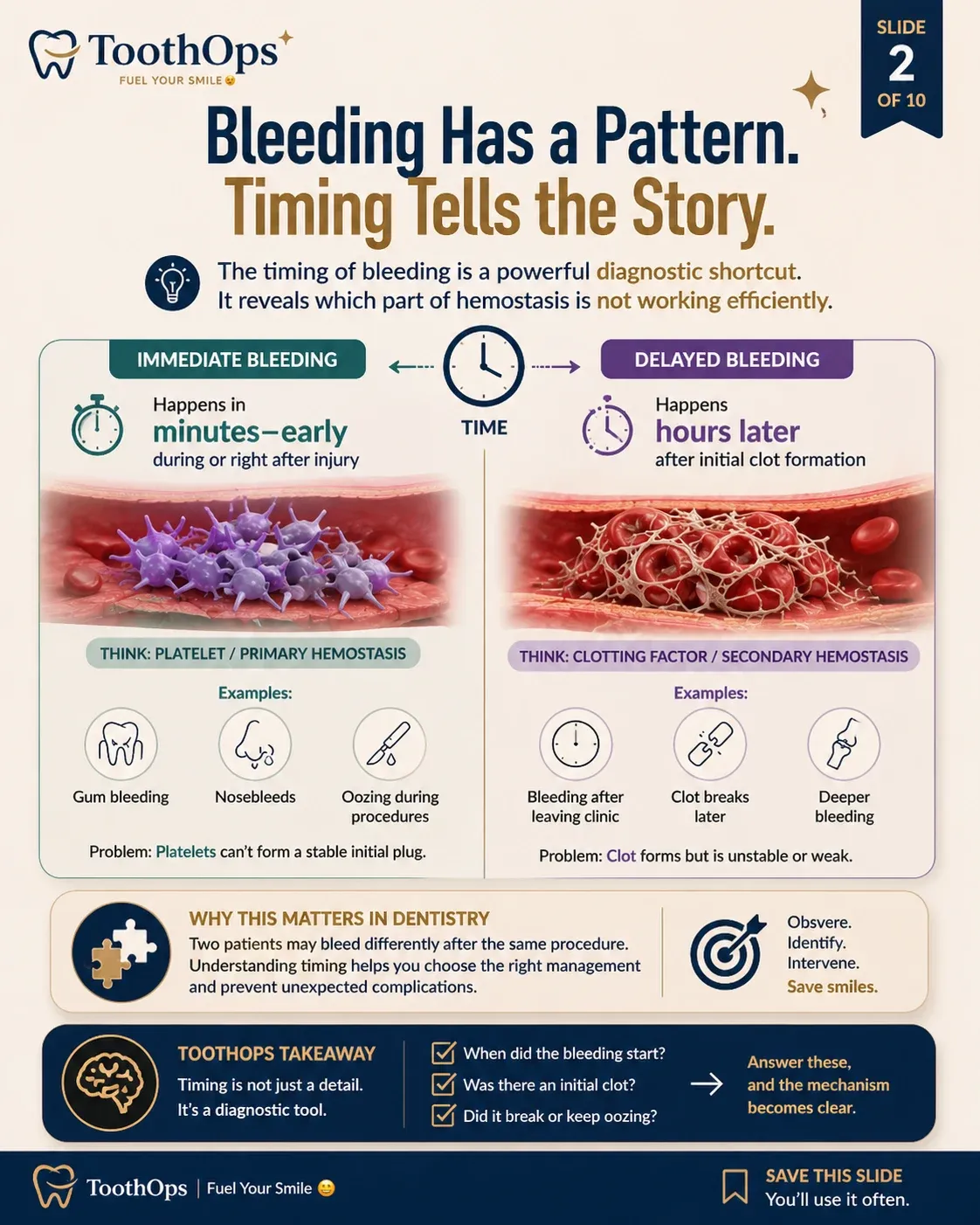
Timing Is Not Random. It Reveals the Mechanism.
🧠 Start Here
Most people assume:
“Bleeding is just bleeding.”
But clinically, timing matters.
Two patients can undergo the same procedure:
- one bleeds immediately
- another bleeds hours later
Same procedure.Different mechanism.
So the real question is not:
“How much bleeding?”
It is:
👉 “WHEN did the bleeding happen—and what does that reveal?”
🧠 CORE RULE
👉 Bleeding timing reflects which layer of hemostasis failed:
- initiationor
- stability
⚙️ SIMPLE FRAMEWORK
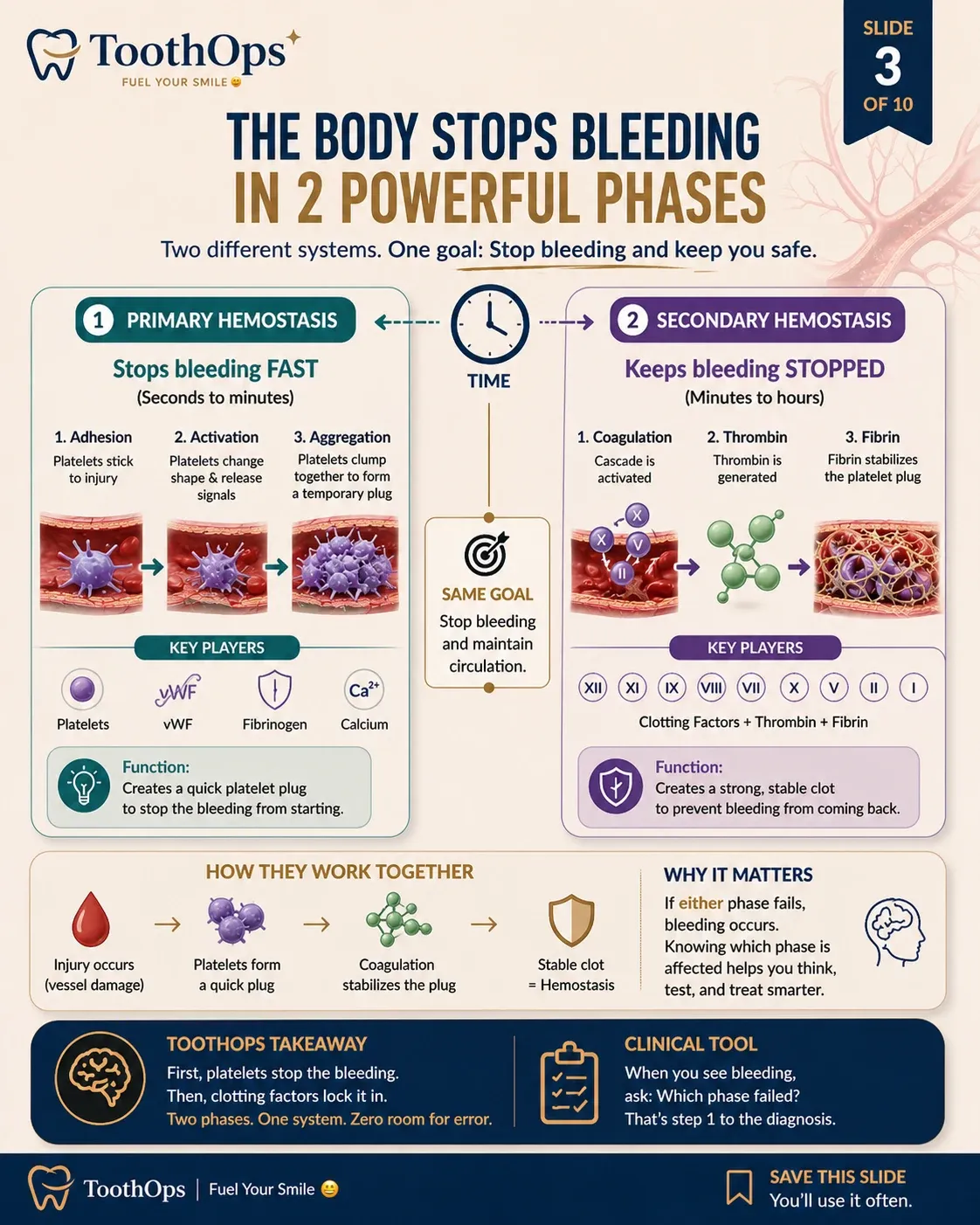
Your body stops bleeding in layers:
🩸 Layer 1
Platelets form a rapid temporary plug.
🧬 Layer 2
Clotting factors stabilize that plug with fibrin.
🧠 Clinical Translation
👉 Immediate bleeding= initiation problem
👉 Delayed bleeding= clot stability problem
🔬 THE MECHANISM LAYER
🧩 Step 1 — Primary Hemostasis
(Initiation Control)
Primary hemostasis acts within seconds.
Cellular Level
Platelets:
- adhere to exposed collagen
- activate
- release signaling molecules
- aggregate into a temporary plug
Key mediator:👉 von Willebrand factor (vWF)
Molecular Level
- vWF binds platelet receptors
- ADP and thromboxane amplify recruitment
Tissue Level
A temporary platelet plug forms.
👉 Fast—but fragile.
🧠 ToothOps Insight
Primary hemostasis prevents bleeding from starting.
🧩 Step 2 — Secondary Hemostasis
(Stability Control)
The platelet plug alone is not durable.
The coagulation system reinforces it.
Thrombin Amplification
Small amounts of thrombin activate:
- Factors V, VIII, XI
- platelets
This creates positive feedback loops.
Thrombin Burst
Large amounts of thrombin then convert:
- fibrinogen → fibrin
Critical Detail
Factor XIII cross-links fibrin and strengthens the clot.
Without proper stabilization:
- fibrin may form
- but the clot remains mechanically weak
🧠 ToothOps Insight
Clotting success depends on thrombin amplification and fibrin stabilization—not just factor presence.
🧩 Step 3 — Platelets as a Reaction Platform
Activated platelets provide the surface where clotting reactions accelerate efficiently.
Without this surface:
- amplification slows
- thrombin generation weakens
- clot formation becomes inefficient
🧩 Step 4 — Mechanical Stability
A stable clot requires:
- fibrin mesh formation
- platelet contraction
- fibrin cross-linking
👉 Now the clot can resist:
- pressure
- movement
- time
📊 PATTERN RECOGNITION
| Feature | Primary Hemostasis Problem | Secondary Hemostasis Problem |
|---|---|---|
| Timing | Immediate bleeding | Delayed bleeding |
| Mechanism | Platelet/vWF dysfunction | Factor deficiency |
| Clot formation | Fails to start | Starts but unstable |
| Location | Surface bleeding | Deep tissue bleeding |
| Lab trends | Often normal | Often abnormal |
| Example | vWD | Hemophilia |
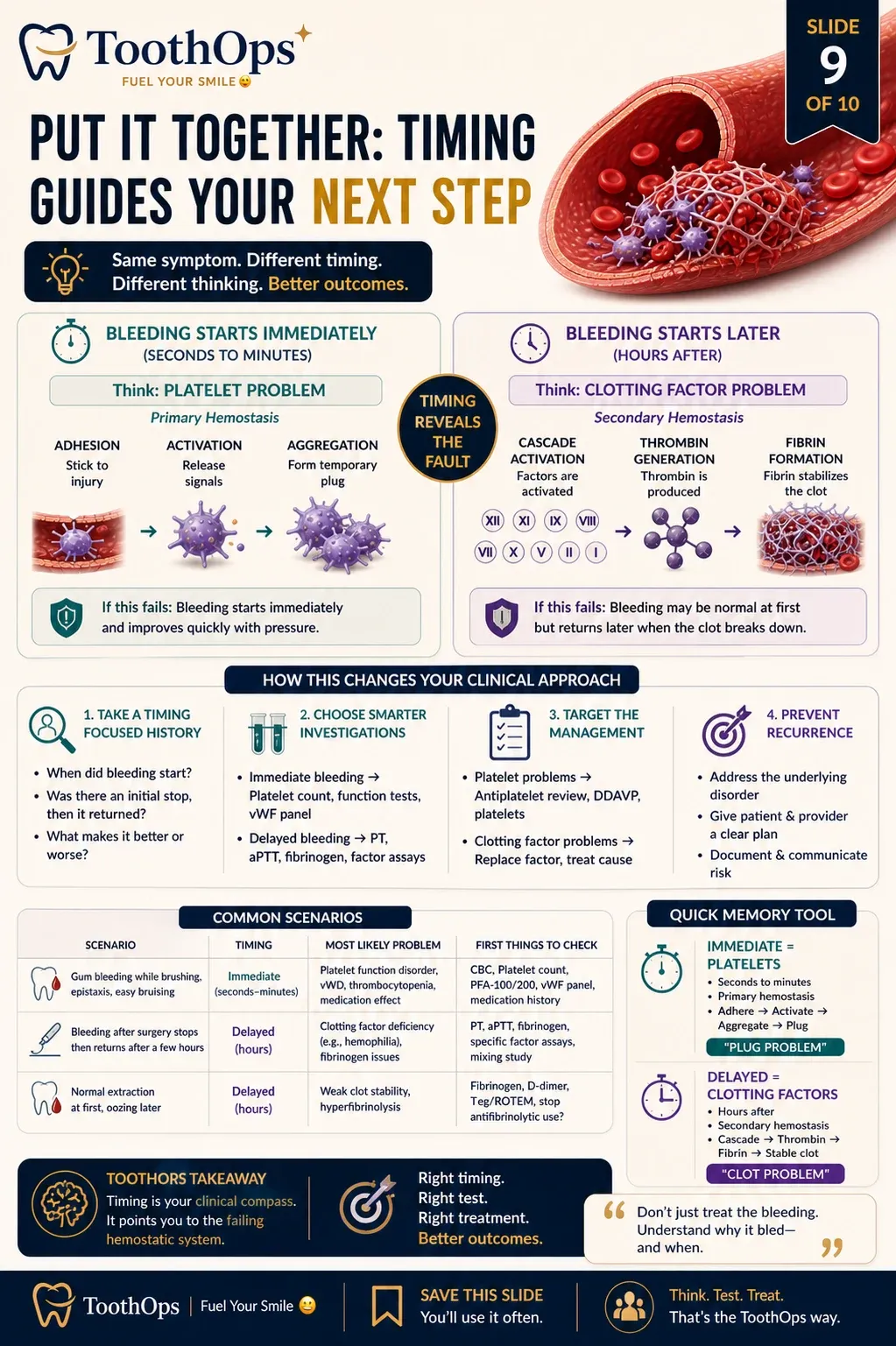
🧠 DIAGNOSTIC THINKING FRAMEWORK
Step 1
When did bleeding begin?
- immediate → platelet/vWF
- delayed → coagulation factors
Step 2
Did a clot initially form?
- no → primary hemostasis issue
- yes, but failed later → stability issue
Step 3
What supports this?
Review:
- labs
- medications
- bleeding history
- procedure type
Step 4
What mechanism explains the pattern?
Always connect:👉 symptom → failed system
⚠️ HIGH-YIELD EXCEPTIONS
Normal labs do NOT always mean normal function.
Example 1
von Willebrand disease may have:
- subtle symptoms
- normal screening labs
Example 2
Factor XII deficiency:
- prolongs aPTT
- does NOT cause clinical bleeding
Example 3
Factor XIII deficiency:
- delayed bleeding
- normal PT/aPTT possible
👉 Important because Factor XIII stabilizes fibrin AFTER fibrin forms.
🦷 CLINICAL APPLICATION
Scenario 1
Bleeding begins immediately during treatment.
👉 Think:
- platelet dysfunction
- inflammation
- vWF problems
Scenario 2
Bleeding starts hours after extraction.
👉 Think:
- weak clot stability
- impaired thrombin amplification
- fibrin instability
Scenario 3
Bleeding continues despite pressure.
👉 Consider:
- von Willebrand disease
- platelet dysfunction
- anticoagulant or antiplatelet medication effects
💬 CHAIRSIDE EXPLANATION
“Your body uses a layered system to stop bleeding. First, it forms a quick plug. Then it strengthens that plug with a stable fibrin clot. In your case, the stability phase may not be working efficiently, so bleeding can return later.”
🧠 SIGNATURE TOOTHOPS INSIGHT
Clotting is not just about starting the clot.It is about making the clot strong enough to last.
🔥 IF YOU ONLY REMEMBER ONE THING
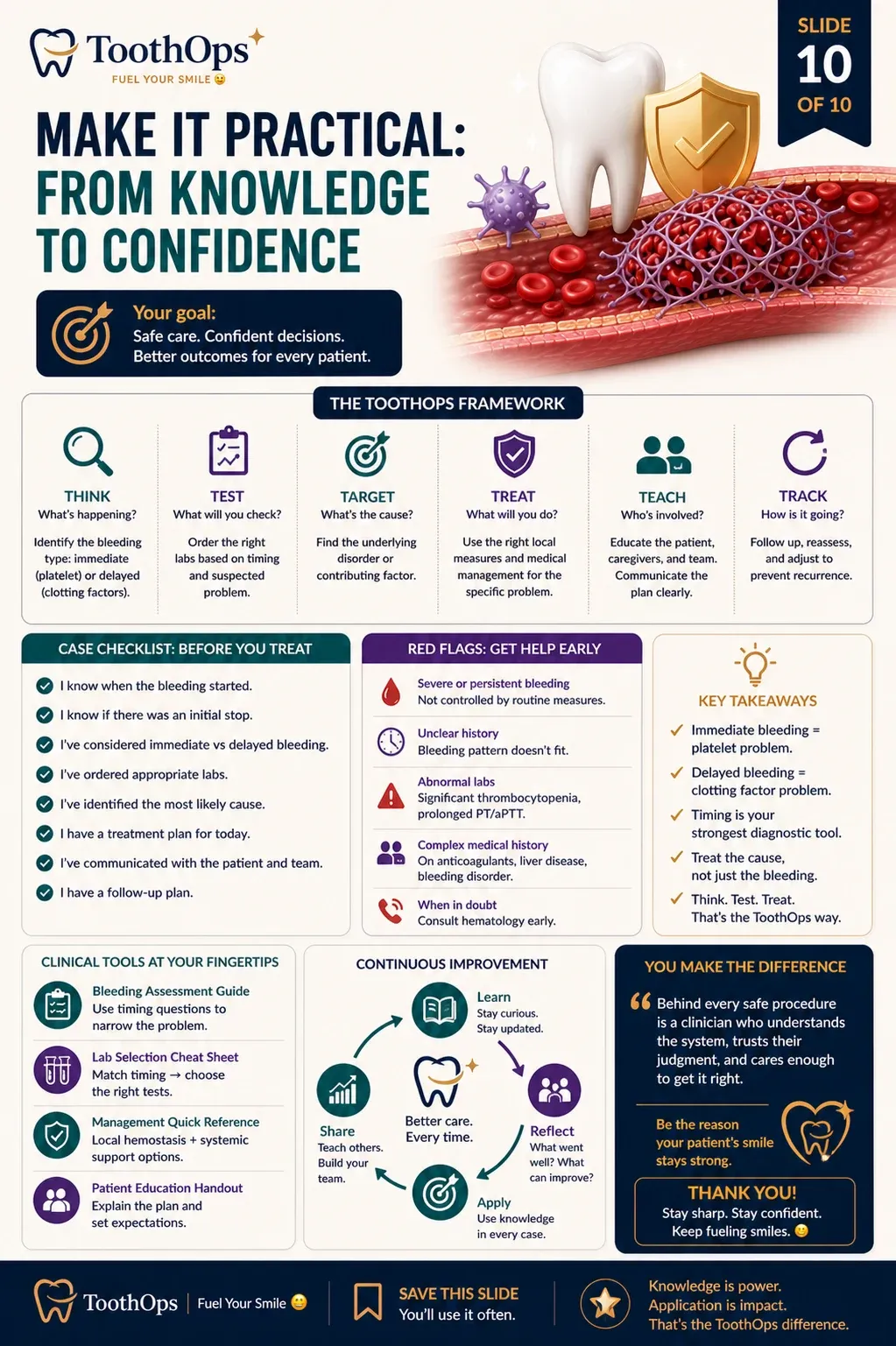
👉 Immediate bleeding= platelet / initiation problem
👉 Delayed bleeding= clot stability problem
🧠 FINAL TAKEAWAY
Bleeding follows patterns.
It reflects:
- how the clot starts
- how it amplifies
- how it stabilizes
When you understand which phase failed:
👉 you stop guessing
👉 and start thinking clinically
🧪 QUESTIONS
Question 1
A patient has minimal bleeding during extraction but later develops post-operative bleeding.
What is the most likely issue?
A. Platelet adhesion problem
B. von Willebrand factor issue
C. Impaired thrombin amplification
D. Vasoconstriction failure
✅ Answer: C
Question 2
A patient reports frequent gum bleeding despite normal routine labs.
What should be strongly considered?
A. Hemophilia
B. Factor XII deficiency
C. von Willebrand disease
D. Factor X deficiency
✅ Answer: C
Question 3
A patient develops delayed bleeding with normal PT and aPTT.
Which disorder should be considered?
A. Platelet dysfunction
B. Factor XIII deficiency
C. Heparin effect
D. Vitamin K deficiency
✅ Answer: B
@ToothOps | Fuel Your Smile 😊
Stay tuned for more insights and educational content in our blog.
Disclaimer: Content is for educational purposes only and not a substitute for medical or dental care.
© 2025 ToothOps | All Rights Reserved.