
🦷 Why Fractures Don’t Always Mean Abuse
 ToothOps6 min read
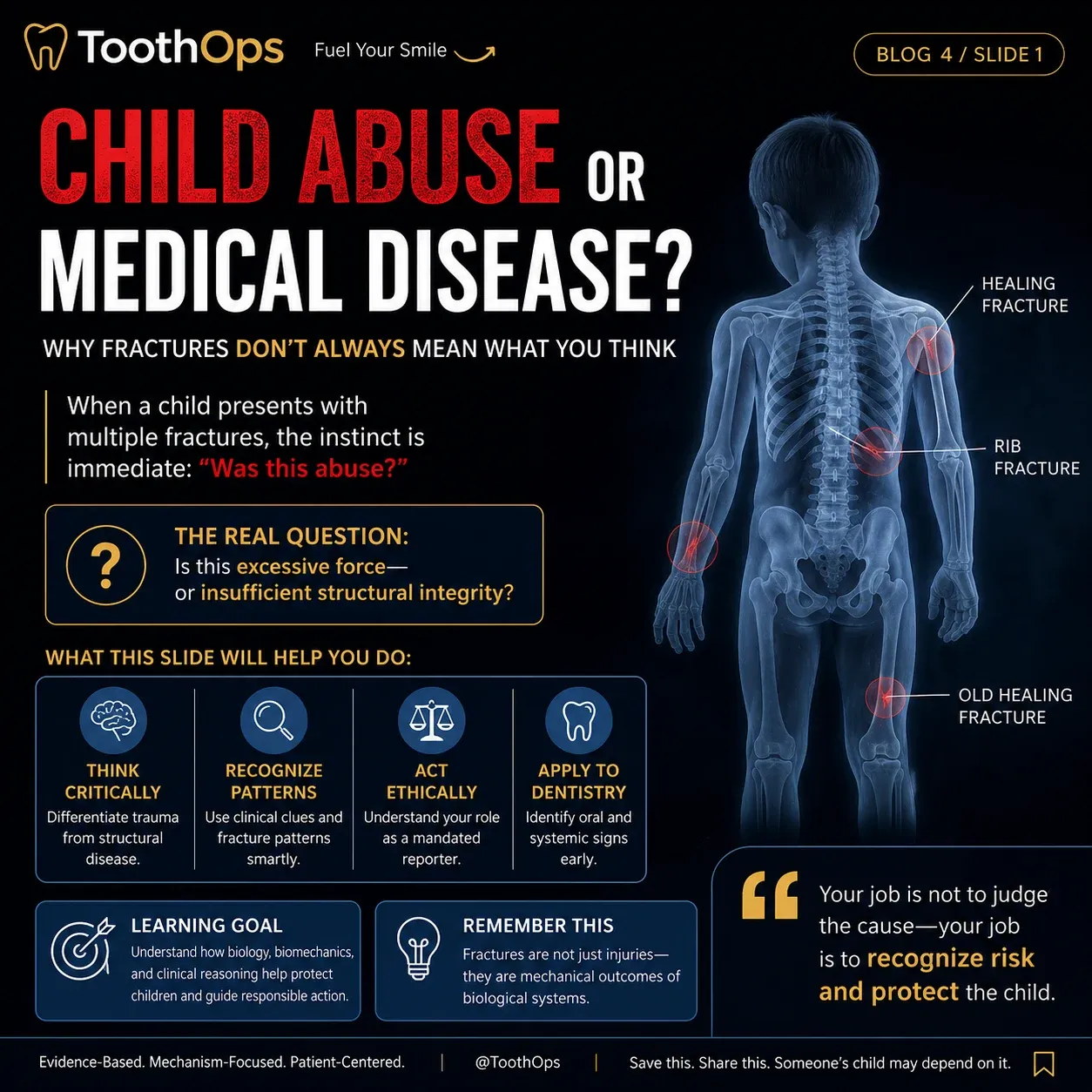
How Dentists Use Biology, Mechanics, and Clinical Reasoning to Tell the Difference
🧠 Start Here: The Real Question
When a child presents with multiple fractures, the instinct is immediate:
“Was this abuse?”
That instinct matters.But stopping there is incomplete.
The real clinical question is:
👉 Is this excessive force—or insufficient structural integrity?
Because fractures do not just reflect what happened externally.They reflect what the tissue was capable of withstanding internally.
⚙️ Core Rule
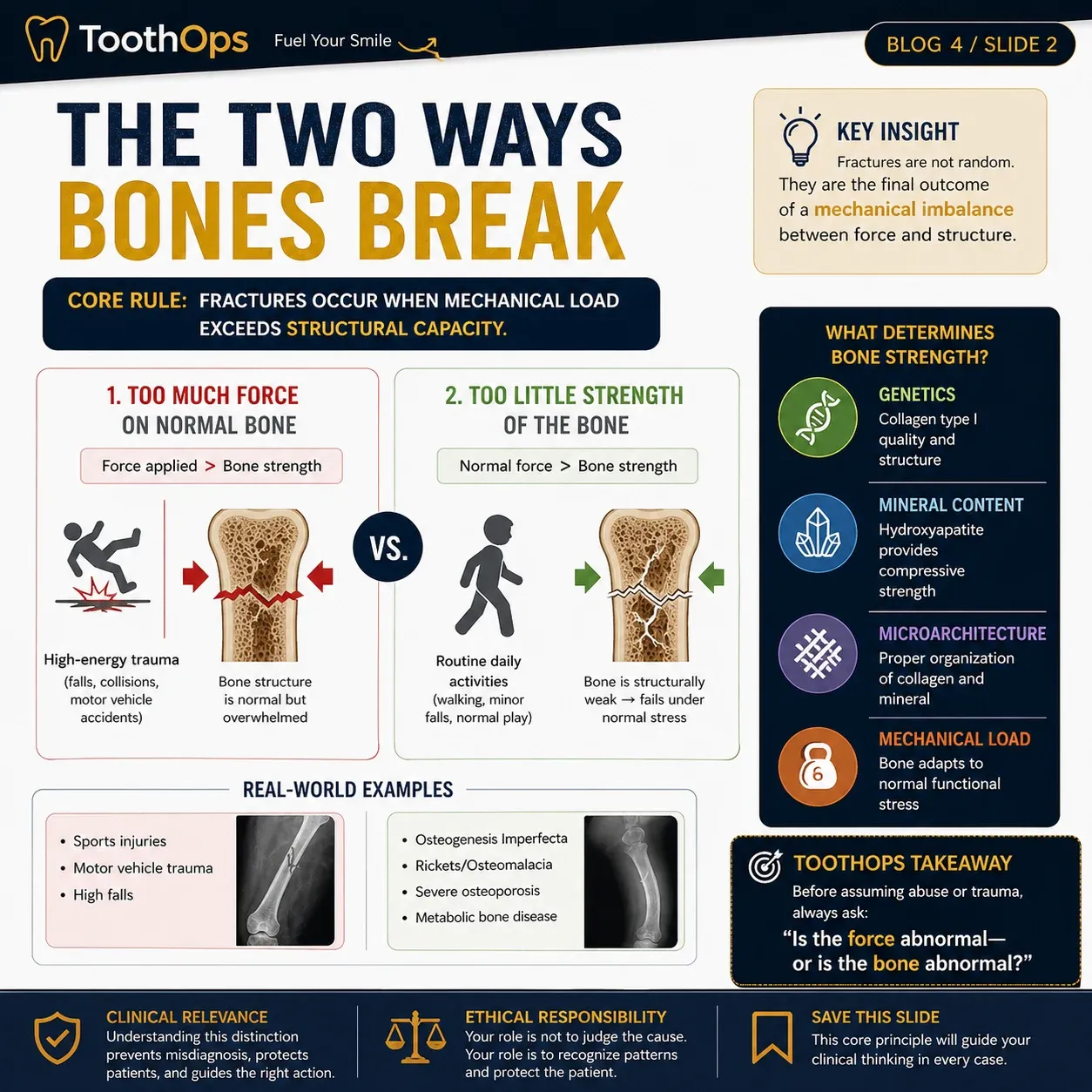
Fractures occur when mechanical load exceeds structural capacity.
That imbalance can happen in two fundamentally different ways:
- High force acting on normal bone
- Normal force acting on abnormal bone
Understanding the difference changes everything about diagnosis, communication, and patient protection.
🪶 Big Picture: Bone Is a Mechanical System
Bone is often described as “hard,” but biologically it is far more sophisticated than that.
Bone is a dynamic composite material designed to:
- absorb stress
- distribute force
- resist crack propagation
- maintain structural integrity during movement
Its strength comes from two major components working together:
| Component | Primary Function |
|---|---|
| Type I collagen | Tensile strength + flexibility |
| Hydroxyapatite mineral | Compressive strength |
🧠 ToothOps Insight
Healthy bone is not simply strong.
👉 It is strong and flexible.
That balance is what prevents fracture during everyday activity.
🔬 Mechanism: What Happens in Osteogenesis Imperfecta
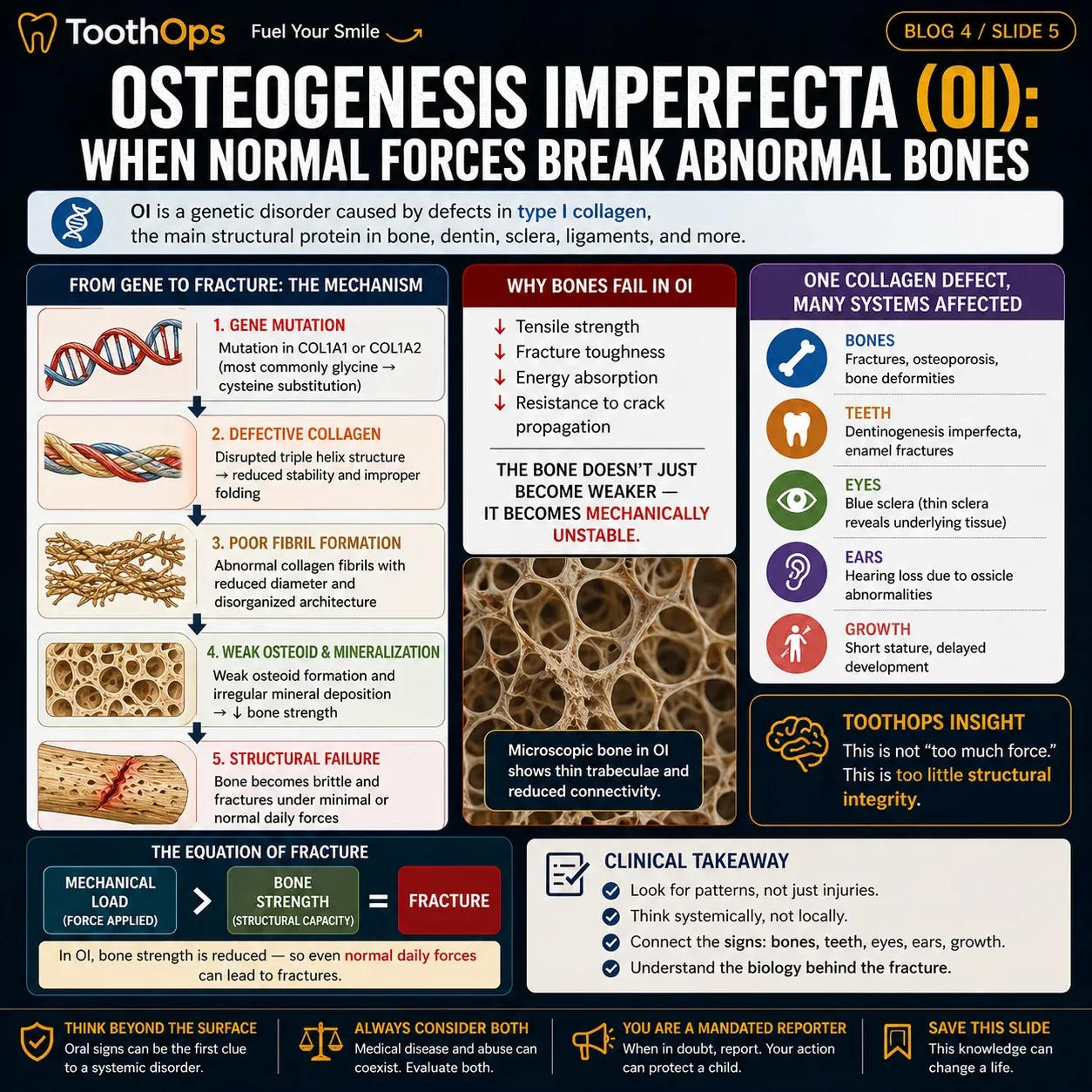
In osteogenesis imperfecta (OI), mutations affect the structure and organization of Type I collagen.
In this case:
- glycine substitution disrupts triple helix stability
- collagen fibrils become disorganized
- osteoid formation becomes defective
- mineral integration becomes abnormal
🔬 Why Glycine Matters
Glycine is the smallest amino acid and appears at every third position in the collagen triple helix.
That small size is critical because it allows:
- tight molecular packing
- stable helix formation
- proper fibril alignment
When glycine is replaced by a larger amino acid:
👉 the helix becomes unstable
This alters the entire structural framework of bone and dentin.
🔬 Biomechanics of Failure
This is where the case becomes clinically important.
Normal bone can:
- absorb energy
- redistribute stress
- slow crack progression
OI bone cannot do this efficiently.
Instead, it develops:
- ↓ tensile strength
- ↓ fracture toughness
- ↓ energy absorption
- ↑ crack propagation
🧠 AHA MOMENT
Fractures in OI are not caused by “too much trauma.”👉 They occur because the structure cannot tolerate normal force.
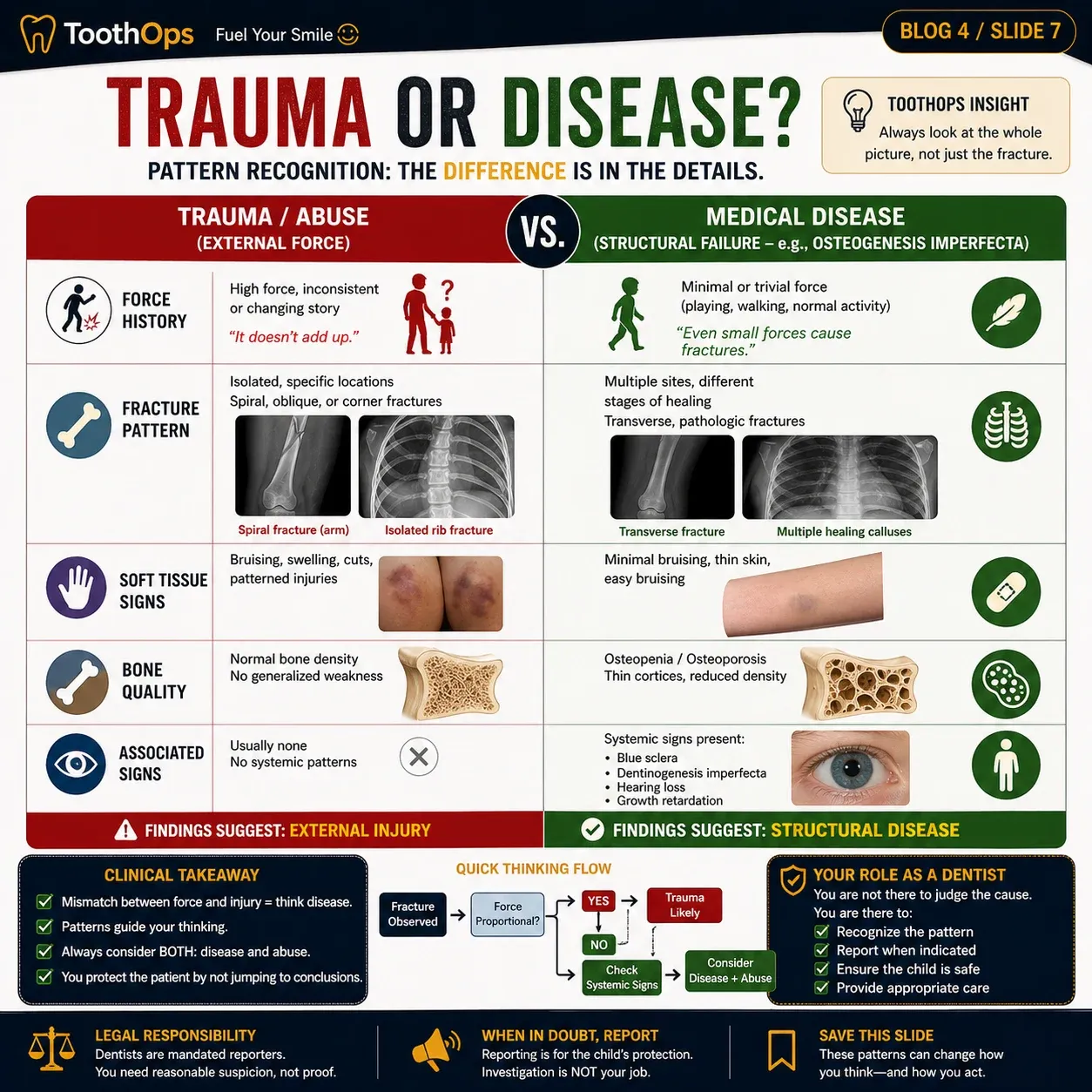
📊 Pattern Recognition: Trauma vs Structural Disease
| Feature | Trauma / Abuse | Structural Disease (OI) |
|---|---|---|
| Force required | Usually significant | Often minimal |
| Fracture frequency | Isolated or episodic | Recurrent |
| Bone quality | Normal | Fragile |
| Soft tissue injury | Common | Often limited |
| Associated findings | Localized injury | Multi-system signs |
🔍 High-Yield Clinical Clues
Features that strongly support systemic collagen disease include:
- blue sclera
- dentinogenesis imperfecta
- hearing abnormalities
- growth delay
- recurrent fractures
- bowing deformities
- multiple healing fractures
These findings reflect a multi-system connective tissue disorder, not isolated trauma.
🔬 Fracture Mechanics: Why Patterns Matter
Fracture patterns often reveal the underlying mechanism of injury.
🧠 Trauma-Based Fractures
High-force injuries commonly produce:
- spiral fractures
- torsional injury patterns
- soft tissue damage
These fractures reflect external mechanical overload.
🧠 Disease-Based Fractures
In OI:
- bone fails under low stress
- fractures may occur during routine movement
- multiple healing fractures may coexist
Common findings include:
- transverse fractures
- generalized osteopenia
- callus formation at multiple stages
🧠 ToothOps Insight
Fracture patterns are mechanical fingerprints of biology underneath.
⚠️ Critical Clinical Reality
One of the most dangerous mistakes in medicine is:
👉 deciding too early that there is only one explanation.
❗ Essential Principle
Structural disease does NOT eliminate the possibility of abuse.
Both possibilities must always be evaluated carefully and responsibly.
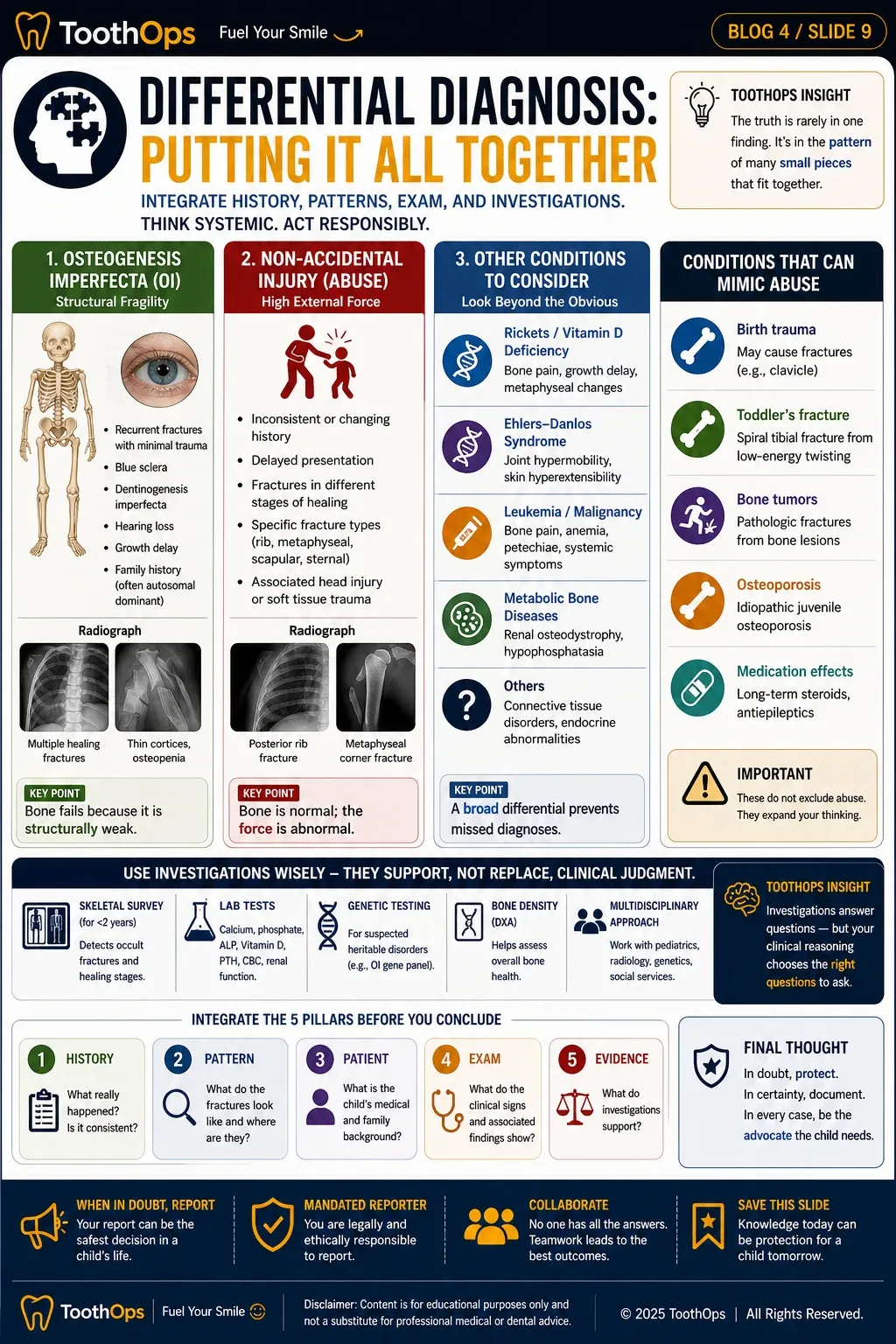
🧠 Clinical Reasoning Framework
When evaluating fractures in children:
1. Compare Force vs Damage
Does the reported mechanism match the severity of injury?
- major trauma + severe fracture → expected
- minor trauma + severe fracture → investigate deeper
2. Look for Systemic Clues
Connect findings across systems:
- teeth
- eyes
- hearing
- growth
- skeletal structure
3. Evaluate Fracture Distribution
Ask:
- isolated or recurrent?
- symmetric or asymmetric?
- multiple healing stages?
4. Integrate Imaging + Clinical Findings
Assess:
- bone density
- osteopenia
- callus formation
- deformities
5. Keep Dual Awareness
Always consider:
- possible abuse
- possible medical disease
🔥 Core Clinical Insight
Strong clinicians do not rush to conclusions.👉 They recognize patterns and follow evidence carefully.
⚖️ Legal and Ethical Responsibility
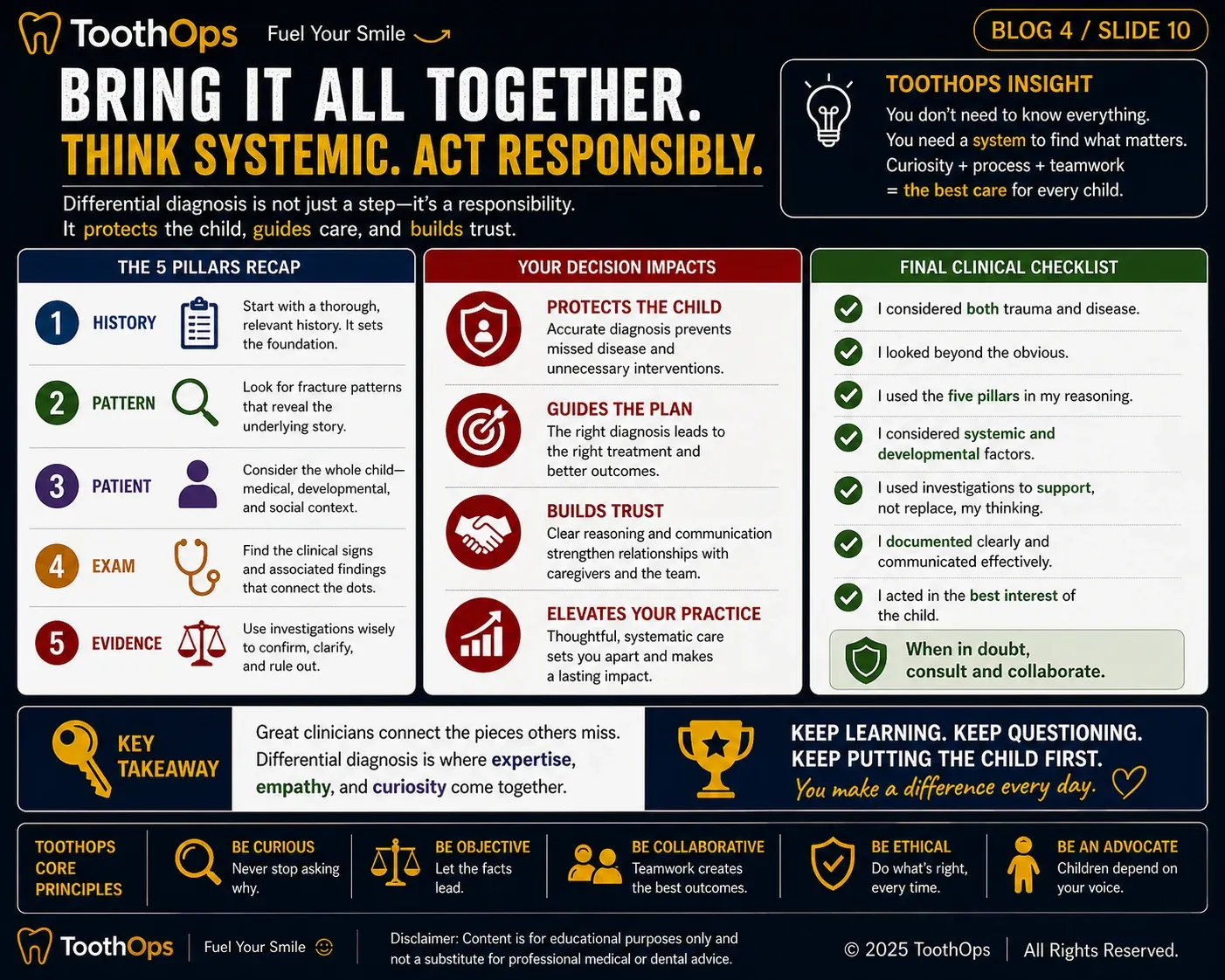
Dentists are mandated reporters.
This means:
👉 you do NOT need proof of abuse👉 you need reasonable suspicion
🧠 Important Clarification
Your responsibility is NOT to:
- confirm abuse
- conduct investigations
- accuse caregivers
Your role is to:
- recognize concerning patterns
- protect the patient
- escalate appropriately
🦷 Why This Matters in Dentistry
Dentists frequently observe:
- facial trauma
- oral injuries
- tooth fractures
- dentin abnormalities
The mouth may become the earliest visible indicator of:
- systemic disease
- trauma
- or neglect
🧠 ToothOps Clinical Insight
Oral findings are often systemic clues in disguise.
💬 Patient and Parent Communication
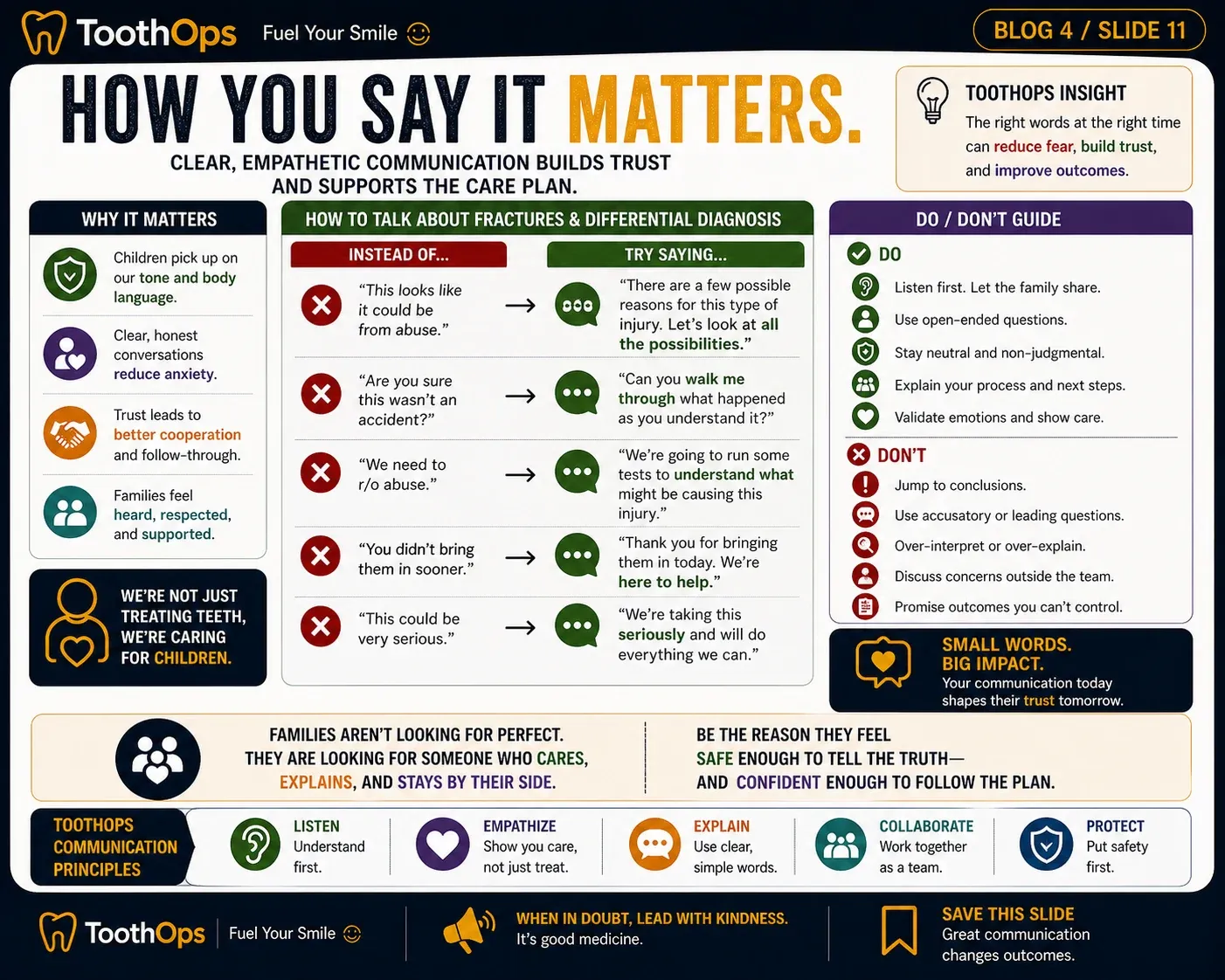
This is one of the most sensitive moments in healthcare.
Parents may hear:
- accusation
- blame
- judgment
Your communication must remain:
- calm
- neutral
- protective
- evidence-based
💬 Chairside Script
“We’re seeing patterns that can sometimes relate to how bones develop or how injuries occur. To make sure your child receives the safest and most appropriate care, we need additional evaluation.”
🧠 Why This Communication Works
It:
- avoids premature accusation
- preserves trust
- fulfills professional duty
- keeps the focus on patient safety
🧠 Communication Principle
Explain the pattern—not the conclusion.
📦 If You Only Remember One Thing
👉 When fracture severity does not match the reported force, think deeper—structure matters.
✨ Final Takeaway
Fractures are not simply injuries.
They are mechanical outcomes shaped by biology, structure, and force.
Understanding that difference allows clinicians to:
- think more accurately
- communicate more responsibly
- and protect patients more effectively
🧠 Question
A 2-year-old presents with:
- multiple fractures at different healing stages
- blue sclera
- translucent teeth
- minimal bruising
What is the MOST appropriate next step?
A. Immediately accuse caregivers of abuse
B. Ignore the findings because bruising is minimal
C. Report concern appropriately and initiate evaluation for systemic disease
D. Treat fractures only and discharge
✅ Correct Answer: C
🧠 Explanation
The patient demonstrates multiple findings strongly associated with osteogenesis imperfecta:
- recurrent fractures
- dentin abnormalities
- blue sclera
- connective tissue involvement
However:
👉 medical disease does NOT exclude abuse.
The correct response is to:
- escalate concern appropriately
- involve multidisciplinary evaluation
- protect the patient while pursuing diagnosis
❌ Why the Other Answers Are Incorrect
A. Immediately accuse caregivers
Accusation is not the clinician’s role.
B. Ignore findings
Dangerous and clinically inappropriate.
D. Treat only
Fails to address the underlying cause and patient safety concerns.
🧠 High-Yield Learning Point
The goal is not premature diagnosis.
👉 The goal is responsible clinical reasoning and patient protection.
@ToothOps | Fuel Your Smile 😊
Stay tuned for more insights and educational content in our blog.
Disclaimer: Content is for educational purposes only and not a substitute for medical or dental care.
© 2025 ToothOps | All Rights Reserved.