
🦷 Why Dentists Assess Caries Risk (CAMBRA)
 ToothOps7 min read
Understanding How Cavities Actually Develop
🤔 Why do some people brush twice a day and still get cavities — while others rarely develop them?
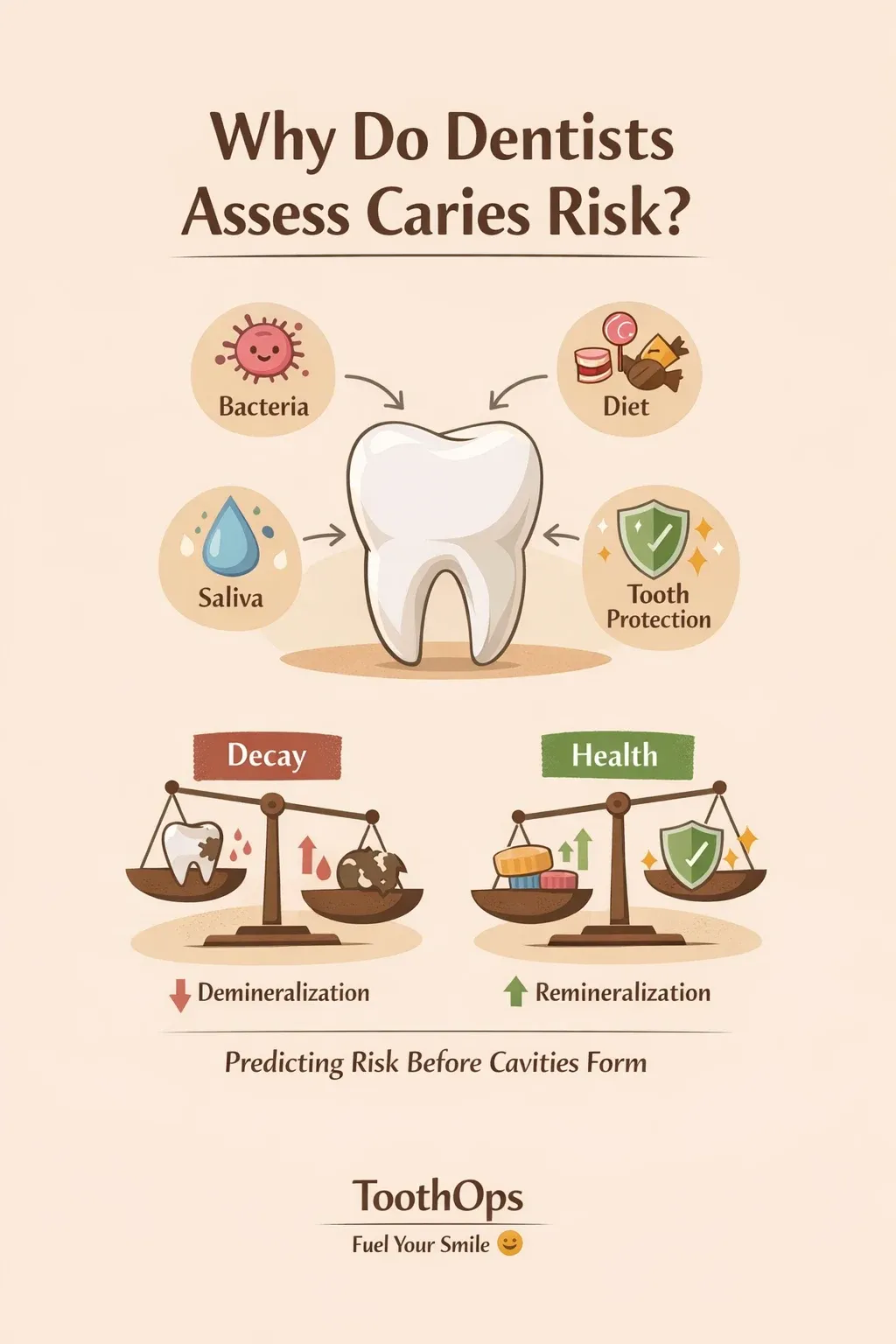
Modern dentistry has learned that cavities are not simply caused by sugar or poor brushing. Instead, tooth decay develops when a complex balance between bacteria, diet, saliva, and tooth structure shifts toward disease.
Understanding this balance allows dentists to predict and prevent cavities earlier through a system called:
🧠 Caries Management by Risk Assessment (CAMBRA)
Rather than waiting until a cavity appears, this approach focuses on identifying:
⚠️ risk factors
🛡 protective factors
🔍 early signs of disease
⚖️ The Caries Balance: Demineralization vs Remineralization
Your teeth are constantly undergoing two opposing processes.
| Process | What Happens |
|---|---|
| ⚠️ Demineralization | Acids from bacteria dissolve minerals from enamel |
| 🛡 Remineralization | Saliva and fluoride restore lost minerals |
When these two processes stay balanced, the tooth remains healthy.
But when demineralization repeatedly exceeds remineralization, minerals are permanently lost and caries begins to develop.
This interaction is known as the caries balance.
⚠️ Pathological Factors
🦠 Acid-producing bacteria
🍬 Frequent sugar intake
💧 Reduced saliva
🪥 Poor oral hygiene
🦷 Plaque accumulation
🛡 Protective Factors
💧 Saliva
🪥 Fluoride toothpaste
🛡 Sealants
🧴 Antibacterial agents
🧠 Healthy lifestyle habits
Caries develops when disease factors outweigh protective factors.
🧠 What Is CAMBRA?
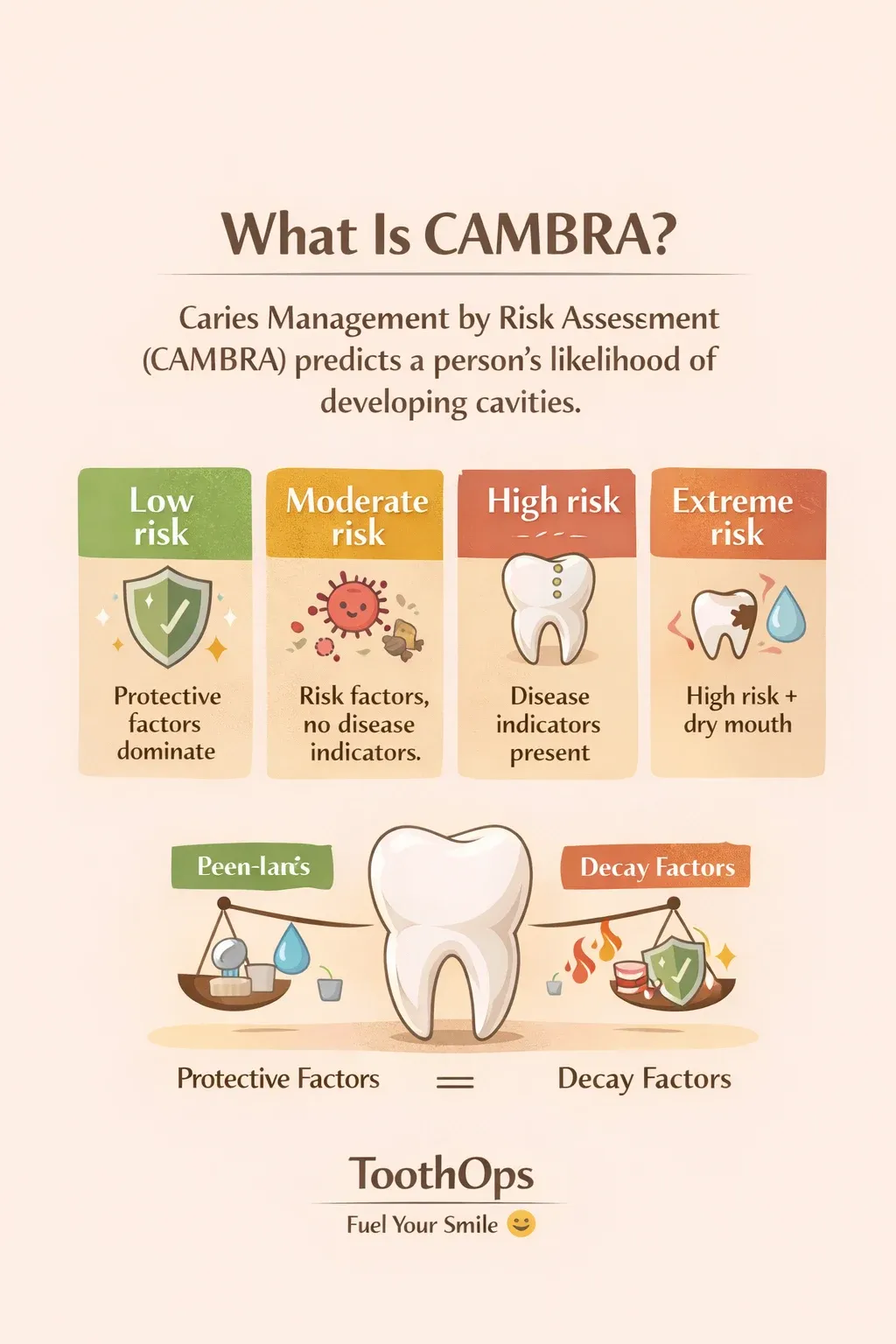
CAMBRA (Caries Management by Risk Assessment) is a clinical framework used to evaluate a patient’s likelihood of developing cavities.
Instead of focusing only on existing decay, dentists evaluate the entire biological environment of the mouth.
Patients are categorized into four risk levels:
| Risk Level | Meaning |
|---|---|
| 🟢 Low risk | Protective factors dominate |
| 🟡 Moderate risk | Risk factors present but no disease indicators |
| 🔴 High risk | Disease indicators present |
| 🔥 Extreme risk | High risk combined with severe dry mouth |
These categories help dentists design personalized prevention strategies.
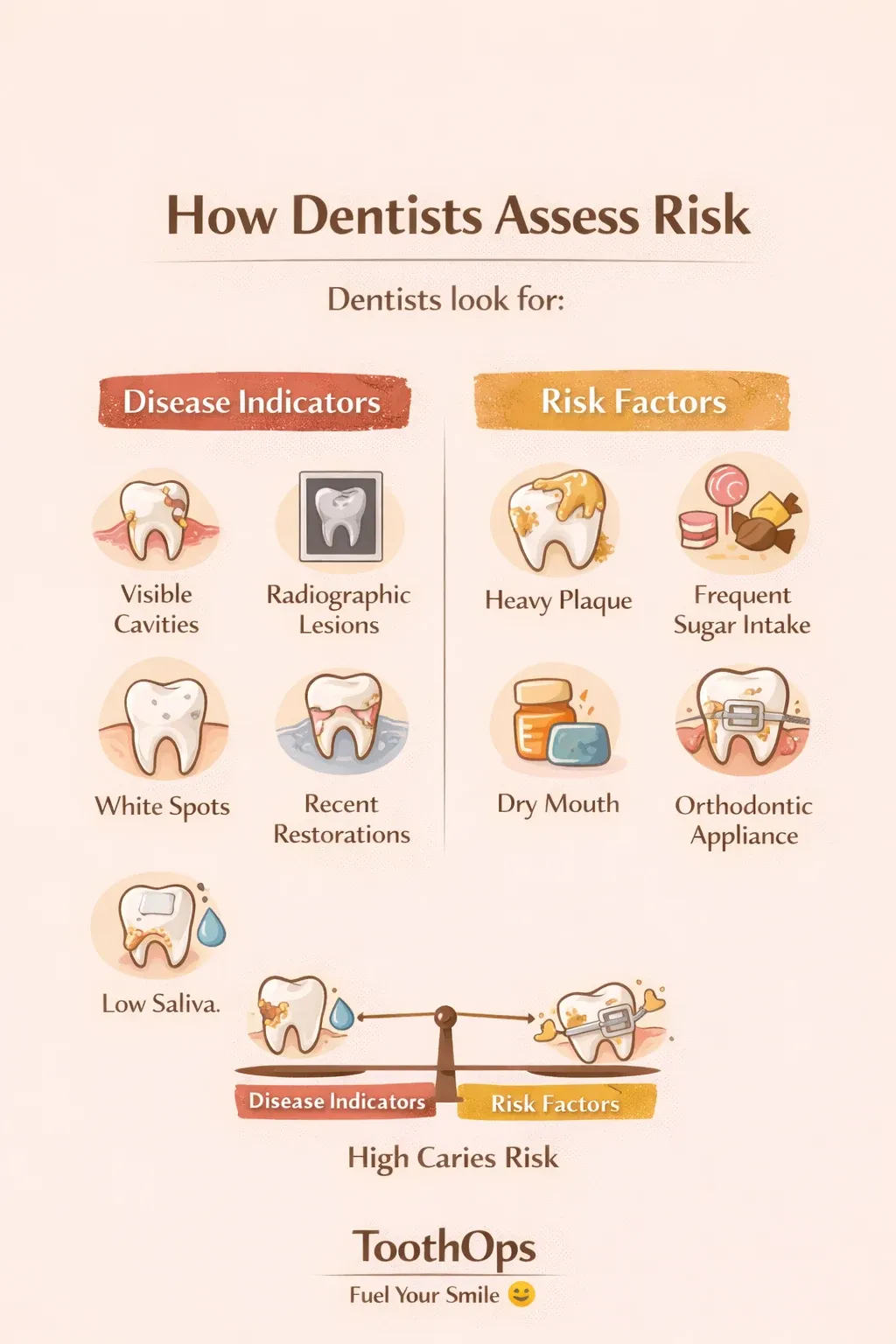
🔎 Disease Indicators: Signs of Active Caries
Some clinical findings strongly indicate active disease.
These are called disease indicators.
| Disease Indicator | Clinical Meaning |
|---|---|
| 🕳 Visible cavities | Established carious lesions |
| 📷 Radiographic enamel or dentin lesions | Hidden or developing decay |
| ⚪ White spot lesions | Early enamel demineralization |
| 🔁 Restorations within last 3 years | Recent disease activity |
| 💧 Reduced salivary function | Increased susceptibility to decay |
If these indicators are present, the patient is typically classified as high caries risk.
⚠️ Risk Factors That Increase Caries Development
Even without visible cavities, certain conditions increase the probability of disease.
| Risk Factor | Why It Matters |
|---|---|
| 🦠 Heavy plaque accumulation | Higher bacterial load |
| 🦷 Deep pits and fissures | Plaque stagnation areas |
| 🦷 Exposed root surfaces | Cementum is more vulnerable |
| 🪥 Orthodontic appliances | Plaque retention |
| 🍬 Frequent snacking (>3× daily) | Repeated acid attacks |
| 💊 Recreational drug use | Often reduces saliva |
| 💧 Reduced salivary flow | Decreased buffering capacity |
Patients with these conditions are often classified as moderate risk.
🛡 Protective Factors That Prevent Cavities
Dentists also evaluate protective factors that strengthen tooth defenses.
| Protective Factor | Benefit |
|---|---|
| 🚰 Fluoridated drinking water | Strengthens enamel |
| 🪥 Fluoride toothpaste | Enhances remineralization |
| 🧴 Fluoride rinses or gels | Provides additional mineral protection |
| 🧪 Chlorhexidine therapy | Reduces cariogenic bacteria |
| 🍬 Xylitol use | Suppresses Streptococcus mutans |
| 💧 Adequate saliva production | Neutralizes acids |
Strong protective factors help shift the caries balance toward health.
🦠 The Microbiology of Dental Caries
Dental caries is fundamentally a biofilm-mediated disease.
The oral microbiome normally contains hundreds of bacterial species living in balance.
However, frequent sugar exposure favors acid-producing bacteria.
Important cariogenic bacteria include:
| Bacteria | Role |
|---|---|
| 🦠 Streptococcus mutans | Initiates enamel demineralization |
| 🦠 Lactobacillus species | Drives dentin caries progression |
| 🦠 Actinomyces species | Associated with root caries |
Repeated sugar exposure causes an ecological shift toward acid-tolerant bacteria.
This concept is known as the ecological plaque hypothesis.
📍 Where Cavities Usually Begin
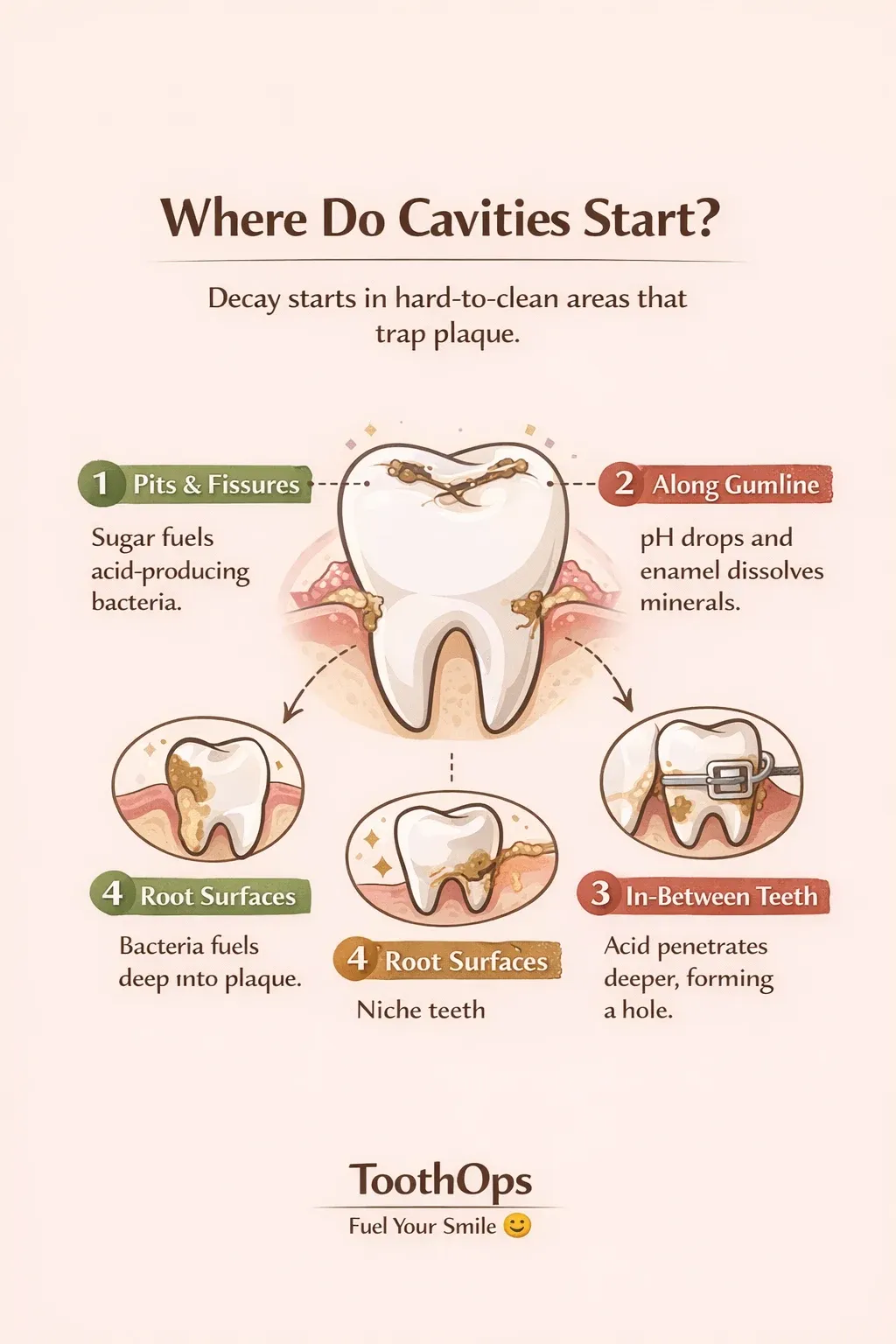
Caries often begins in areas where plaque accumulates and cleaning is difficult.
These are called plaque stagnation areas.
| Area | Why High Risk |
|---|---|
| 🦷 Pits and fissures | Deep anatomy traps plaque |
| 🪥 Cervical margins | Plaque accumulates near gingiva |
| 🦷 Interproximal surfaces | Hard to clean with brushing |
| 🦷 Root surfaces | Less mineralized than enamel |
| 🦷 Around restorations | Margins trap plaque |
| 🦷 Orthodontic brackets | Plaque retention zones |
Understanding these areas helps dentists detect early lesions.
🔬 Methods Dentists Use to Detect Caries
Dentists combine multiple diagnostic tools to evaluate caries.
| Detection Method | Purpose |
|---|---|
| 👁 Visual examination | Detect surface changes |
| 🪛 Explorer probing | Identify surface breakdown |
| 📷 Radiographs | Detect interproximal lesions |
| 🔴 Laser fluorescence | Detect mineral loss |
| 💡 Transillumination | Identify hidden lesions |
| ⚡ Electrical impedance | Detect structural changes |
| 🧪 Caries dye | Identify infected dentin |
Each method contributes to the overall diagnosis.
💡 Example: Laser Fluorescence (Diagnodent)
Laser fluorescence devices measure changes in tooth mineralization.
| Reading | Interpretation |
|---|---|
| 0–10 | 🟢 Healthy tooth |
| 11–20 | ⚪ Outer enamel lesion |
| 21–30 | ⚠️ Inner enamel lesion |
| >31 | 🔴 Dentin caries |
These technologies help dentists detect disease before cavities become visible.
🔍 Active vs Arrested Caries Lesions
Not every lesion progresses.
Dentists evaluate lesion activity to determine if the lesion is advancing or stable.
| Feature | Active Lesion | Arrested Lesion |
|---|---|---|
| Appearance | ⚪ Matte white/yellow | 🟤 Shiny brown |
| Texture | Rough / soft | Smooth / hard |
| Plaque | Thick / sticky | Minimal |
| Location | Plaque stagnation areas | Easily cleaned areas |
| Gingiva | Inflamed | Healthy |
This assessment determines whether a lesion should be treated or monitored.
📊 ICDAS: A Modern Caries Classification System
Dentists often use the International Caries Detection and Assessment System (ICDAS).
| ICDAS | Description |
|---|---|
| 0 | 🟢 Sound tooth |
| 1 | ⚪ First visual change after drying |
| 2 | ⚪ Visible enamel change |
| 3 | ⚠️ Localized enamel breakdown |
| 4 | ⚫ Underlying dentin shadow |
| 5 | 🔴 Cavitated dentin lesion |
| 6 | 🔥 Extensive cavitation |
This classification allows early detection and conservative treatment.
💧 Why Saliva Is One of the Body’s Strongest Defenses
Saliva plays an essential role in oral health.
Functions include:
💧 buffering acids
💧 delivering calcium and phosphate
💧 washing away bacteria
💧 supporting remineralization
Normal salivary flow rates:
| Saliva Type | Normal Flow |
|---|---|
| Unstimulated | ~0.3 mL/min |
| Stimulated | 1–2 mL/min |
Reduced salivary flow significantly increases caries risk.
⚠️ Conditions That Reduce Saliva
Dry mouth (xerostomia) is one of the strongest predictors of dental caries.
Common causes include:
💊 Medications
• antidepressants
• antihistamines
• antihypertensives
• opioids
• benzodiazepines
🩺 Medical conditions
• Sjögren’s syndrome
• diabetes
• autoimmune diseases
• neurological disorders
🌿 Lifestyle factors
• smoking
• dehydration
• mouth breathing
Reduced saliva disrupts the natural protective environment of the mouth.
🍬 Why Frequent Sugar Intake Causes Cavities
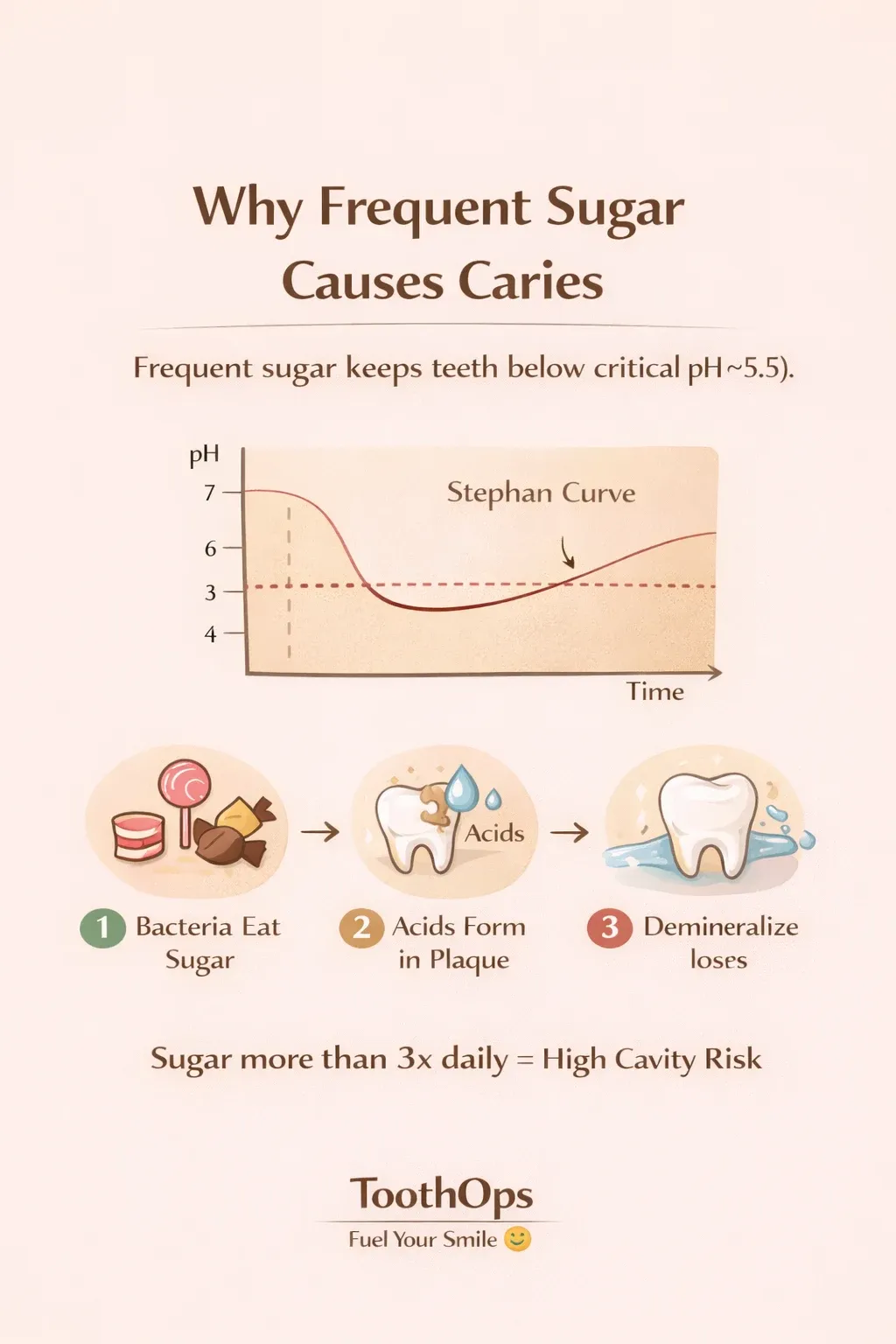
The relationship between sugar and tooth decay is explained by the Stephan Curve.
After sugar consumption:
1️⃣ bacteria metabolize sugar
2️⃣ acids are produced
3️⃣ plaque pH drops below critical pH (~5.5)
4️⃣ enamel begins to demineralize
5️⃣ saliva gradually restores pH
Frequent snacking keeps the mouth below the critical pH longer, increasing caries risk.
🧠 Clinical Example
A patient presents with:
• heavy plaque accumulation
• frequent snacking between meals
• moderate levels of Streptococcus mutans
• no visible cavities
The patient brushes twice daily with fluoride toothpaste.
Because risk factors are present but no disease indicators are detected, the patient would be classified as:
➡ Moderate caries risk
This classification helps guide preventive treatment.
🧩 The Modern Philosophy of Dentistry
Modern dentistry focuses on managing disease rather than simply repairing damage.
The goal is to:
🔍 identify risk early
🦠 control bacterial activity
🛡 strengthen enamel
🦷 preserve natural tooth structure
Understanding caries as a biological disease process allows clinicians to prevent damage before irreversible cavities form.
@ToothOps | Fuel Your Smile 😊
Stay tuned for more insights and educational content in our blog.
Disclaimer: Content is for educational purposes only and not a substitute for medical or dental care.
© 2025 ToothOps | All Rights Reserved.