
🦷 When Fluid Becomes DangerousAscites, Infection Risk, and the System-Level Failure Behind Secondary Bacterial Peritonitis
 ToothOps7 min read
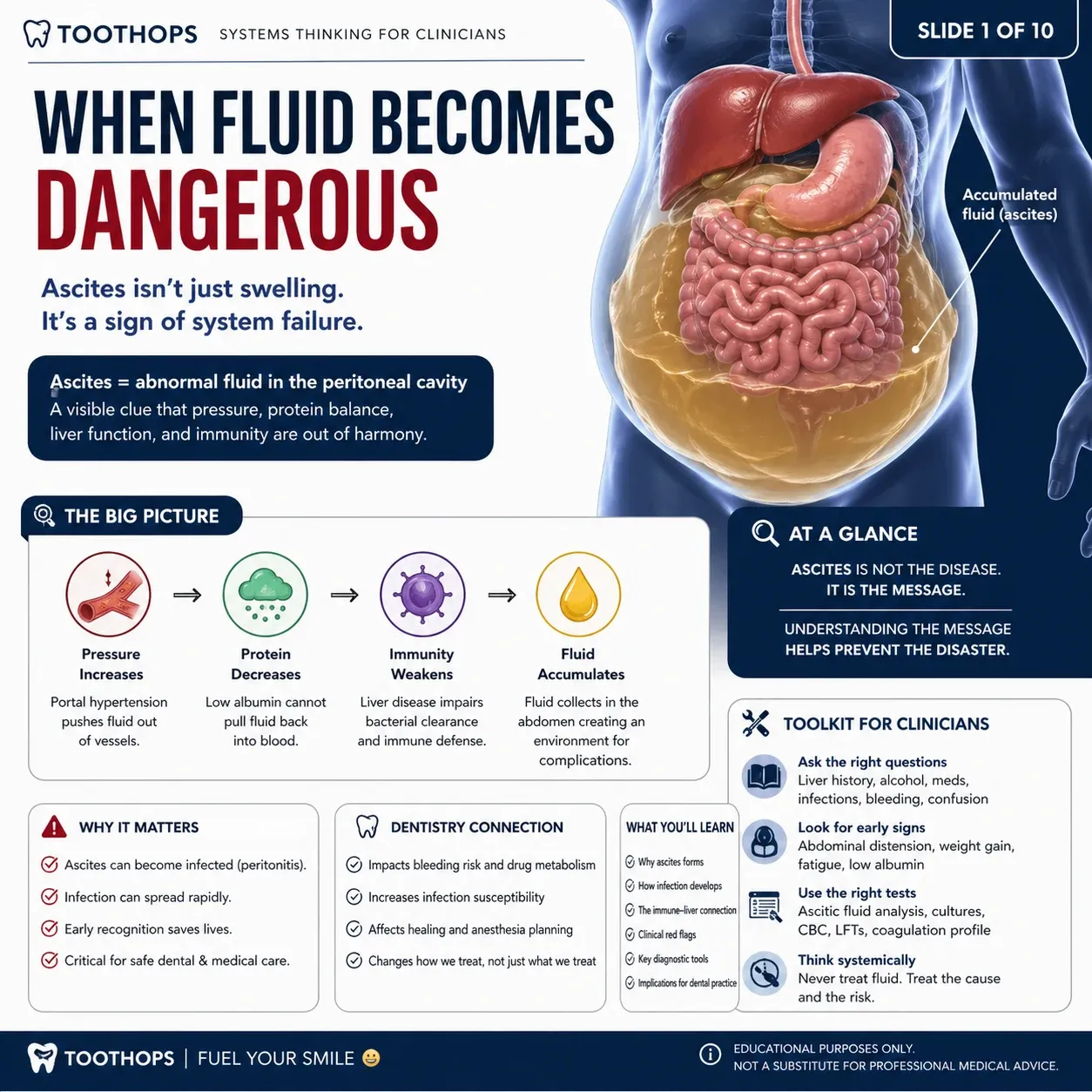
From pressure imbalance to infection: why “just fluid” can become a serious clinical problem
🧠 Big Picture: The Simple Mental Model
Think of the body as three connected systems:
| System | Simple Model | Job |
|---|---|---|
| Blood vessels | Pipes | Keep fluid moving in the right place |
| Liver | Filter + pressure regulator | Processes blood, proteins, toxins, immune signals |
| Immune system | Security system | Prevents bacteria from spreading |
When these systems work well, fluid stays inside vessels, bacteria are controlled, and inflammation stays regulated.
When they fail together:
pressure builds → fluid leaks → immunity weakens → bacteria enter → infection spreads
That is why ascites is not simply “fluid in the belly.”
👉 Ascites is a sign that vascular pressure, liver function, and immune defense are no longer balanced.
1. What Is Ascites?
Ascites is abnormal fluid accumulation in the peritoneal cavity, the space inside the abdomen around the organs.
Patients may notice:
- abdominal swelling
- tightness or discomfort
- shortness of breath when severe
- reduced appetite
- rapid weight gain from fluid
But clinically, the real concern is not only the fluid itself.
The real question is:
👉 Why did the body allow fluid to leave the bloodstream and collect there?
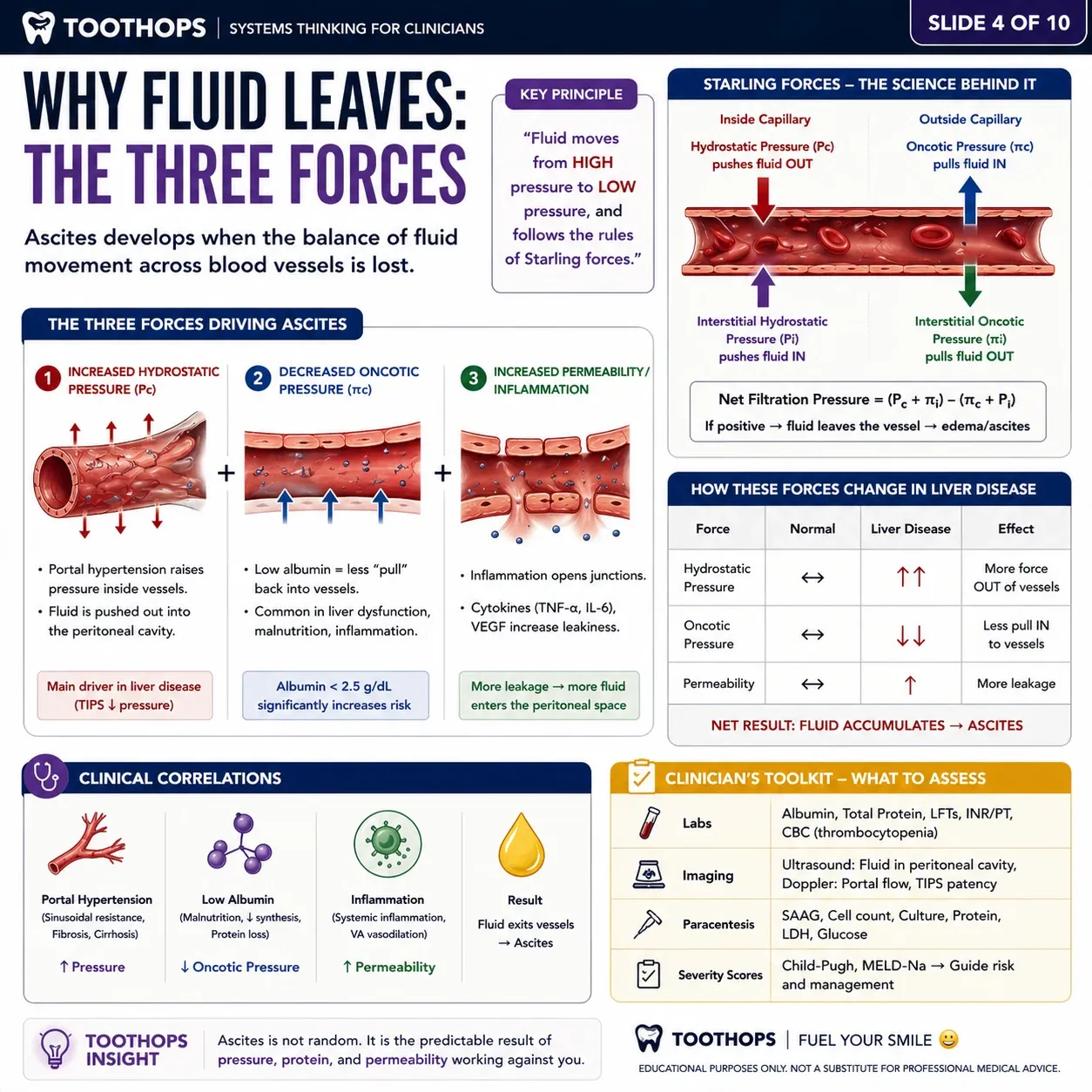
2. Why Ascites Forms: Pressure + Protein + Permeability
Ascites usually reflects a breakdown in fluid balance.
The three main forces
| Problem | Mechanism | Result |
|---|---|---|
| Increased hydrostatic pressure | Portal hypertension pushes fluid outward | Fluid leaves vessels |
| Decreased oncotic pressure | Low albumin means less pulling fluid back into blood | Fluid stays outside vessels |
| Increased permeability/inflammation | Vessels become leakier | More fluid escapes |
The easiest way to understand it
Imagine a clogged filter connected to a pipe.
If the filter becomes stiff or blocked, pressure builds behind it. Eventually, fluid is forced out of the system.
In liver disease, the liver can become that “clogged filter.”
3. Portal Hypertension: The Pressure Problem
Blood from the intestines normally drains through the portal vein into the liver.
The liver then processes that blood before it returns to the general circulation.
When liver architecture becomes distorted by inflammation, fibrosis, or cirrhosis:
- blood cannot flow through easily
- portal pressure rises
- fluid is pushed out of vessels
- ascites develops
This is why ascites is often not a “fluid problem” first.
It is often a pressure problem caused by liver disease.
4. Why the Liver Matters Beyond Pressure
The liver is not just a filter.
It also helps maintain:
- albumin production
- clotting factor production
- immune protein production
- bacterial clearance
- toxin metabolism
So when liver function declines, the body loses more than one defense at the same time.
| Liver Function | What Happens When It Fails |
|---|---|
| Albumin production | Fluid stays in tissues/body cavities |
| Immune protein production | Infection defense weakens |
| Bacterial clearance | Bacteria survive longer |
| Clotting factor synthesis | Bleeding risk increases |
| Toxin metabolism | Confusion/encephalopathy risk rises |
This is why patients with advanced liver disease may have ascites, bleeding risk, infection risk, and altered mental status at the same time.
5. Why Ascitic Fluid Can Become Dangerous
Here is the key idea:
👉 Fluid becomes dangerous when it becomes an environment.
Ascitic fluid may contain:
- proteins
- immune cells
- inflammatory mediators
- bacteria
- breakdown products
If bacteria enter that fluid and immune defenses are weak, infection can develop.
That infection may become peritonitis, inflammation/infection involving the peritoneal cavity.
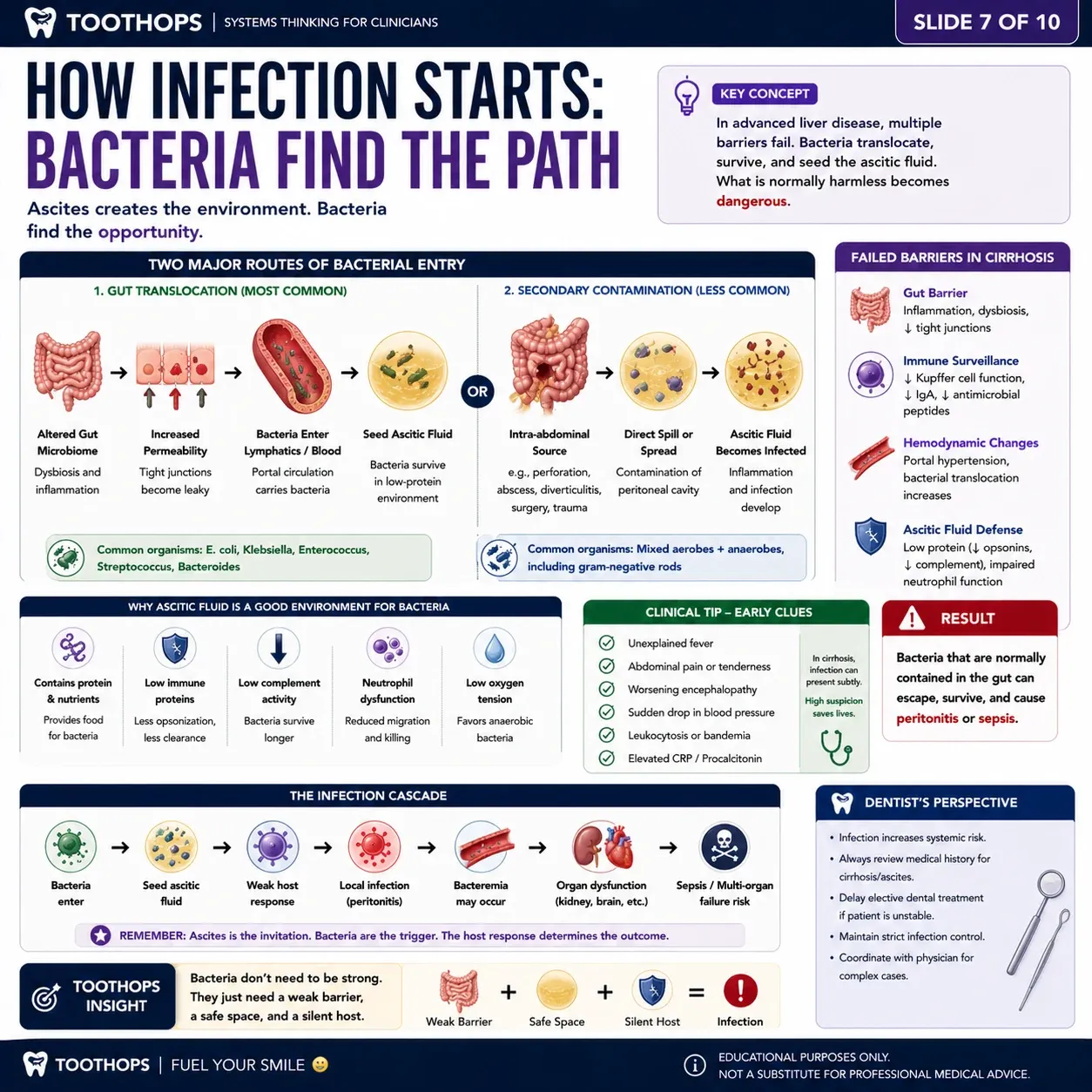
6. How Bacteria Reach Ascitic Fluid
There are two major routes.
Route 1: Gut translocation
The intestines normally contain bacteria.
In liver disease and portal hypertension:
- gut barrier function may weaken
- circulation changes
- immune surveillance decreases
- bacteria can cross into lymphatics or blood
Then bacteria can seed ascitic fluid.
Route 2: Secondary contamination
Secondary bacterial peritonitis may occur when bacteria enter from a specific source, such as:
- perforated bowel
- intra-abdominal infection
- surgical complication
- trauma
Key distinction
| Type | Main Idea |
|---|---|
| Spontaneous bacterial peritonitis | Infection without an obvious surgically treatable source |
| Secondary bacterial peritonitis | Infection from another intra-abdominal source |
For ToothOps-level teaching, the point is:
👉 Ascites creates the setting; bacteria create the escalation.
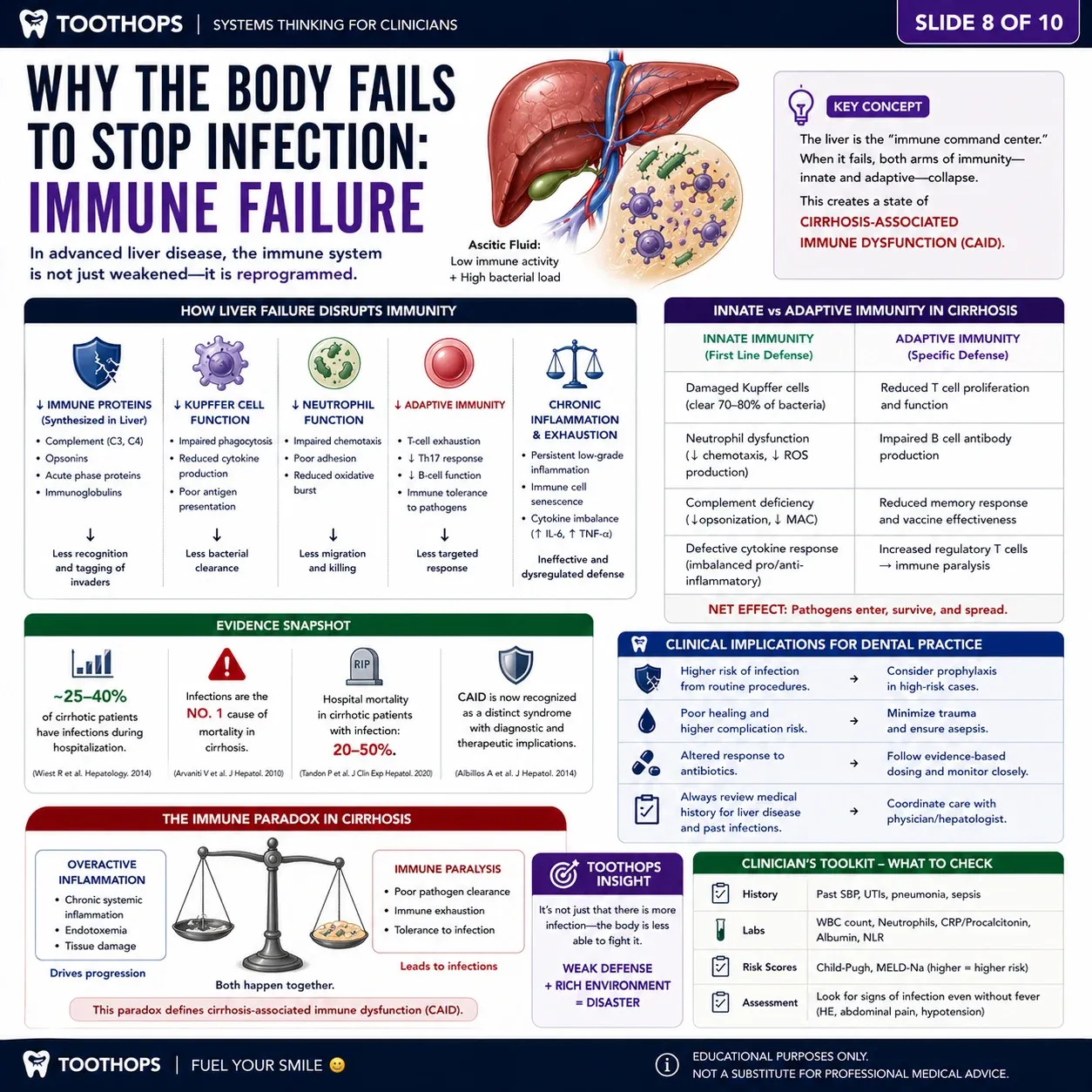
7. Why the Immune System Struggles
In a healthy body, bacteria entering the bloodstream or body spaces are recognized and cleared.
In liver disease, multiple defenses weaken:
- reduced complement proteins
- reduced opsonization
- impaired macrophage/Kupffer cell clearance
- altered gut barrier
- systemic inflammation
- poor nutritional and protein status
So infection risk rises not because bacteria are “stronger,” but because the host defense environment is weaker.
Big picture
| Normal Defense | In Advanced Liver Disease |
|---|---|
| Liver filters bacteria | Clearance decreases |
| Immune proteins tag microbes | Opsonization decreases |
| Gut barrier limits spread | Translocation increases |
| Ascitic fluid resists infection | Low-protein fluid may defend poorly |
8. Clinical Pattern: What You Might See
Ascites alone may cause:
- abdominal distension
- discomfort
- fluid wave
- early satiety
- shortness of breath
But infection can change the picture quickly.
Red flags
- fever
- abdominal pain
- tenderness
- worsening fatigue
- confusion
- low blood pressure
- rapid clinical decline
Important clinical insight
Patients may not always look dramatically ill at first.
👉 Infection in a compromised system can start subtly and worsen quickly.
9. Diagnostics: You Test the Fluid, Not Just the Patient
When ascites becomes concerning, clinicians often analyze the fluid directly.
This may include:
- cell count
- neutrophil count
- culture
- protein level
- albumin comparison
- bacterial identification
Diagnostic logic table
| Test/Clue | What It Helps Determine |
|---|---|
| Ascitic neutrophils | Is there inflammatory/infectious response? |
| Culture | What organism is present? |
| Protein level | How protective is the fluid environment? |
| Blood cultures | Has infection spread systemically? |
| Imaging/clinical exam | Is there a secondary source? |
ToothOps insight
You are not just diagnosing “fluid.”You are diagnosing whether that fluid has become infected, inflamed, or dangerous.
10. Why This Matters in Dentistry
This topic may sound medical, but it matters in dental care because liver disease and ascites can signal systemic fragility.
Patients with advanced liver disease may have:
- impaired healing
- increased bleeding tendency
- altered drug metabolism
- increased infection risk
- fatigue or reduced physiologic reserve
11. Dentistry-Specific Clinical Implications
Before dental treatment
Clinicians should consider:
- current liver disease status
- ascites severity
- recent hospitalization
- infection history
- bleeding history
- medications
- platelet count / coagulation labs if relevant
- medical consultation for unstable patients
During dental treatment
Priorities include:
- minimize tissue trauma
- use careful local hemostasis
- avoid unnecessary invasive procedures if medically unstable
- consider medication metabolism and contraindications
- maintain infection-control precautions
After dental treatment
Patients may need:
- clear post-op instructions
- close follow-up
- reinforced infection warning signs
- careful coordination if systemic status changes
12. Chairside Explanation
Here is a realistic patient-friendly script:
“Your liver condition can affect how your body manages fluid, infection, bleeding, and healing. Because of that, we want to be careful with any procedure, reduce trauma, and make sure your body has the best chance to heal safely.”
A simpler version:
“This isn’t just about fluid. It tells us your body may be under extra stress, so we’ll plan treatment more carefully.”
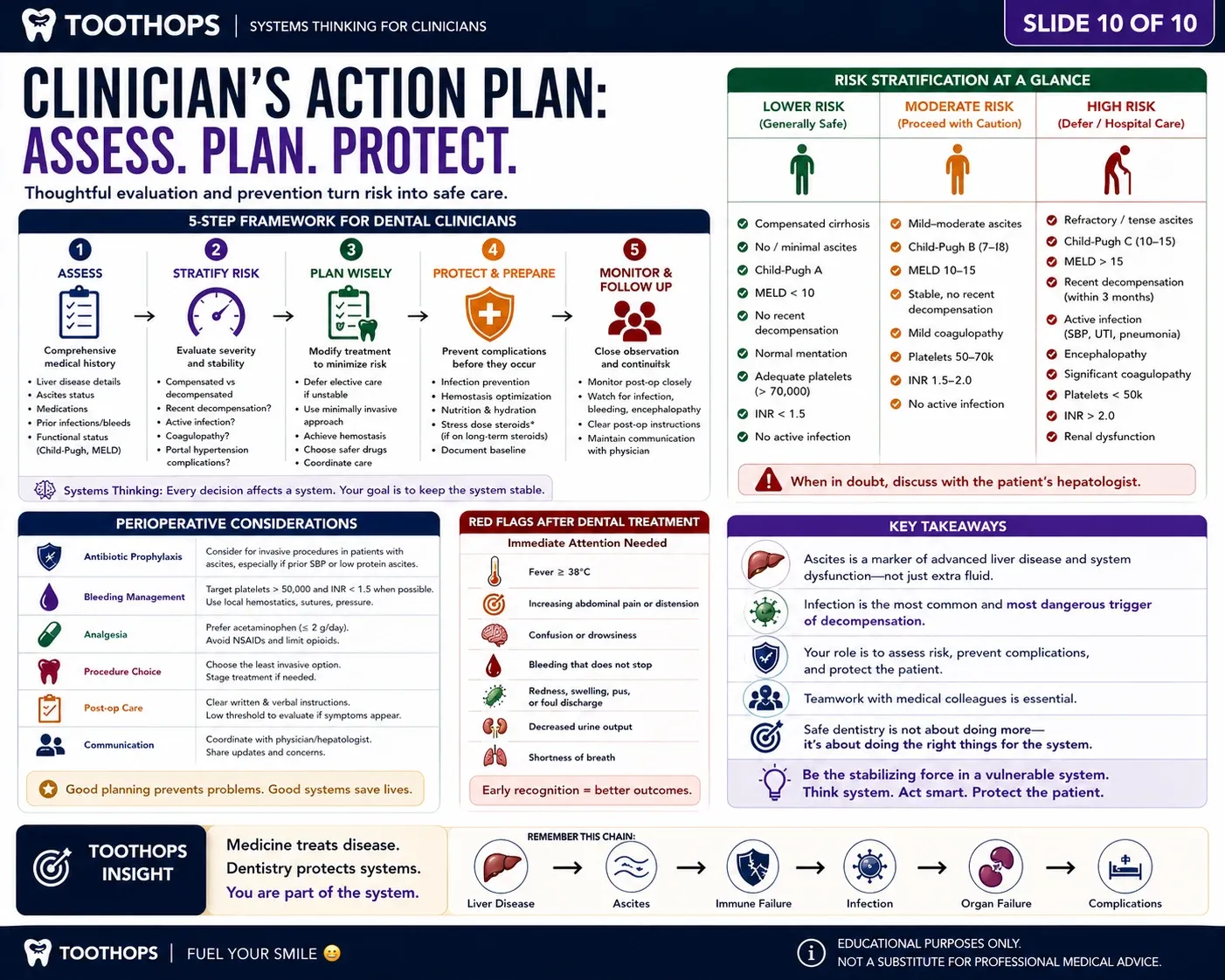
13. Clinical Reasoning Framework
When you hear “ascites,” think through this sequence:
| Step | Clinical Question | Why It Matters |
|---|---|---|
| 1 | Why is fluid accumulating? | Pressure/protein/liver dysfunction |
| 2 | Is the patient stable? | Determines urgency |
| 3 | Could the fluid be infected? | Peritonitis risk |
| 4 | Is liver function impaired? | Bleeding, healing, drug metabolism |
| 5 | Is dental treatment elective or urgent? | Timing matters |
| 6 | Do we need medical coordination? | Safer care planning |
14. If You Only Remember One Thing
Ascites becomes dangerous because it represents more than swelling.
It means:
👉 pressure is abnormal
👉 liver function may be impaired
👉 immune defense may be weakened
👉 fluid can become infected
That is why ascites is a system-level warning sign.
ToothOps Insight
Ascites is not “just fluid.”
It is a visible sign that the body’s pressure regulation, protein balance, liver function, and immune defenses are connected—and when those systems fail together, infection can escalate quickly.
Final Takeaway
Fluid becomes dangerous when it stops being passive and becomes a place where infection, inflammation, and systemic instability can develop.
Understanding ascites means understanding the body as a connected system—not isolated organs.
@ToothOps | Fuel Your Smile 😊
Stay tuned for more insights and educational content in our blog.
Disclaimer: Content is for educational purposes only and not a substitute for medical or dental care.
© 2025 ToothOps | All Rights Reserved.