
🦷 The Spleen — How the Body Filters Blood, Removes Cells, and Shapes Immunity
 ToothOps10 min read
Why this quiet organ matters for infection risk, anemia, platelet count, bleeding, and dental care
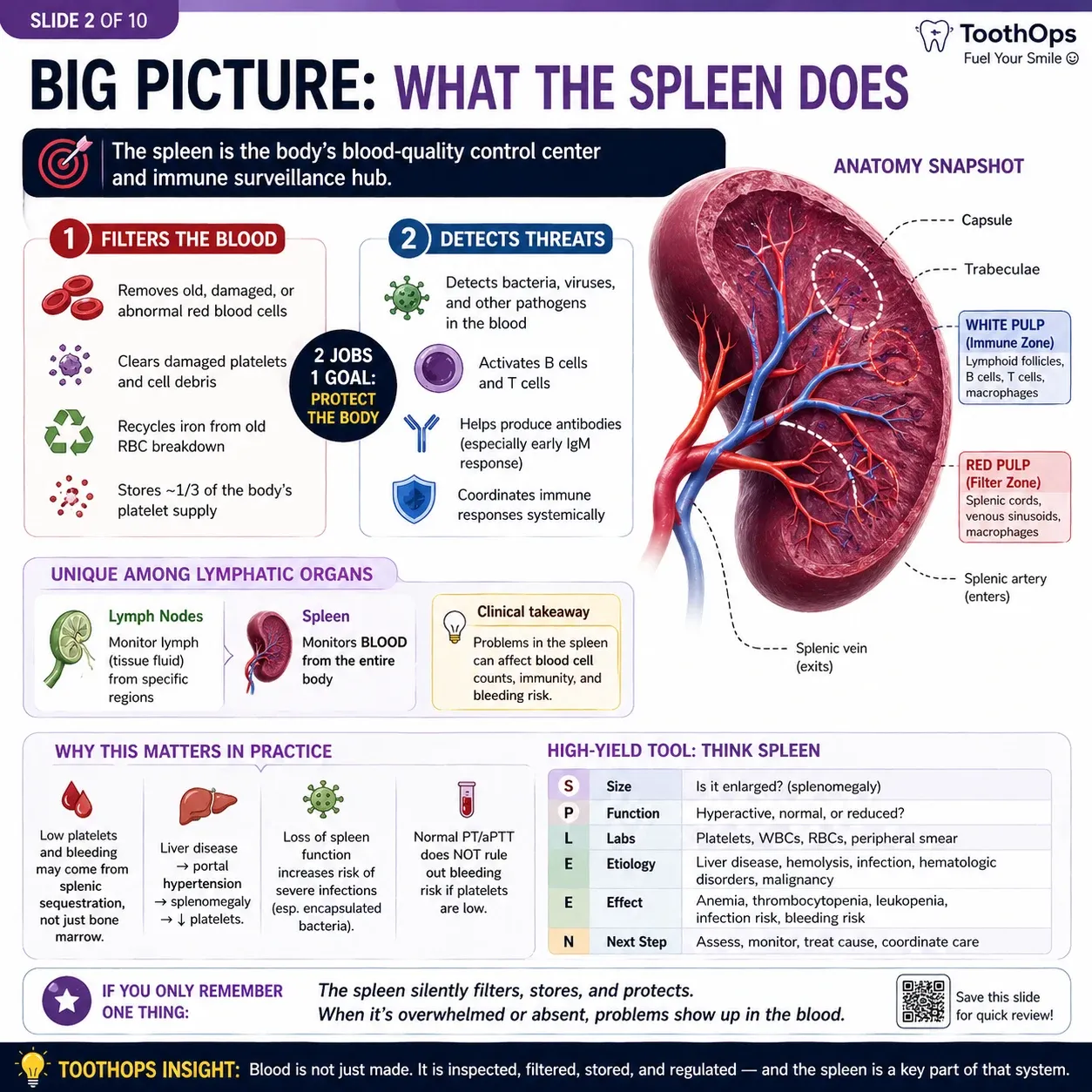
🧠 Big Picture: The Spleen in One Sentence
The spleen is your body’s blood-quality control organ.
It does two major jobs:
- Filters the blood→ removes old, damaged, or abnormal cells.
- Scans the blood for threats→ helps the immune system respond to blood-borne microbes.
Most people think of blood as something that simply flows. But blood is constantly being inspected, cleaned, filtered, and regulated. The spleen is one of the main organs doing that work. The spleen is the largest single mass of lymphatic tissue, with white pulp for immune activity and red pulp containing blood-filled sinuses and splenic cords involved in removal of old or defective blood cells and platelets.
🧩 The Simplest Mental Model
Think of the spleen like an airport security system for blood:
| Airport Security | Spleen Equivalent |
|---|---|
| Passengers enter | Blood enters through the splenic artery |
| IDs are checked | Cells are inspected |
| Suspicious items are removed | Old RBCs, damaged platelets, microbes are cleared |
| Threats trigger response | Immune cells activate |
| Cleared passengers continue | Filtered blood returns to circulation |
If you only remember one thing:
The spleen decides what should stay in circulation and what should be removed.
1. Where the Spleen Fits in the Immune System
The spleen is a secondary lymphatic organ. That means it is not where immune cells are first made, but it is where immune responses can occur.
Lymphatic organs:
| Type | Main Role | Examples |
|---|---|---|
| Primary lymphatic organs | Immune cells develop and mature | Bone marrow, thymus |
| Secondary lymphatic organs | Immune responses occur | Lymph nodes, spleen, lymphatic nodules |
The spleen is especially unique because it monitors blood, while lymph nodes monitor lymph/tissue fluid.
ToothOps Insight
Lymph nodes ask:
“What is happening in the tissues?”
The spleen asks:
“What is circulating in the blood?”
That distinction matters because blood-borne infections, abnormal blood cells, and platelet changes often involve the spleen.
2. The Two Main Zones: Red Pulp and White Pulp
The spleen is not one uniform structure. It has two major functional regions:
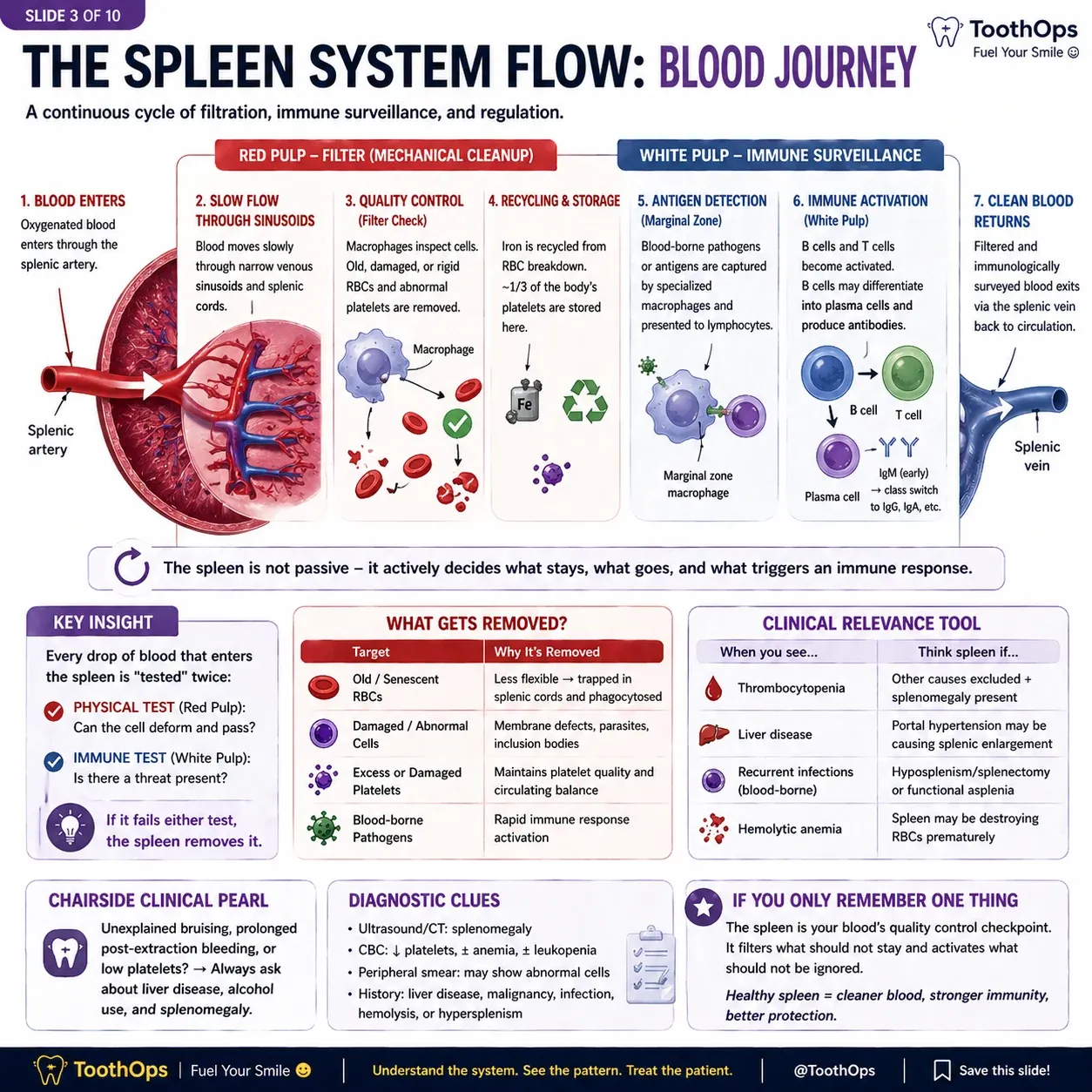
Red Pulp = Mechanical Blood Filter
The red pulp contains blood-filled venous sinuses and splenic cords. It removes old or defective blood cells and platelets through macrophages. Your study guide describes the red pulp as closely associated with veins and involved in removing old/defective blood cells and platelets, while also storing approximately one-third of the body’s platelet supply.
What red pulp does:
- removes old red blood cells
- clears damaged platelets
- removes cellular debris
- helps recycle iron from RBC breakdown
- provides macrophage-mediated blood filtration
M****echanism:
Red blood cells must deform to pass through narrow splenic spaces. Healthy RBCs are flexible. Older or damaged RBCs become less deformable, get trapped, and are phagocytosed by splenic macrophages.
| Cell Status | Mechanical Property | Spleen Response |
|---|---|---|
| Healthy RBC | Flexible | Passes through |
| Old RBC | Less flexible | Trapped and removed |
| Damaged RBC | Abnormal membrane | Phagocytosed |
| Excess platelets in enlarged spleen | Sequestered | Platelet count may fall |
White Pulp = Immune Surveillance Center
White pulp is lymphatic tissue arranged around branches of the splenic artery and contains lymphocytes and macrophages. Your guide notes that blood flows through splenic structures where B and T cell immune reactions occur, and macrophages destroy blood-borne pathogens.
What white pulp does:
- detects blood-borne antigens
- activates B cells and T cells
- supports antibody production
- helps coordinate immune responses
- helps clear pathogens circulating in blood
Mechanism:
Blood brings antigens into the spleen. Antigen-presenting cells process and present them to lymphocytes. B cells can differentiate into plasma cells and produce antibodies, especially early IgM responses.
3. Red Pulp vs White Pulp: High-Yield Table
| Region | Main Job | Main Cells | Clinical Meaning |
|---|---|---|---|
| Red pulp | Filters blood | Macrophages, RBCs, platelets | Removes old cells; can contribute to cytopenias |
| White pulp | Immune response | B cells, T cells, macrophages | Detects blood-borne pathogens |
| Marginal zone | Interface zone | Specialized macrophages, B cells | Rapid response to circulating antigens |
If you only remember one thing:
Red pulp filters cells. White pulp activates immunity.
4. Why the Spleen Matters for Platelets and Bleeding
This is where the spleen becomes clinically important for dentistry.
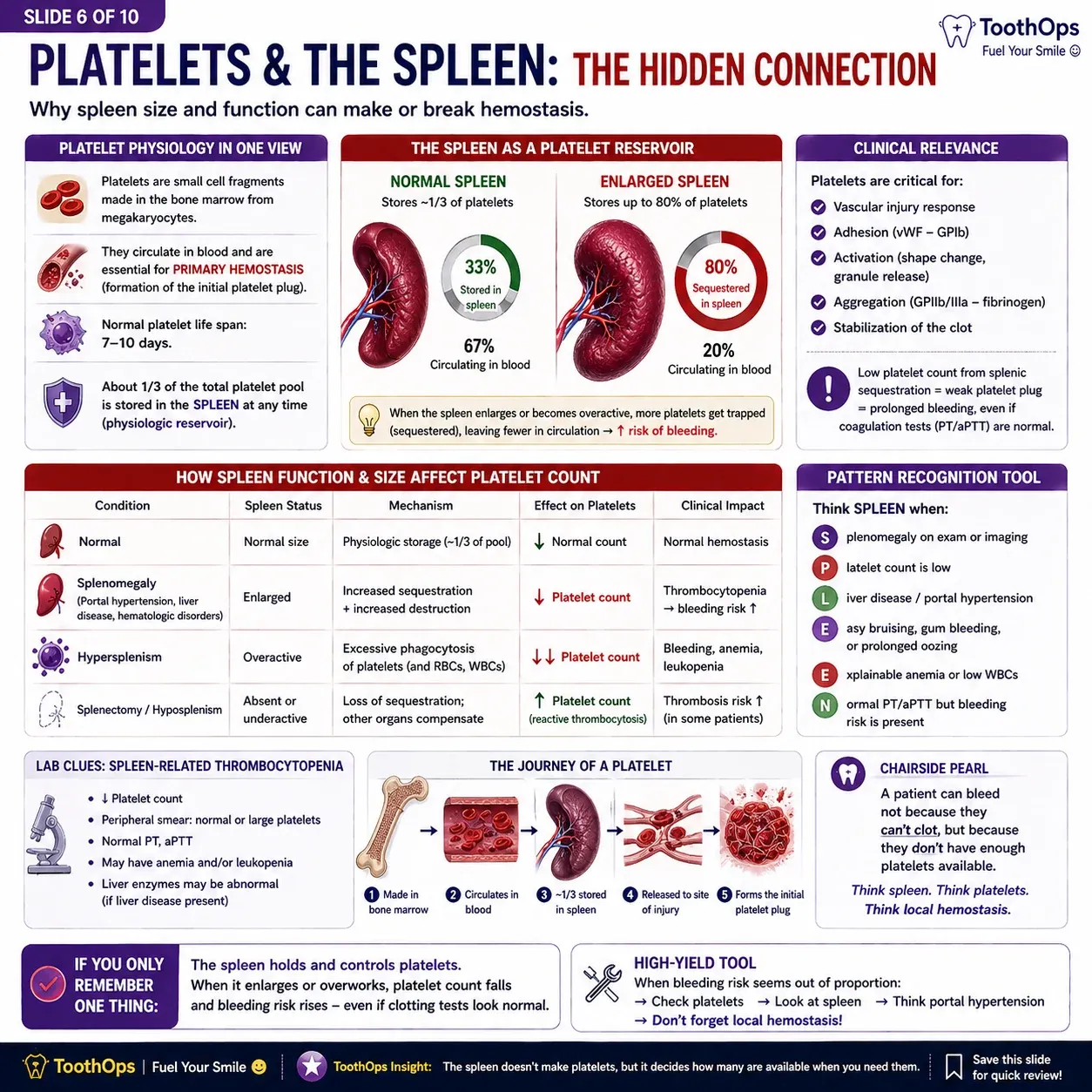
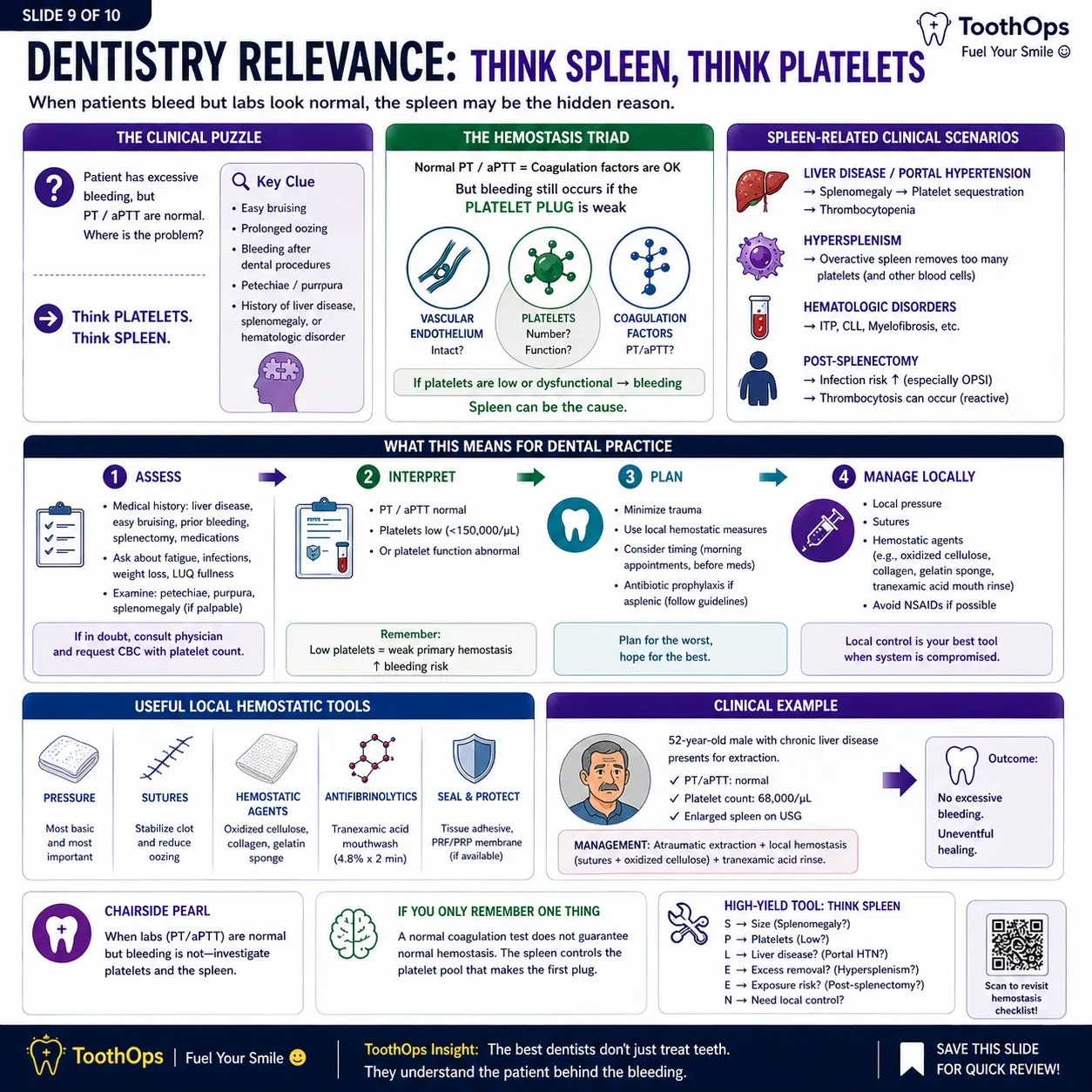
Platelets are required for primary hemostasis, the first plug that forms after vascular injury. If platelet number is low, a patient may have normal clotting factor labs but still bleed because the initial plug is weak.
Under normal circumstances, about one-third of the platelet pool is sequestered in the spleen, and splenomegaly may sequester up to 80% of the platelet pool, contributing to thrombocytopenia.
Mechanism Chain
| Step | Mechanism | Clinical Effect |
|---|---|---|
| Spleen enlarges | More blood cells are trapped | Platelets decrease |
| Platelet count decreases | Primary hemostasis weakens | More mucosal bleeding |
| Dental procedure occurs | Local tissue injury challenges clotting | Bleeding may persist |
Key Clinical Point
A patient can have:
- normal PT
- normal aPTT
- but still bleed
Why?
Because PT/aPTT evaluate coagulation pathways, not platelet number or platelet plug strength.
5. Hypersplenism: When the Filter Becomes Too Aggressive
Big Picture
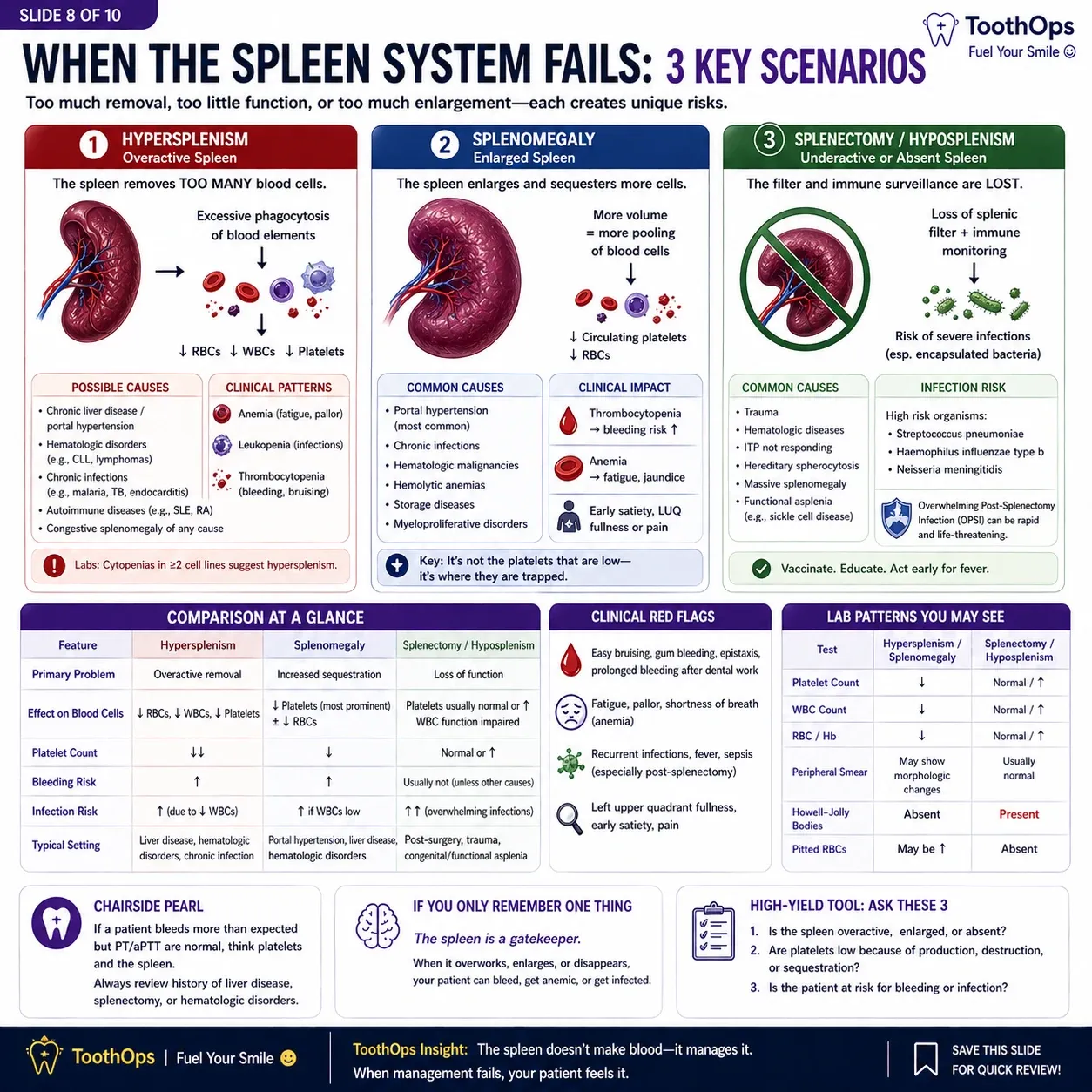
Hypersplenism means the spleen is overactive and removes too many circulating cells.
It can reduce:
- red blood cells → anemia
- white blood cells → leukopenia
- platelets → thrombocytopenia
Your study guide describes hypersplenism as excessive phagocytosis of formed blood elements, which may lead to anemia, leukopenia, or thrombocytopenia.
Why This Matters
If platelets drop, bleeding risk can increase.If RBCs drop, anemia can develop.If WBCs drop, immune defense may weaken.
| Cell Reduced | Term | Possible Clinical Pattern |
|---|---|---|
| RBCs | Anemia | Fatigue, pallor, jaundice if hemolysis |
| WBCs | Leukopenia | Infection susceptibility |
| Platelets | Thrombocytopenia | Easy bruising, gum bleeding, prolonged bleeding |
6. Hyposplenism or Splenectomy: When the Filter Is Missing
Big Picture
If the spleen is absent or underfunctioning, the body loses part of its blood filtration and immune surveillance system.
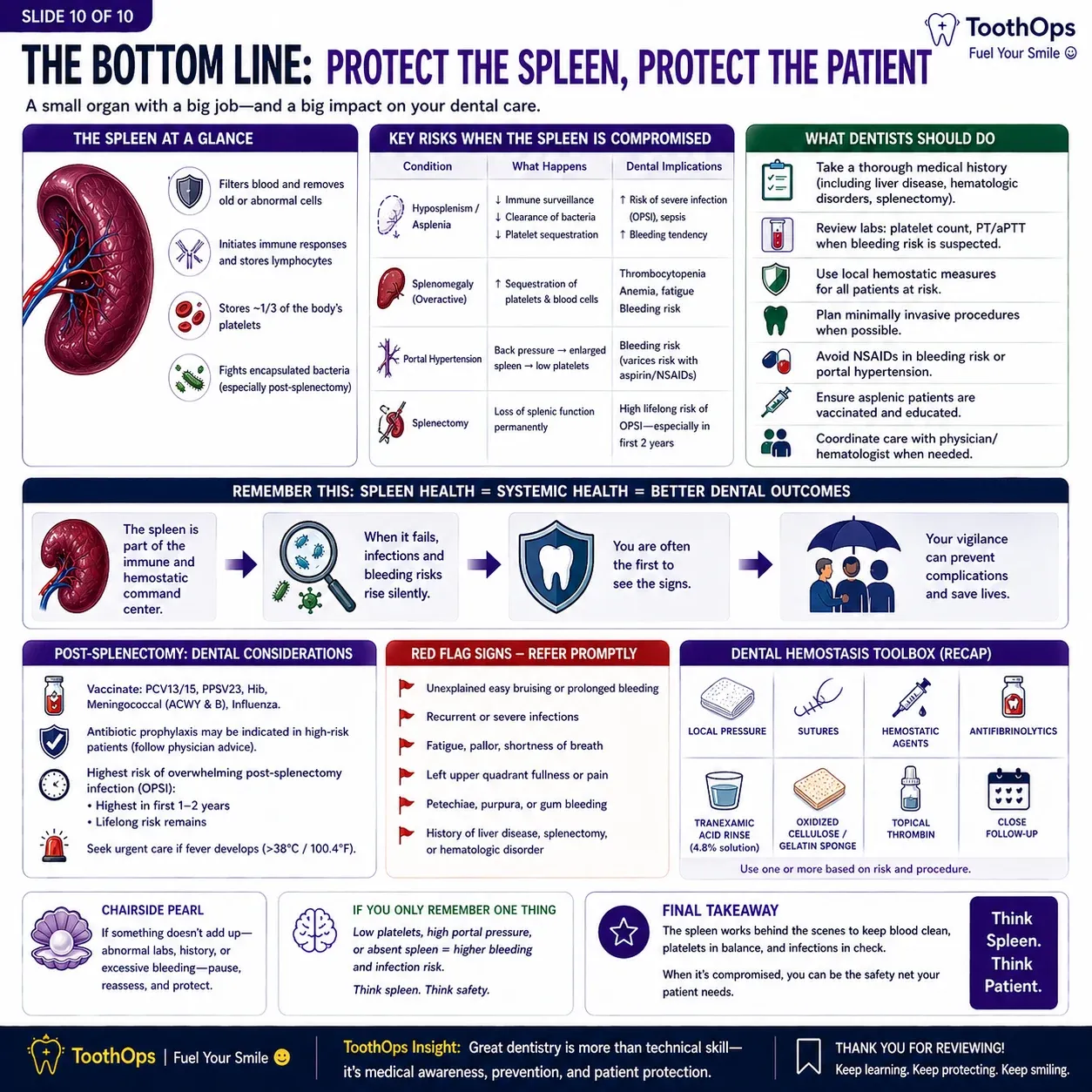
Other macrophage systems, such as hepatic and bone marrow macrophages, can compensate partly, but the spleen has a special role in responding to blood-borne pathogens, especially encapsulated organisms. Your guide notes that hyposplenism is loss of spleen function and that other macrophage systems may carry out some functions, but encapsulated organisms are a concern.
Clinical Meaning
Patients without a functioning spleen may have increased susceptibility to certain infections because blood-borne pathogens are not cleared as efficiently.
| Problem | Mechanism | Why It Matters |
|---|---|---|
| Splenectomy | Loss of splenic filtering | Higher infection risk |
| Hyposplenism | Reduced immune surveillance | Blood-borne microbes persist longer |
| Sickle cell disease | Functional splenic loss over time | Increased risk from encapsulated bacteria |
7. Liver Disease, Portal Hypertension, and the Spleen
This is one of the most important system-level connections.
The spleen drains into the portal circulation. When liver disease increases resistance to portal blood flow, pressure can back up into the portal system and affect the spleen.
Cause → Effect Chain
| Cause | Mechanism | Result |
|---|---|---|
| Cirrhosis or liver fibrosis | Resistance to portal blood flow increases | Portal hypertension |
| Portal pressure rises | Blood backs up toward spleen | Splenomegaly |
| Spleen enlarges | More platelets sequestered | Thrombocytopenia |
| Platelets decrease | Platelet plug weaker | Bleeding risk increases |
ToothOps Insight
Liver disease can increase bleeding risk in two ways:
- Reduced clotting factor production
- Splenic platelet sequestration from portal hypertension
So bleeding in liver disease is not just a “clotting factor problem.” It can also be a platelet distribution problem.
8. How the Spleen Connects to Jaundice
The spleen participates in red blood cell turnover. When RBCs are broken down, heme metabolism eventually contributes to bilirubin production.
Mechanism Model
| Event | What Happens |
|---|---|
| RBC breakdown increases | More heme is processed |
| Bilirubin load rises | Liver must conjugate and excrete more bilirubin |
| Liver processing is impaired or overwhelmed | Bilirubin accumulates |
| Bilirubin accumulates | Jaundice may appear |
Patient-Friendly Explanation
Jaundice is not just “yellow skin.”It is a visible sign that the body is having trouble processing or clearing bilirubin.
9. Dentistry Relevance: Why Dentists Should Care About the Spleen
Dentists do not treat the spleen directly. But dental procedures challenge hemostasis.
The spleen matters when it changes:
- platelet count
- immune status
- bleeding risk
- infection susceptibility
Clinical Scenario
A patient presents for extraction and has:
- history of cirrhosis
- enlarged spleen
- low platelet count
- normal or mildly abnormal PT/aPTT
How a clinician thinks:
| Question | Why It Matters |
|---|---|
| Are platelets low? | Primary hemostasis may be weak |
| Is liver disease present? | Coagulation factors may also be reduced |
| Is the procedure invasive? | Higher tissue injury increases bleeding risk |
| Is local control possible? | Most dental bleeding is controlled locally |
| Is medical coordination needed? | Severe thrombocytopenia or advanced liver disease changes planning |
10. Chairside Communication
Patient explanation:
“Your spleen helps filter your blood and can hold onto platelets. Platelets are important for the first step of stopping bleeding. If the spleen is enlarged or overactive, your platelet count can be lower, which may make bleeding last longer after dental treatment. We’ll plan carefully and use local measures to help your body form and protect a stable clot.”
11. Clinical Reasoning Framework
When you suspect the spleen may be involved, think in this order:
Step 1 — Is the bleeding platelet-like?
Look for:
- gum bleeding
- easy bruising
- prolonged oozing
- petechiae or purpura
Step 2 — Is platelet count low?
If yes, ask:
- decreased production?
- increased destruction?
- splenic sequestration?
Step 3 — Is liver disease present?
If yes, think:
- portal hypertension
- splenomegaly
- reduced clotting factor synthesis
- thrombocytopenia
Step 4 — Is the patient immunologically vulnerable?
If spleen function is absent or reduced, consider infection risk and medical history.
Step 5 — What does dentistry need to modify?
Consider:
- local hemostatic agents
- suturing
- pressure
- minimally traumatic technique
- medical consult if severe bleeding risk
12. High-Yield Summary Table
| Spleen Problem | Mechanism | Blood Finding | Dental Relevance |
|---|---|---|---|
| Hypersplenism | Excess cell removal | Low platelets, anemia, leukopenia | Bleeding risk, healing considerations |
| Splenomegaly from portal hypertension | Blood backs up into spleen | Platelet sequestration | Post-op bleeding risk |
| Hyposplenism/splenectomy | Reduced immune filtering | Possible thrombocytosis, infection risk | Medical history matters |
| Red pulp dysfunction | Poor cell filtering | Abnormal cell persistence | Systemic disease clues |
| White pulp dysfunction | Poor immune activation | Infection susceptibility | Risk assessment |
13. Common Misconceptions
| Misconception | Better Understanding |
|---|---|
| “Bleeding is always a clotting factor problem.” | Platelets, vessels, spleen, liver, and local tissue all matter. |
| “Normal PT/aPTT means no bleeding risk.” | PT/aPTT do not measure platelet count or platelet function. |
| “The spleen only fights infection.” | It also filters RBCs, stores platelets, and affects blood cell balance. |
| “Liver disease causes bleeding only because of clotting factors.” | Portal hypertension can enlarge the spleen and lower platelets. |
ToothOps Insight
The spleen teaches one of the most important clinical lessons:
Blood is not just made.Blood is filtered, inspected, stored, and regulated.
And when that regulation changes, the signs may appear as:
- bleeding
- anemia
- infection risk
- or hidden lab abnormalities
Final Takeaway
The spleen is the body’s blood filter and immune checkpoint.
It removes old cells, helps detect blood-borne pathogens, stores platelets, and connects liver disease to bleeding risk through portal hypertension and platelet sequestration.
For dentistry, the key question is not just:
“Can this patient clot?”
It is:
“Does this patient have enough functional platelets, stable clotting, and immune support to heal safely?”
@ToothOps | Fuel Your Smile 😊
Stay tuned for more insights and educational content in our blog.
Disclaimer: Content is for educational purposes only and not a substitute for medical or dental care.
© 2025 ToothOps | All Rights Reserved.