
🦷 Why Growth Fails Before Disease Is Diagnosed
 ToothOps6 min read
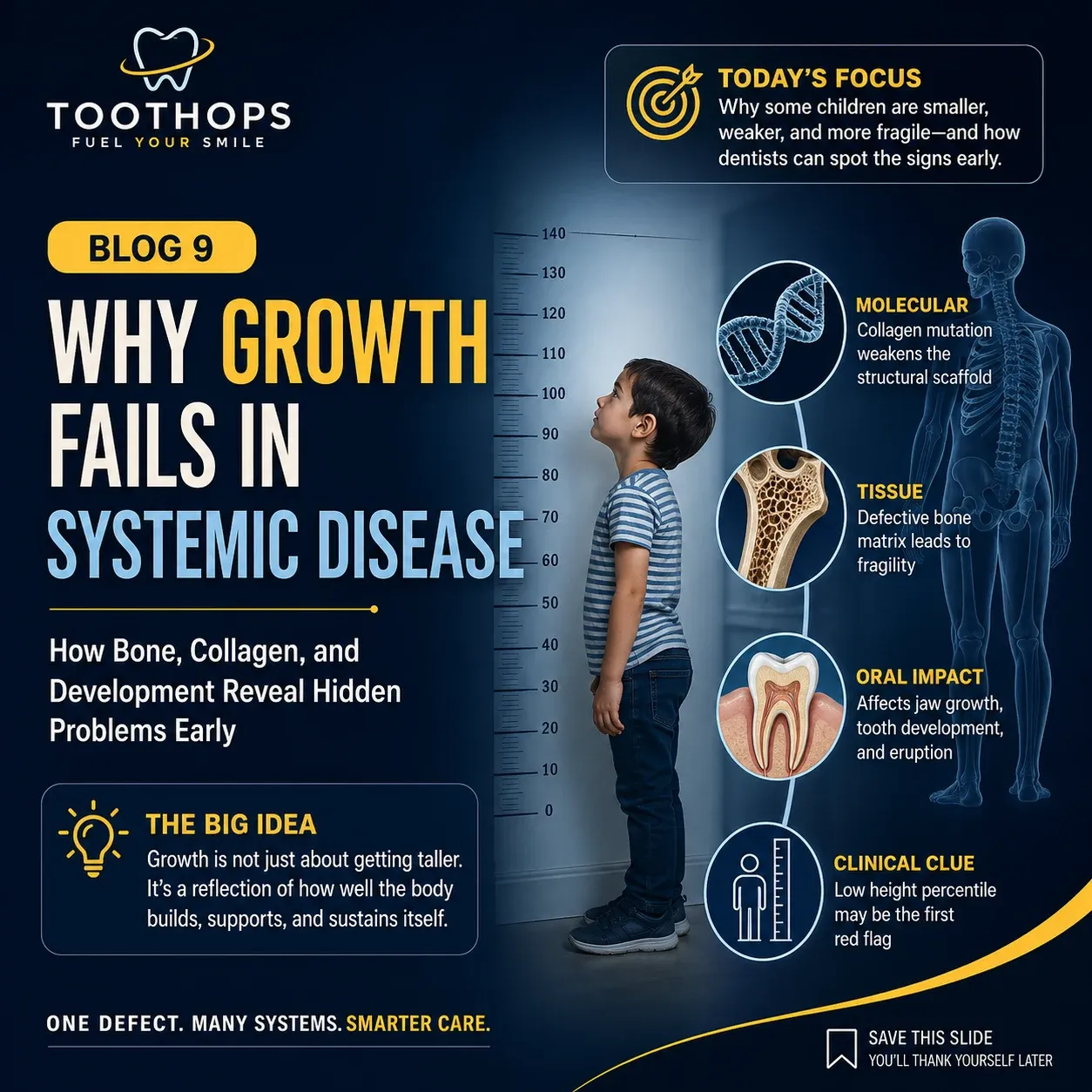
How Collagen, Bone Biology, and Development Reveal Systemic Disease Early
🧠 Start Here: The Real Question
When a child is significantly smaller than expected, the question is not simply:
“Why isn’t this child growing?”
The deeper clinical question is:
“What system is failing to support normal growth?”
Because growth is not random.
Growth reflects:
- tissue integrity
- cellular coordination
- structural stability
- metabolic support
- mechanical adaptation
When growth fails, the body is often revealing a deeper systemic problem long before a diagnosis is formally made.
⚙️ The Big Picture: Growth Is a Structural Process
Many people think growth is mainly about:
- calories
- hormones
- genetics
Those matter.
But biologically, growth depends on something even more fundamental:
👉 the ability to build stable tissue
🧠 Core Rule
Growth is not just getting bigger.Growth is the successful construction of durable biological structure.
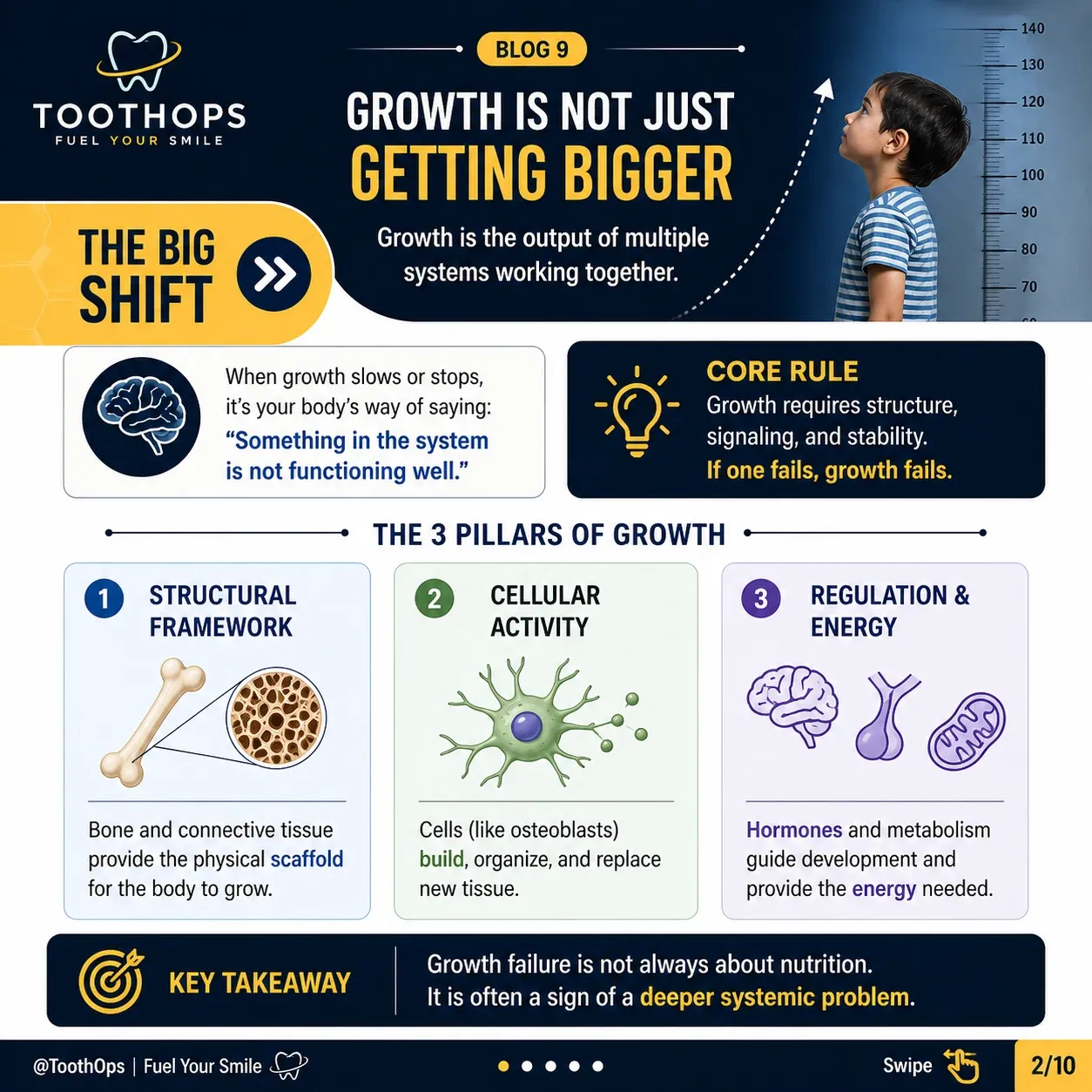
🪶 A Simple Framework for Understanding Growth
Normal development requires three major systems to work together:
| System | Function | Why It Matters |
|---|---|---|
| Structural scaffold | Provides framework for tissue formation | Bone and connective tissue must support load |
| Cellular activity | Produces and remodels tissue | Osteoblasts, chondrocytes, and osteoclasts coordinate growth |
| Metabolic & signaling regulation | Directs energy and development | Hormones, nutrition, and growth factors regulate expansion |
👉 If one system fails, growth becomes impaired.
👉 If multiple systems fail together, the body develops abnormal structure.
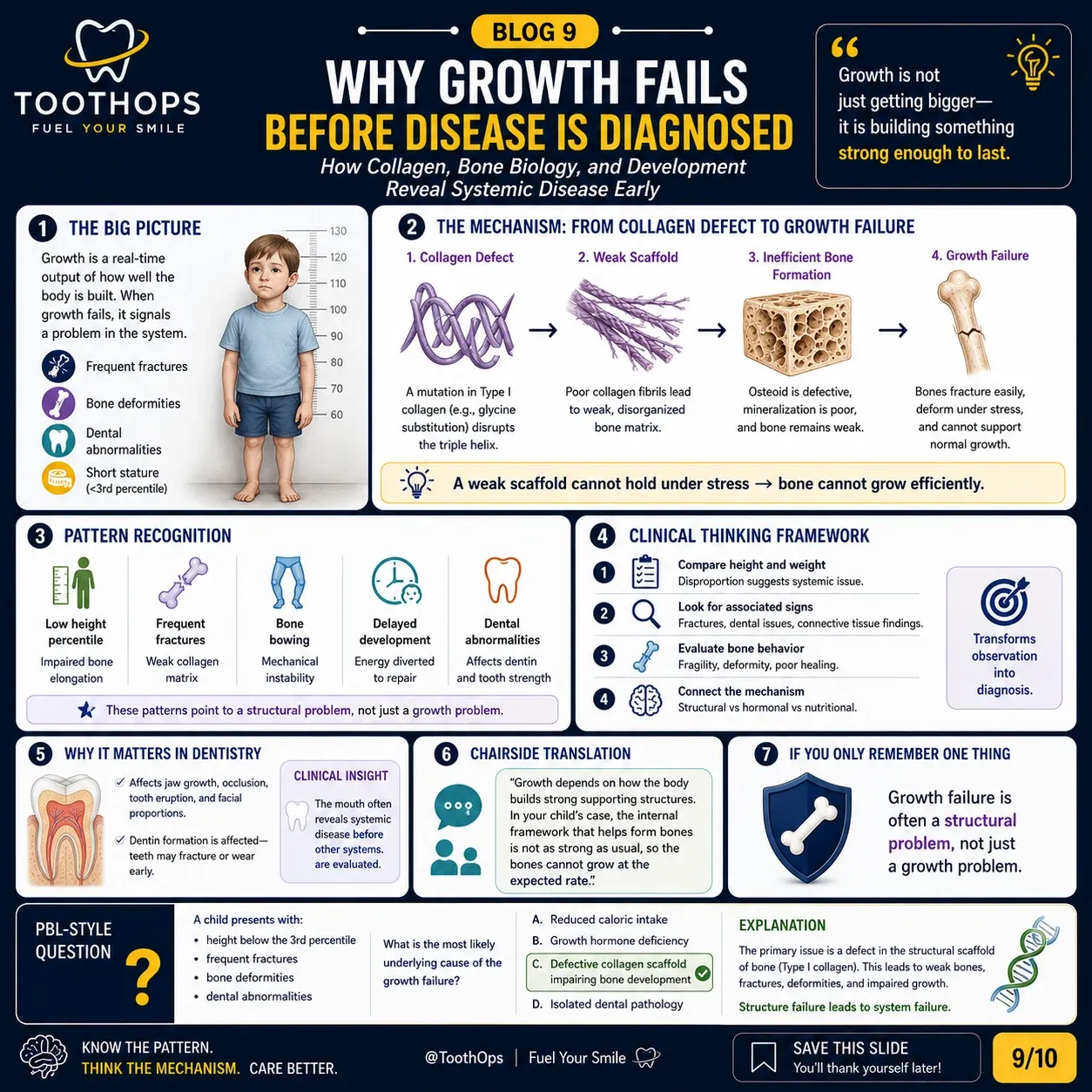
🔬 Mechanism Layer: From Molecule → Bone → Growth Failure
🧬 Type I Collagen: The Structural Backbone
Bone is not simply “hard mineral.”
It is a highly organized composite material composed primarily of:
- Type I collagen
- hydroxyapatite mineral
🧠 Mechanical Roles
| Component | Primary Function |
|---|---|
| Type I collagen | Tensile strength + flexibility |
| Hydroxyapatite | Compression resistance |
🧠 Important Insight
Mineral gives bone hardness.Collagen gives bone resilience.
Without collagen integrity:
- bone becomes brittle
- stress cannot be distributed efficiently
- fractures occur more easily
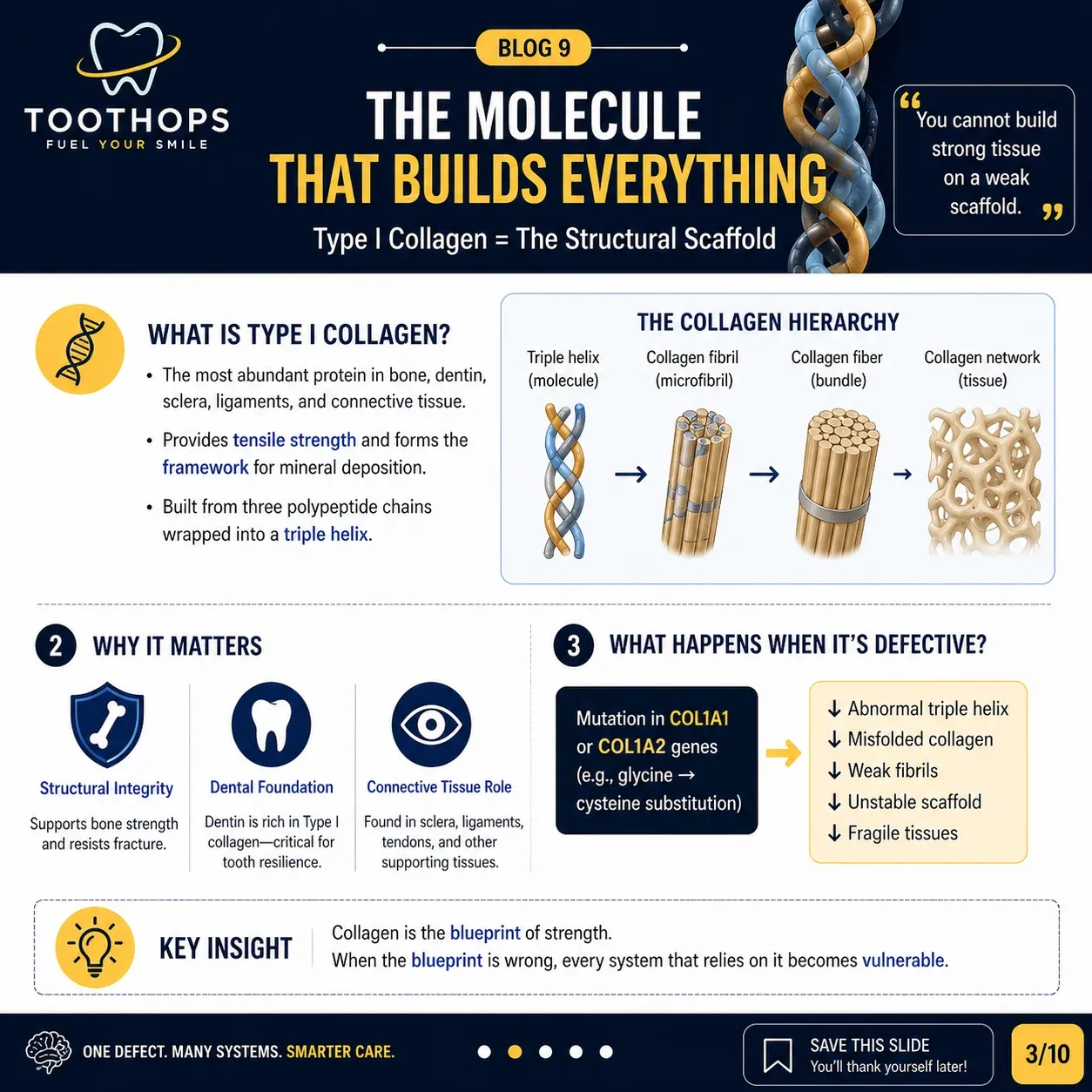
🧬 The Mutation That Changes the Entire System
In Osteogenesis Imperfecta (OI):
- glycine within the collagen triple helix is replaced by another amino acid
- the helix becomes unstable
- collagen fibrils form abnormally
🔥 Consequences
This disrupts:
- fibril organization
- cross-linking
- matrix strength
- mineral support
🧠 ToothOps Insight
You cannot build strong tissue on a weak scaffold.
🔬 Bone Formation Becomes Mechanically Inefficient
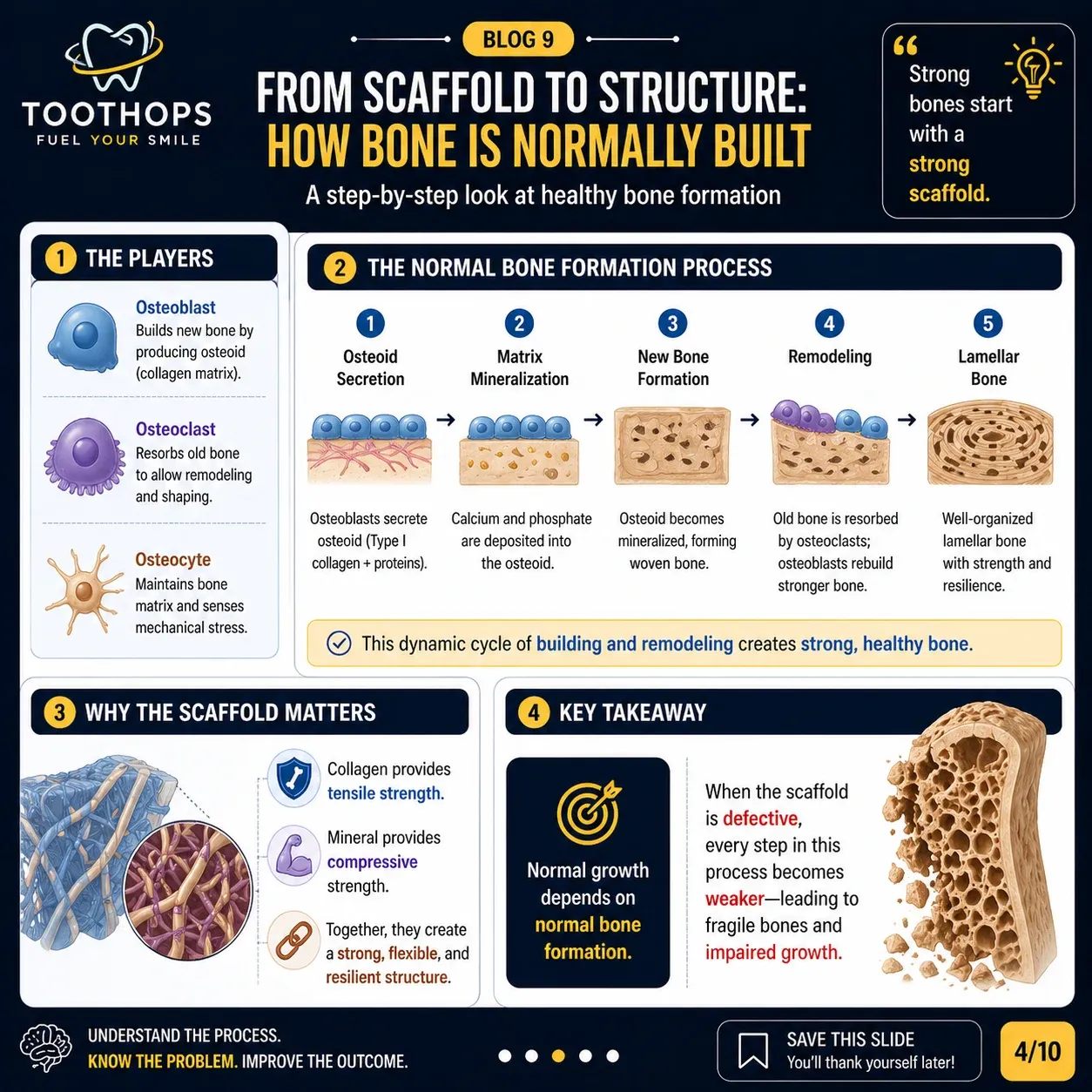
Normal bone development requires:
- osteoblasts to deposit osteoid
- collagen scaffold organization
- mineral deposition
- remodeling under stress
In OI:
- osteoid formation is defective
- mineral integration becomes unstable
- bone cannot tolerate normal mechanical loading
👉 The result:
- fractures
- bowing deformities
- impaired growth
- chronic remodeling stress
🧠 Aha Moment
Growth failure is not simply “slow growth.”
👉 It is often:
failure of tissue to maintain structural integrity during development
🔬 Advanced Mechanism: The Growth Plate Under Stress
🧠 Where Longitudinal Growth Happens
Long bones grow through the:👉 epiphyseal (growth) plate
This process depends on:
- chondrocyte proliferation
- extracellular matrix organization
- collagen support
- controlled mineralization
🧬 Growth Plate Zones
| Zone | Function |
|---|---|
| Resting zone | Stem cell reserve |
| Proliferative zone | Chondrocyte division |
| Hypertrophic zone | Cell enlargement |
| Ossification zone | Bone replacement |
🔥 What Happens in OI
Because collagen is defective:
- the scaffold becomes mechanically unstable
- microdamage accumulates
- stress distribution becomes abnormal
👉 This disrupts:
- normal elongation
- mineral organization
- load adaptation
🧠 Critical Insight
Growth is partly a mechanical process—not just a hormonal one.
📊 Pattern Recognition Table
| Finding | Mechanism | Clinical Meaning |
|---|---|---|
| Height < 3rd percentile | Impaired longitudinal bone growth | Structural/systemic disease |
| Frequent fractures | Weak collagen matrix | Mechanical fragility |
| Bone bowing | Inability to resist stress | Chronic instability |
| Delayed development | Energy diverted to repair | Reduced growth efficiency |
| Dental abnormalities | Defective dentin collagen | Multi-system involvement |
⚠️ Important Clinical Distinction
Not all growth failure comes from the same mechanism.
| Cause | Primary Problem |
|---|---|
| Malnutrition | Insufficient building materials |
| Endocrine disorders | Signaling dysfunction |
| Chronic inflammatory disease | Metabolic burden |
| Structural disorders (OI) | Scaffold failure |
🧠 Key Clinical Pattern
When:
- fractures
- dental abnormalities
- connective tissue findings
- and growth failure
occur together:
👉 think systemic structural disease
🧠 Diagnostic Thinking Framework
Step 1 — Compare Height vs Weight
Disproportionate reduction in height may suggest:
- skeletal disease
- endocrine dysfunction
- chronic structural disorder
Step 2 — Look for Systemic Clues
In this case:
- blue sclera
- dentinogenesis imperfecta
- fractures
- hearing changes
👉 One defect affecting multiple tissues suggests connective tissue pathology.
Step 3 — Evaluate Bone Behavior
Ask:
- Are fractures proportional to trauma?
- Is bone deforming under normal load?
- Are healing patterns abnormal?
Step 4 — Connect Mechanism to Pattern
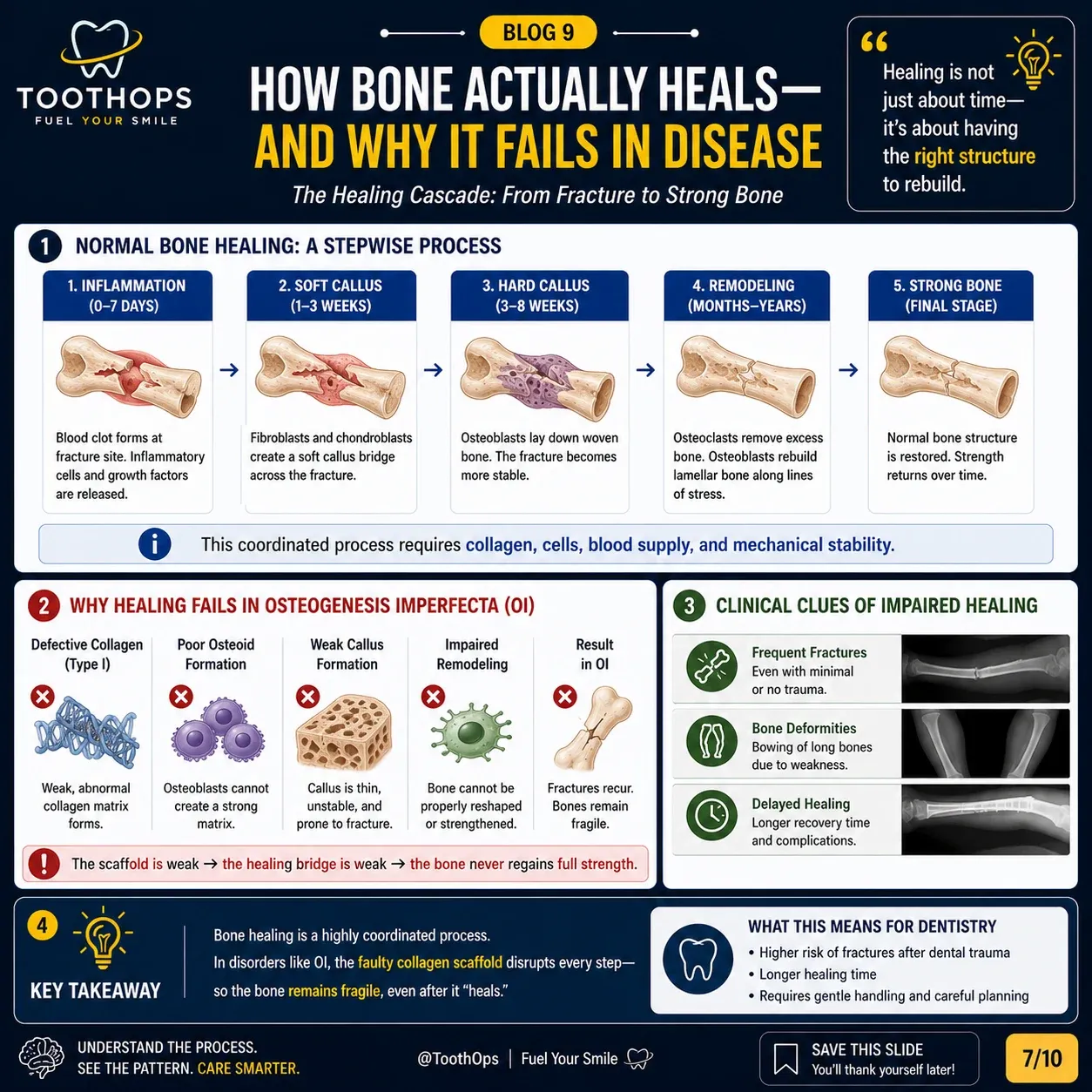
👉 collagen defect→ weak matrix→ poor biomechanics→ impaired growth
🔥 High-Yield Clinical Insight
Growth charts do not diagnose disease.They reveal biological patterns.
🦷 Dentistry Relevance: Why Dentists Should Care
Growth affects:
- jaw development
- facial proportions
- eruption timing
- occlusion
- skeletal relationships
In OI:
- dentin formation is abnormal
- tooth structure becomes fragile
- eruption and occlusion may be altered
🧠 ToothOps Clinical Insight
The mouth often reveals systemic disease before the rest of the body is fully evaluated.
💬 Chairside Translation
When parents ask:
“Why is my child not growing normally?”
A calm, accurate explanation:
“Growth depends on how the body builds strong supporting structures. In your child’s case, the internal framework that helps form bones is not as strong as usual, so the bones cannot grow and support stress the way we would normally expect.”
🧠 Why This Matters
Good explanations:
- reduce fear
- remove blame
- improve trust
- help families understand long-term care
🧠 ToothOps Insight
Growth is not just about becoming larger.It is about building something stable enough to last.
📦 If You Only Remember One Thing
👉 Growth failure is often a structural problem—not simply a growth problem.
✨ Final Takeaway
Osteogenesis Imperfecta does not just weaken bones.
It disrupts:
- structure
- mechanics
- development
- growth
👉 A single collagen defect can alter the entire developmental system.
Understanding that changes how clinicians:
- diagnose
- communicate
- and treat patients.
🧠 Question
A child presents with:
- height below the 3rd percentile
- frequent fractures
- bone bowing
- dentin abnormalities
What is the most likely underlying mechanism for the growth failure?
A. Reduced caloric intake
B. Growth hormone deficiency
C. Defective collagen scaffold impairing structural development
D. Isolated dental pathology
✅ Correct Answer: C
🧠 Explanation
The primary defect is structural.
Type I collagen forms the scaffold that supports:
- osteoid formation
- mineral organization
- mechanical stability
When collagen is defective:
- bone becomes fragile
- growth plates function abnormally
- longitudinal growth becomes impaired
Why the others are incorrect
A. Reduced caloric intake
Would typically affect weight first.
B. Growth hormone deficiency
Affects signaling—not structural integrity.
D. Isolated dental pathology
Does not explain systemic skeletal findings.
🧠 High-Yield Insight
Structure failure eventually becomes system failure.
@ToothOps | Fuel Your Smile 😊
Stay tuned for more insights and educational content in our blog.
Disclaimer: Content is for educational purposes only and not a substitute for medical or dental care.
© 2025 ToothOps | All Rights Reserved.