
🧬 Type 1 vs Type 2 Diabetes: Same Sugar, Very Different Biology
 ToothOps4 min read

When people hear “diabetes,” they often imagine a single disease with one problem: high blood sugar.In reality, Type 1 and Type 2 diabetes share a name but differ fundamentally in biology, progression, and risk.
For dental professionals and students, this distinction matters — not for labeling patients, but for understanding why some patients decompensate quickly, why others go undiagnosed for years, and how insulin pathways shape everything from wound healing to periodontal breakdown.
This post breaks down Type 1 vs Type 2 diabetes through insulin pathways, step-by-step, without drowning you in jargon.
🧠 Start With Normal: How Insulin Works in a Healthy Patient
Under normal conditions, insulin acts as the body’s master metabolic coordinator.
After a meal:
- Rising blood glucose stimulates pancreatic β-cells to release insulin
- Insulin:
- Suppresses hepatic glucose production
- Promotes glucose uptake into skeletal muscle and adipose tissue (via GLUT4 translocation)
- Encourages storage of energy as glycogen, fat, and protein
- At the same time, insulin inhibits lipolysis and proteolysis, preventing ketone formation
🧠 **Memory Anchor:**Insulin doesn’t just lower glucose — it tells the body, “We are fed. Store. Repair. Build.”
🔴 What Fails in Diabetes (The Big Picture)
In diabetes, this tightly regulated system breaks in one of two ways:
- Insulin is absent or severely reduced
- Insulin is present but ineffective
Both lead to hyperglycemia — but the downstream consequences differ dramatically.
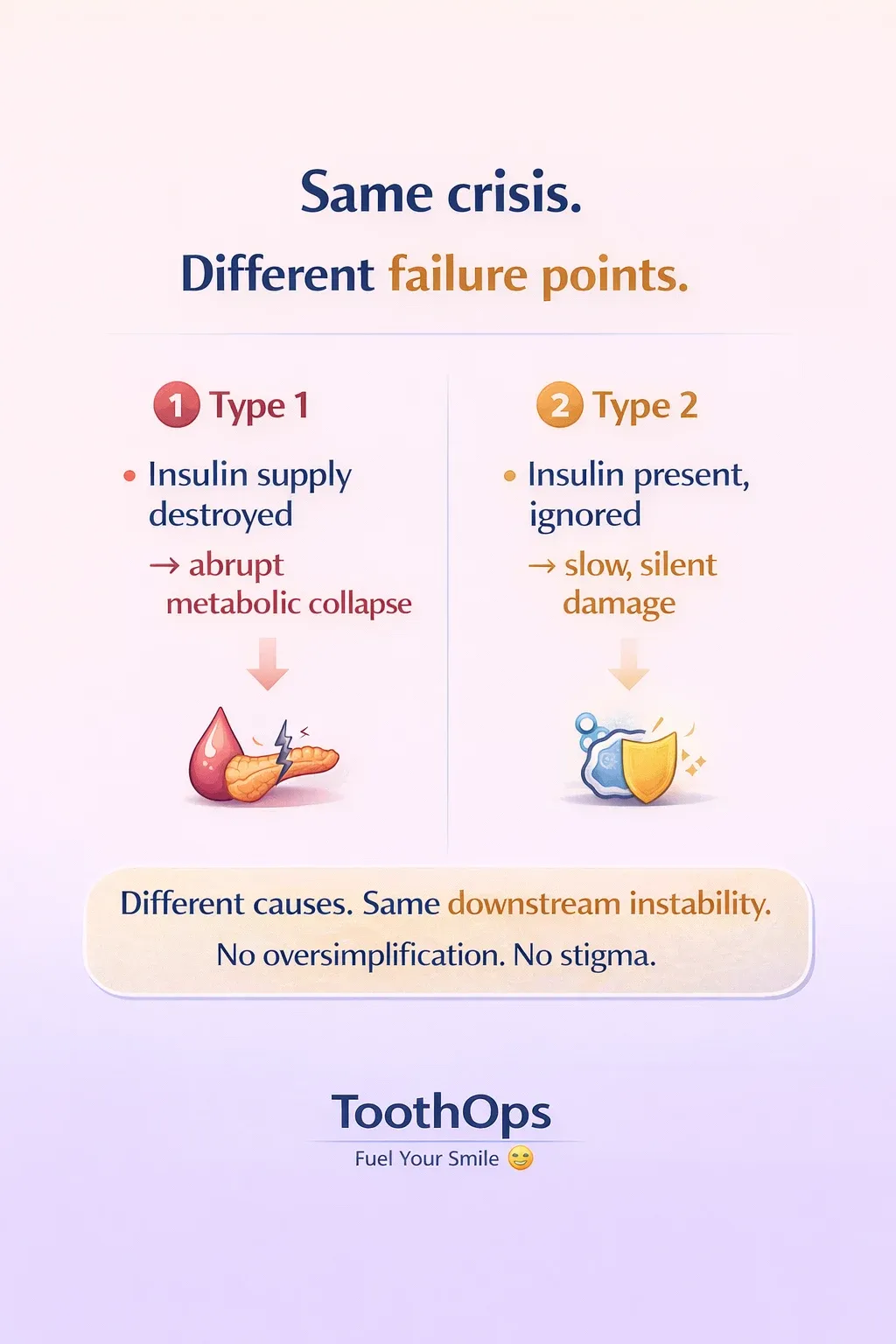
🩸 Type 1 Diabetes: When Insulin Is Gone
Type 1 diabetes results from autoimmune destruction of pancreatic β-cells, leading to absolute insulin deficiency.
There is:
- Little to no endogenous insulin
- No meaningful “backup system”
Metabolic Consequences
Without insulin:
- Glucose cannot enter insulin-dependent tissues
- Hepatic glucose production continues unchecked
- Lipolysis and proteolysis accelerate
- The liver shifts aggressively to ketone production
This creates the classic metabolic pattern:
- Rapid weight loss
- Dehydration
- Ketone accumulation
- Metabolic acidosis
Up to 25–50% of patients with Type 1 diabetes present initially in diabetic ketoacidosis, particularly during infection or stress.
🦷 Dental Relevance: Type 1 patients are more vulnerable to acute metabolic instability during illness, surgery, or infection — even when previously stable.
🟡 Type 2 Diabetes: When Insulin Can’t Do Its Job
Type 2 diabetes is driven by insulin resistance, often combined with relative insulin deficiency over time.
Early on:
- Insulin levels may be normal or elevated
- Target tissues (muscle, liver, fat) fail to respond appropriately
The pancreas compensates by producing more insulin — until it can’t.
Metabolic Consequences
- Peripheral glucose uptake is impaired
- Hepatic glucose production remains elevated
- Hyperglycemia develops gradually
- Ketone production is usually suppressed early due to residual insulin activity
This explains why:
- Many patients remain asymptomatic for years
- Diagnosis is often delayed
- Diabetes is frequently discovered during routine care or acute illness
🧠 Key Distinction: Type 2 diabetes is not “mild diabetes.”It is chronic metabolic stress with slow but progressive tissue damage.
⚖️ Side-by-Side: What Actually Differs
| Feature | Type 1 Diabetes | Type 2 Diabetes |
|---|---|---|
| Primary defect | Autoimmune β-cell destruction | Insulin resistance ± β-cell failure |
| Insulin levels | Absent or minimal | Normal → elevated → insufficient |
| Onset | Often abrupt | Gradual, insidious |
| DKA risk | High | Lower (but possible under stress) |
| Diagnosis timing | Often early | Frequently delayed |
| Common presentation | Acute symptoms | Silent progression |
🦷 The Oral-Systemic Link (Why Dentists See the Difference)
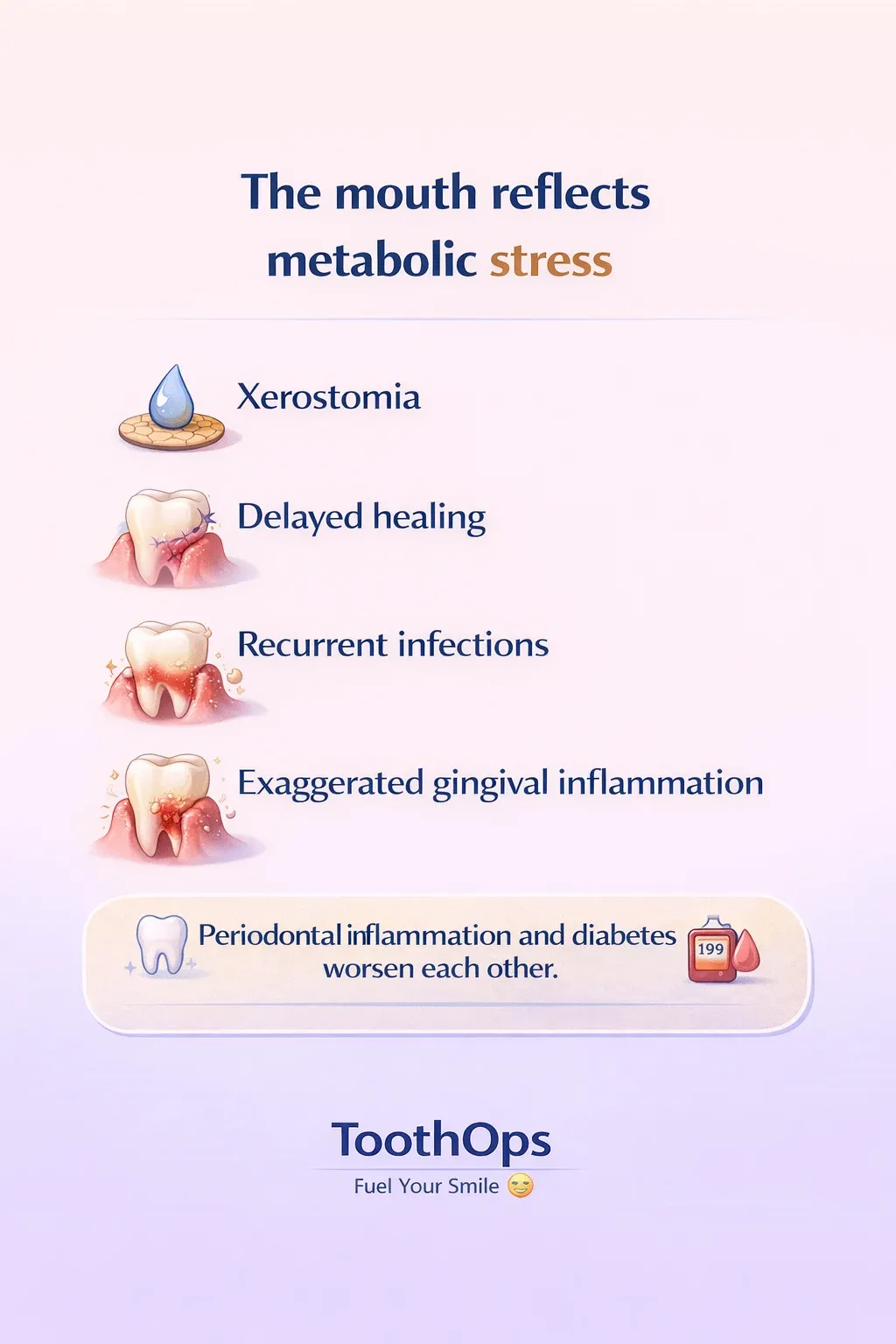
Both types affect oral health — but through shared inflammatory and vascular pathways.
Chronic hyperglycemia:
- Impairs neutrophil function
- Alters collagen turnover
- Increases pro-inflammatory mediators
- Delays wound healing
The American Dental Association recognizes diabetes as a major modifier of periodontal disease severity, with a bidirectional relationship:
- Poor glycemic control worsens periodontal inflammation
- Periodontal inflammation worsens glycemic control
💡 Clinical Insight: If periodontal breakdown seems disproportionate to plaque levels,don’t
blame hygiene alone — think metabolism.
🧠 Memory Tool: The “INSULIN” Lens
Ask one question:
Is insulin missing — or ignored?
- Missing → Type 1 physiology
- Ignored → Type 2 physiology
Everything else flows from that.
Type 1 and Type 2 diabetes share a name, but they are not interchangeable diseases. They differ in mechanism, tempo, and risk, yet converge on the same outcome: chronic hyperglycemia with systemic consequences.
For dental professionals, understanding insulin pathways transforms diabetes from a checkbox in the medical history into a predictable, biologically coherent disease — one we encounter daily, often before it is formally diagnosed.
🎯 ToothOps Microhabit
When you see a clinical sign, ask: “Is this insulin absence — or insulin resistance?” That single question reframes the entire case.
@ToothOps | Fuel Your Smile 😊
Stay tuned for more insights and educational content in our blog.
Disclaimer: Content is for educational purposes only and not a substitute for medical or dental care.
© 2025 ToothOps | All Rights Reserved