
🦷 The Silent Line: What Your Cheeks Are Trying to Tell You
 ToothOps5 min read
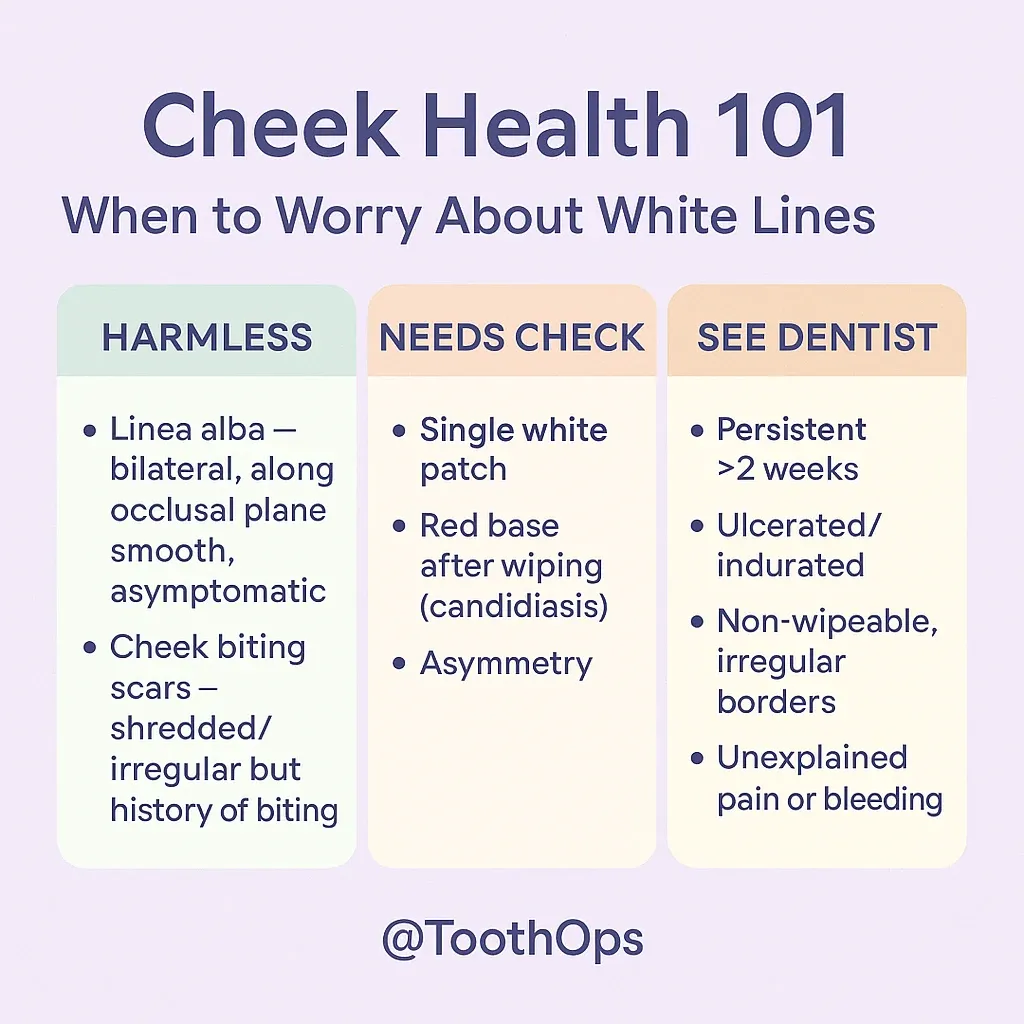
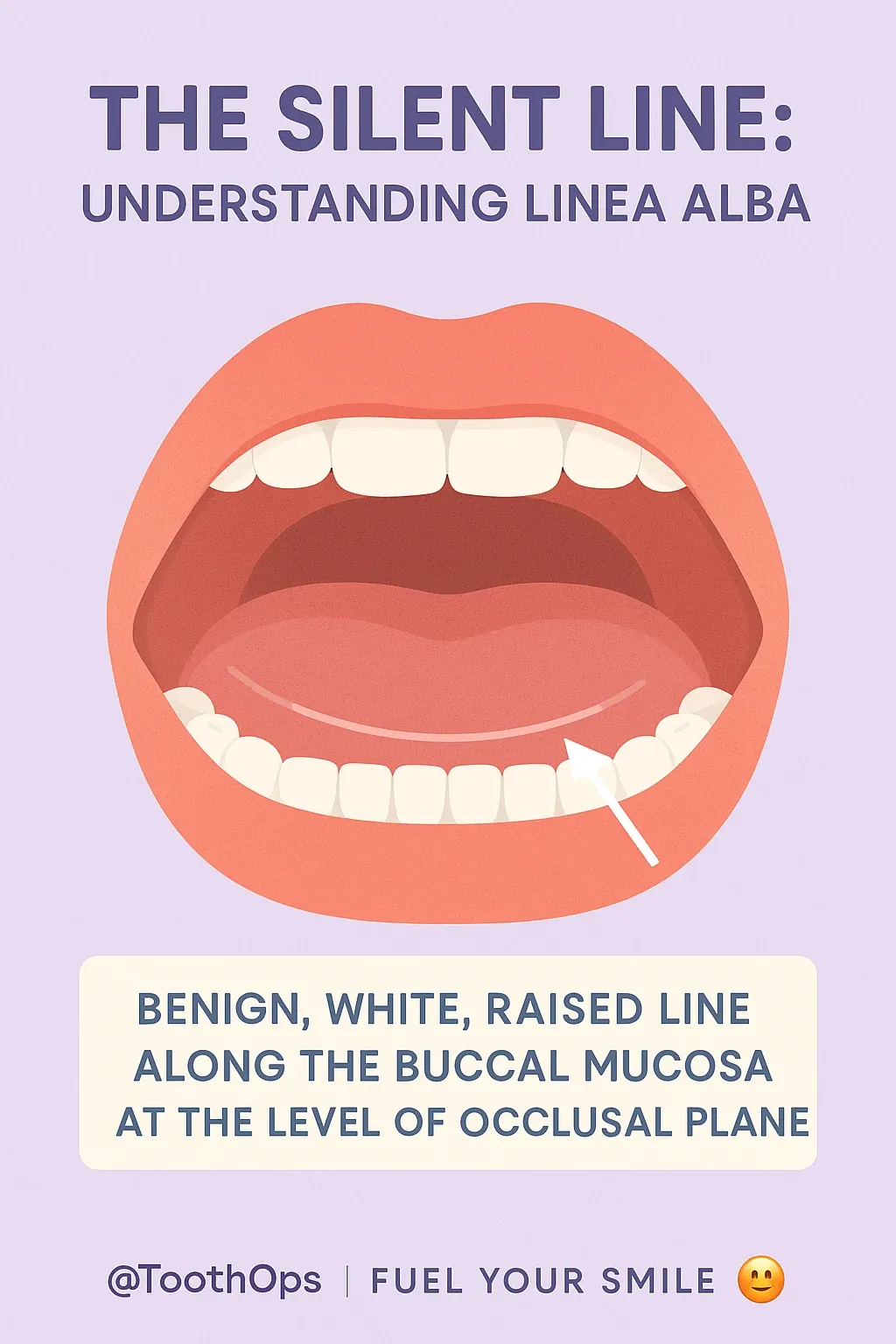
Have you ever noticed a faint white line running across the inside of your cheeks — right where your upper and lower teeth meet?No, it’s not some secret code your mouth is writing — it’s linea alba, Latin for “white line.”
And while it might look mysterious, it’s actually your body’s quiet way of saying:
“Hey, you’re putting me through a little too much friction here.”
Let’s peel back the layers of this subtle but fascinating oral clue.
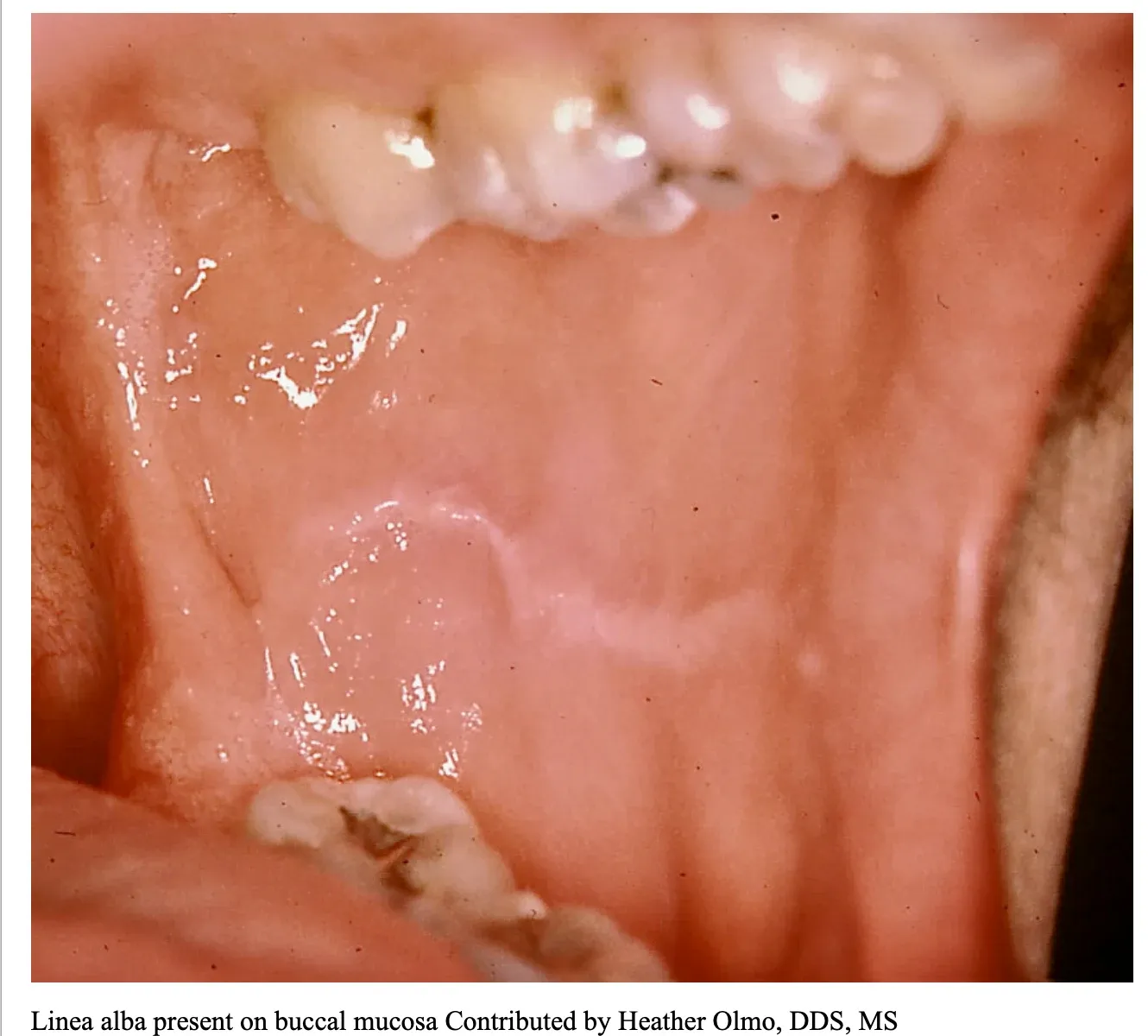
https://www.ncbi.nlm.nih.gov/books/NBK570596/figure/article-131803.image.f4/
1️⃣ What Exactly Is the Linea Alba?
Imagine wearing the same pair of shoes every day that rub the side of your foot. Eventually, your skin adapts — it thickens where it’s being rubbed.Your cheek mucosa does the same thing.
The linea alba is a benign, hyperkeratotic line that forms along the buccal mucosa at the occlusal plane — the level where your upper and lower teeth meet.In plain language: it’s a harmless buildup of keratin from repeated contact or friction between your cheek and teeth.
🧠 Think of keratin like armor plating. When there’s repeated “friction warfare,” your body lays down extra protection.
It’s usually:
- Bilateral (appearing on both cheeks)
- Smooth and raised, with a whitish hue
- Asymptomatic, meaning you don’t feel pain or discomfort
This is not an infection, not cancer, and not something you can “catch.”It’s simply your cheek’s version of a callus.
2️⃣ Why It Happens: The “Cheek Bite Chronicles”
The main culprit? Chronic mechanical irritation.
Here’s how it happens:
- You might clench or grind (bruxism), especially during stress or sleep.
- Your cheek may get sucked in slightly while chewing, especially if you’re tired or anxious.
- Sometimes, orthodontic issues (like a crossbite) or sharp restorations make that contact worse.
Over time, the constant rubbing leads your cheek epithelium to produce more keratin — a
process known as frictional keratosis.
💬 Carranza’s Clinical Periodontology (14th ed.) notes that linea alba is a common anatomic finding in both dentate and edentulous patients, with no premalignant potential.
So, if you’ve ever caught yourself gently gnawing the inside of your cheek during exams or while concentrating — congrats, you’re participating in a very human stress habit.
3️⃣ Why You Should Care (Even If It’s Harmless)
“Okay,” you might say, “so it’s harmless. Why should I care?”
Because your mouth is an amazing storyteller.Even when something isn’t dangerous, it’s still informative.
The linea alba can serve as an early biomechanical indicator of habits you might not even realize you have:
- Are you clenching or grinding your teeth subconsciously?
- Do you chew more on one side?
- Is your occlusion uneven, causing more pressure in one area?
Each cheek line is like a stress map, showing where your mouth endures repeated microtrauma. While it doesn’t require treatment, it can lead you to explore better occlusal balance, habit awareness, or even stress management — all of which contribute to long-term oral health.
🧠 If your mouth were a car, the linea alba would be the faint skid marks on the tires — not dangerous, but a hint that you might be taking the corners a little too hard.
4️⃣ Differential Diagnosis: When White Lines Aren’t So Innocent
Not every white lesion is a linea alba — and this is where dental students and clinicians sharpen their diagnostic skills.
| Condition | Description | Distinguishing Feature |
|---|---|---|
| Linea Alba | White line at occlusal plane | Bilateral, frictional, smooth |
| Leukoplakia | White patch of unknown cause, possibly dysplastic | Irregular, may not wipe off, unilateral |
| Lichen Planus | Immune-mediated lesion | Wickham’s striae (lacy pattern) |
| Cheek Chewing (Morsicatio Buccarum) | Ragged white tissue, often tender | Rough, irregular surface |
| Candidiasis (Chronic) | Fungal infection | May wipe off, red base underneath |
💡 **Pro Tip:**If it’s bilateral, straight, smooth, and matches your bite line, it’s most likely linea alba.If it’s irregular, ulcerated, or isolated, refer for further evaluation — sometimes, a biopsy is the only way to rule out pathology.
5️⃣ The Psychology of the Cheek Bite
Here’s something fascinating: the linea alba doesn’t just tell a physical story — it can hint at psychological patternstoo.
Mild cheek biting or clenching is often a stress-related parafunctional habit.According to behavioral dentistry research, microtraumas in the buccal mucosa correlate with moments of high concentration or anxiety.
It’s like your mouth’s version of tapping your foot or clicking your pen — except it leaves a trace.
If you notice that you’re developing a more pronounced linea alba during exam season, high-stress work periods, or even gaming marathons — it may be your cue to unclench, breathe, and reset.
💡 **Pro Tip:**Try “jaw mindfulness” — take a few seconds each hour to notice if your teeth are touching. They shouldn’t be!Your jaw should rest slightly apart with relaxed muscles — what dentists call the physiologic rest position.
6️⃣ Prevention and Management: Calm Your Cheeks
Although linea alba doesn’t require treatment, managing the underlying habits keeps your mouth happier overall.
Tips to reduce friction:
- Avoid cheek chewing. If it’s an anxious habit, consider sugar-free gum as a redirection tool.
- Review your bite. Ask your dentist to evaluate for occlusal interferences or sharp restorations.
- If you grind your teeth, especially at night, a nightguard can reduce friction and pressure.
- Stay hydrated. Dry mucosa increases friction; saliva helps lubricate and heal tissues.
- Stress reduction. Meditation, exercise, or mindfulness can reduce clenching habits.
💬 According to the ADA and Gehrig’s Fundamentals of Periodontal Instrumentation, maintaining healthy soft tissues involves minimizing mechanical trauma and keeping mucosa moist and clean.
7️⃣ Myth Busting:
🚫 “Linea alba means I have oral cancer.” → False. It’s benign keratosis.
🚫 “It’ll go away only if I scrub it.” → False. Friction reduction, not abrasion, helps.
🚫 “It’s an infection.” → Nope. It’s your own tissue adapting.
8️⃣ Fun Fact: The Linea Alba Evolution
Even edentulous patients (those without teeth) can have a mild linea alba if their denture flanges or cheek movementsrepeatedly contact the mucosa.So yes — even without teeth, your cheeks still remember the rhythm of old habits.
🩵 Final Takeaway
Your mouth is a mirror — not just of your health, but of your habits.The linea alba is your cheek’s soft whisper reminding you:
“Ease up — I’ve got your back, but let’s stop rubbing shoulders so hard.”
It’s harmless, common, and completely reversible once friction or clenching subsides.And while it may never make headlines like cavities or whitening trends, it’s a beautiful example of how even the tiniest features in the oral cavity reveal your body’s resilience.
So the next time you notice that faint white line, smile — your mouth just left you a gentle post-it note.
@ToothOps | Fuel Your Smile 😊
Stay tuned for more insights and educational content in our blog.
Disclaimer: Content is for educational purposes only and not a substitute for medical or dental care.
© 2025 ToothOps | All Rights Reserved