
🧠 Inflammation: How Does Your Body Turn Chaos into Healing?
 ToothOps3 min read
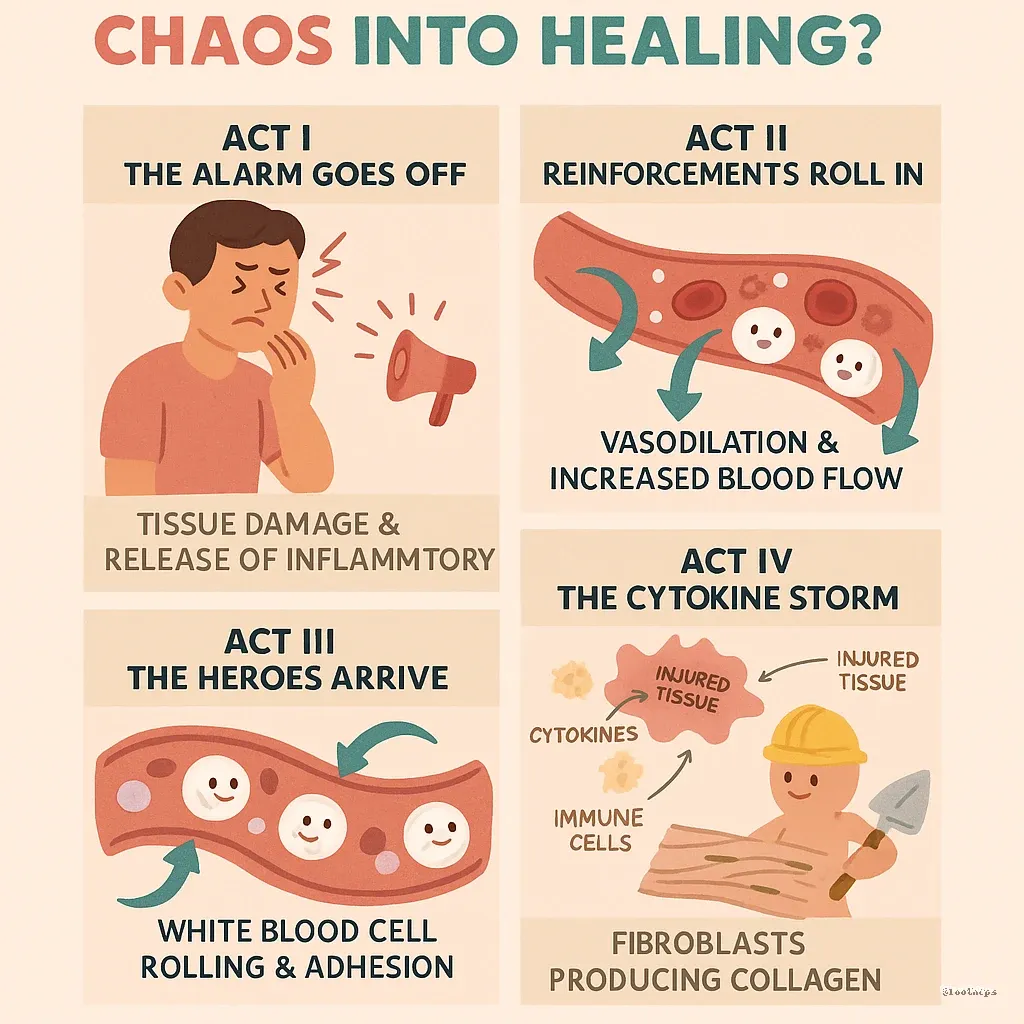
When we think of inflammation, we usually picture redness, swelling, and pain. But beneath the surface, it’s one of the most impressive rescue operations in human biology — a cinematic process where chaos turns into coordination, and destruction leads to repair.
Let’s roll the reel. 🎥
🎬 ACT I: The Alarm Goes Off
You’re living your best life — brushing, flossing, thriving — and then bam: you bite your cheek or nick your gum. Cue the dramatic soundtrack.
Your body doesn’t shrug it off. It launches a full-scale tactical response. Damaged cells release alarm molecules called DAMPs (damage-associated molecular patterns) that alert immune sentinels. Within minutes, chemical flares — histamine, prostaglandins, bradykinin — signal vasodilation and attract the immune cavalry.
📚 Research note: Within hours, inflammatory markers like C-reactive protein (CRP) and interleukin-6 (IL-6) can spike more than 300 %, showing just how fast this internal alert system fires.
🩸 ACT II: Reinforcements Roll In
Welcome to vasodilation, the “open-the-floodgates” scene. Blood vessels widen, sending an oxygen- and nutrient-rich surge to the injured site.
That’s why it’s red and warm — not infection yet, just strategic overdelivery. Endothelial cells loosen up, letting plasma and immune proteins leak out to form the first defensive barrier.
📚 In studies, localized blood flow can rise by up to 60 % during early inflammation — proof that your micro-circulation is working overtime.
🦠 ACT III: The Heroes Arrive — White Blood Cells
Enter the stars of the show: neutrophils and macrophages — your body’s SWAT team and cleanup crew.
They don’t just float in randomly; they follow a precise choreography known as leukocyte extravasation:
Margination → Rolling → Adhesion → Diapedesis → Chemotaxis.
Think of neutrophils rolling along blood-vessel walls like tactical vehicles easing into position before a raid. Once inside, they neutralize bacteria, clear debris, and prevent infection from spreading.
📚 Clinical relevance: Roughly 80 % of circulating neutrophils can mobilize to an injured site within hours — one reason dental swelling peaks around day 1–2 after surgery.
⚔️ ACT IV: The Cytokine Storm
Now the fight scene: a cytokine storm — not always bad, but always busy.Cytokines like IL-1, TNF-α, and IL-8 work as encrypted messages between immune cells, amplifying defenses and recruiting reinforcements.
Balance is everything:
- Too little signaling → infection lingers.
- Too much → chronic inflammation or tissue damage.
📚 Fact check: Controlled cytokine release can increase immune activity up to 200 %, but unchecked storms are implicated in autoimmune and periodontal disease.
🧱 ACT V: The Construction Crew Moves In
Once the smoke clears, fibroblasts arrive — your body’s construction engineers. They lay down collagen (mostly type III first, later replaced by type I) and rebuild the extracellular matrix.
Think of it as turning a battlefield into a building site.This is the proliferative phase of wound healing — new tissue, new blood vessels (angiogenesis), and gradual restoration of structure.
💡 Fun fact: Proper collagen cross-linking can boost tissue tensile strength by nearly 40 %, giving healed tissue better resilience.
🌤️ ACT VI: Resolution — Mission Complete
As the area stabilizes, macrophages flip roles — from fighters to peacekeepers. They clear out spent immune cells, release IL-10 and TGF-β, and signal fibroblasts to slow down.
Roughly 90 % of inflammatory cells withdraw once the job is done. Swelling fades, pain subsides, and tissue balance (homeostasis) returns.
Inflammation wasn’t the problem; it was the plan.
🧠 ToothOps Tip: Your Body’s Crisis-Management Team
Next time your gums swell after scaling or your cheek feels sore post-procedure, don’t panic.Imagine your immune system running a well-coordinated military op — detect, defend, rebuild, retire.
Inflammation isn’t the enemy.It’s your body’s way of saying: “We’ve got this.” 💪
💬 Final Takeaway
Your body executes this entire operation within hours — a flawless example of discipline, communication, and recovery.
So the next time you notice redness, warmth, or swelling, see it for what it is:
A heroic story of biology turning chaos into healing.
🎥 Roll credits.🎵 “Stayin’ Alive” plays softly in the background.
✍️Turning complex science into stories that stick (and smile). 😎
Follow @ToothOps for more bite-sized lessons on healing, dentistry, and the science behind your smile.
Stay tuned for more insights and educational content in our blog.
Disclaimer: Content is for educational purposes only and not a substitute for medical or dental care.
© 2025 ToothOps | All Rights Reserved
@ToothOps | Fuel Your Smile 😊