
🦷 Essential Guide to Lymph Nodes of the Head and Neck for Dental Students
 ToothOps4 min read
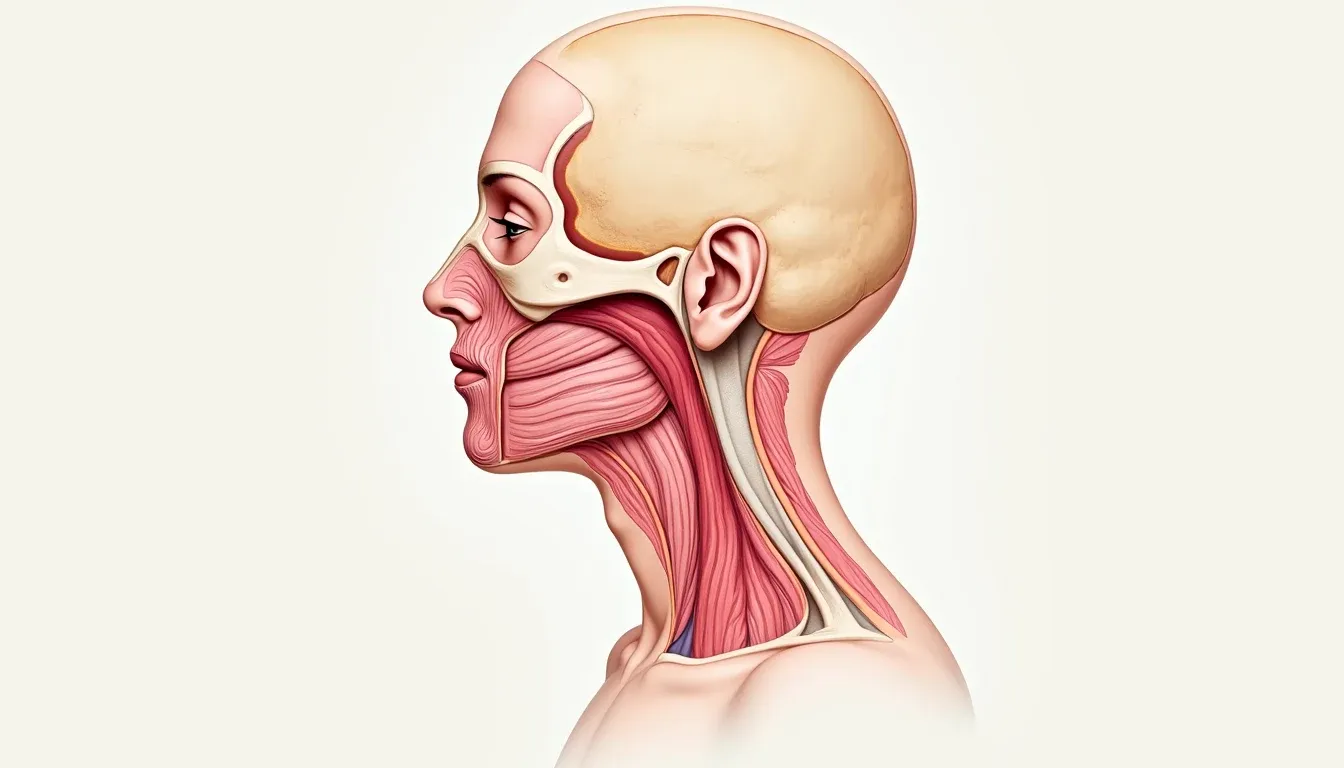
Understanding the anatomy of the lymphatic system is essential for dental students and professionals. The lymph nodes of the head and neck are crucial for the immune response and serve as key indicators for diagnosing various conditions. This guide offers an educational overview of the lymph nodes in this region, highlighting their locations, functions, and drainage pathways.
💡 Why Lymph Nodes Matter in Dentistry
The lymph nodes of the head and neck are more than just anatomy checkboxes — they are clinical beacons that reveal infection, inflammation, or malignancy long before symptoms appear elsewhere.For dental students and clinicians, mastering lymphatic anatomy bridges textbook learning and real-world diagnostic insight.
In short: Lymph nodes tell a story — you just need to know how to listen.
🔬 Understanding the Lymphatic System in Context
Lymph nodes are small, bean-shaped immune filters that trap pathogens, toxins, and cancer cells.They connect through an intricate network of lymphatic vessels that drain excess tissue fluid and return it to circulation.When infection or inflammation occurs, these nodes often swell, harden, or become tender, providing valuable clues during extra-oral examinations.
🧠 The Importance of Lymph Nodes in Dental Practice
🦠 1. Diagnosis of Oral and Systemic Diseases
Swollen nodes can indicate dental abscesses, gingival infections, tonsillitis, or even oral cancer.Example: a tender submandibular node may reflect an infection from a lower molar or the floor of the mouth.
🩺 2. Treatment and Surgical Planning
Understanding lymphatic drainage patterns is vital in oncologic and oral surgery.In oral cancer, knowing which cervical nodes are affected helps determine tumor stage, surgical extent, and prognosis.
💬 3. Patient Education and Trust
Explaining to patients that “swollen glands” are actually lymph nodes fighting infection empowers them to seek care early — reinforcing your credibility as a clinician.
📍 Lymph Node Regions of the Head and Neck
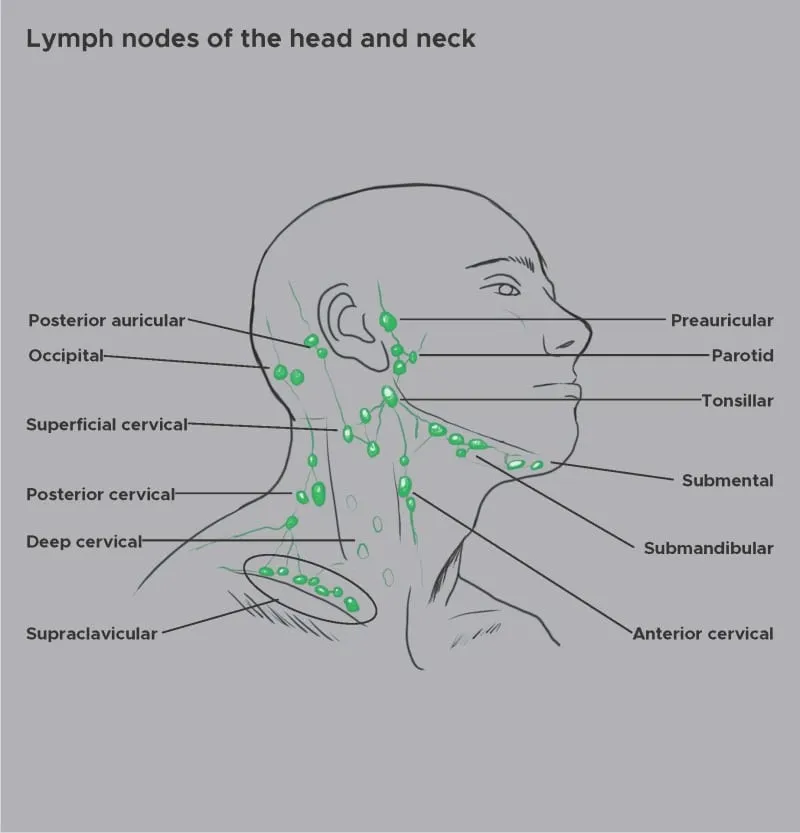
https://www.ncbi.nlm.nih.gov/books/NBK544300/figure/article-32309.image.f1/
| Node Group | Location | Drains | Clinical Relevance |
|---|---|---|---|
| Submental | Beneath the chin, between anterior digastric bellies | Lower lip (midline), floor of mouth, tip of tongue | Early sign of anterior oral infections or trauma |
| Submandibular | Along lower border of mandible | Cheeks, lips, maxillary & mandibular teeth (except 3rd molars) | Commonly palpable with dental abscesses or periodontal disease |
| Parotid | Over & within parotid gland | Lateral face, scalp, external ear | Enlarged in parotitis or skin lesions |
| Preauricular | In front of ear | Eyelids, temporal scalp, external auditory canal | Swollen with conjunctivitis or otitis externa |
| Postauricular | Behind ear, over mastoid process | Posterior scalp, auricle | Enlarged in scalp infections |
| Occipital | Base of skull | Posterior scalp & neck | Indicator for scalp infections or seborrheic dermatitis |
| Superficial Cervical | Along external jugular vein | Skin & muscles of neck | Visible in generalized lymphadenopathy |
| Deep Cervical (Jugulodigastric & Jugulo-omohyoid) | Along internal jugular vein beneath SCM | Tongue, tonsils, pharynx, thyroid | Primary drainage for oropharyngeal cancers |
| Supraclavicular | Above clavicle | Thorax & abdomen | Left node (Virchow’s) = red flag for metastasis |
✋ How to Palpate Like a Pro
“Gentle, systematic, and symmetrical”
Technique:
- Seat patient upright, head relaxed.
- Use pads of index and middle fingers in gentle circular motion.
- Palpate bilaterally to compare symmetry.
- Move sequentially: Occipital → Postauricular → Preauricular → Submandibular → Submental → Cervical → Supraclavicular.
- Note size, consistency, mobility, tenderness, and fixation.
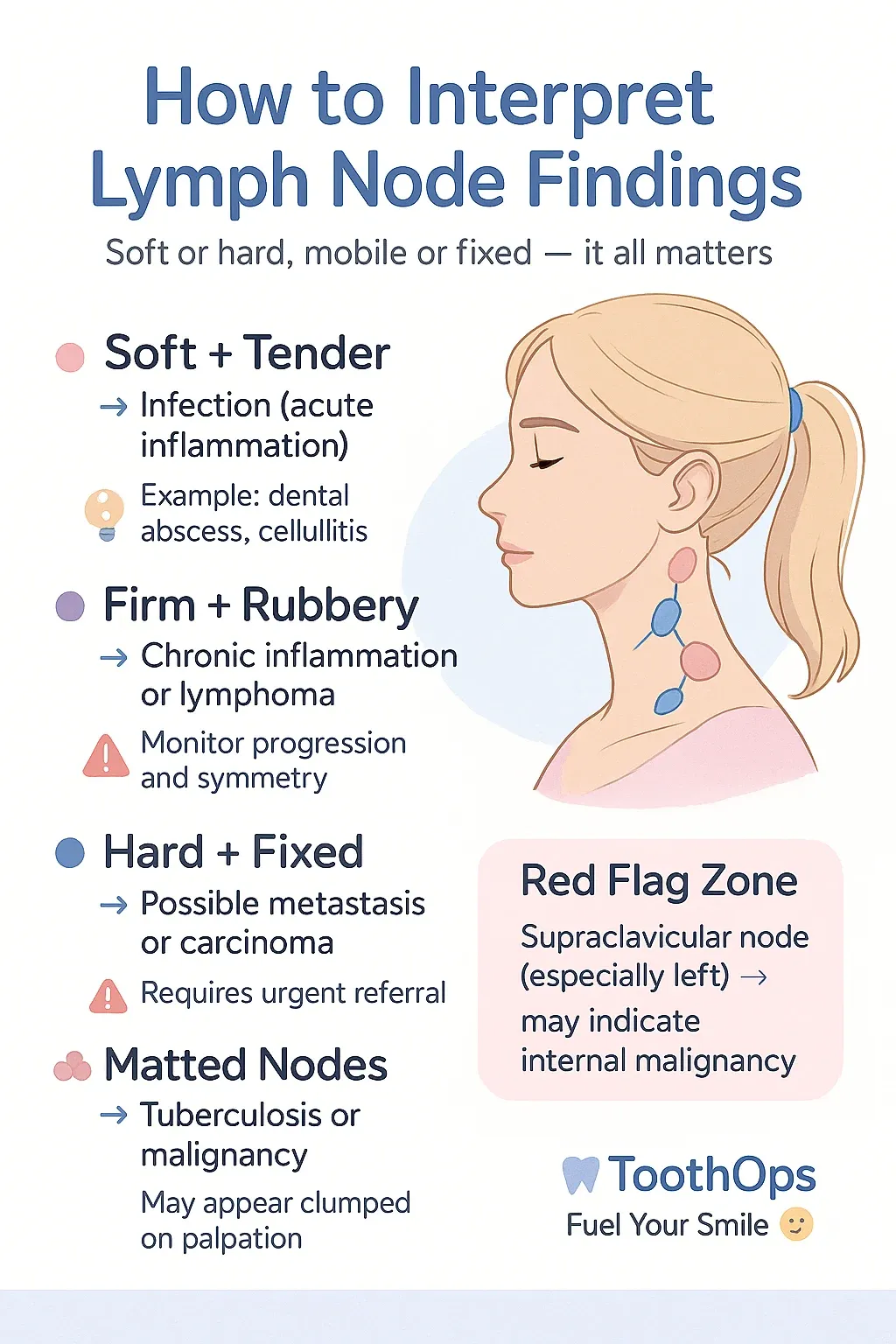
- Soft + tender = infection
- Hard + fixed = malignancy
- Firm + rubbery = chronic inflammation or lymphoma
Tip for dental exams: Always palpate before intra-oral inspection — swelling can guide where pathology originates.
🔄 Lymphatic Drainage in Dentistry
Oral Cavity → Submental & Submandibular Nodes → Deep Cervical Nodes
- Mandibular incisors & tip of tongue → Submental nodes
- Canines, premolars, anterior tongue → Submandibular nodes
- Posterior tongue, oropharynx → Deep cervical chain
- Maxillary 3rd molars → Deep cervical or retropharyngeal nodes
🧭 Remember: “Anterior drains anterior, posterior drains deep.”
🩸 Clinical Relevance in Dentistry
🔹 Infections
- Dental abscess → Submandibular/Submental
- Tonsillitis → Jugulodigastric
- Facial cellulitis → Multiple contiguous nodes
🔹 Malignancy
- Hard, non-tender, immobile node = Possible metastasis
- Cervical node involvement in oral SCC dramatically impacts survival rate.
🔹 Systemic Disease
- Generalized node enlargement = viral (e.g., mononucleosis) or hematologic disease (e.g., leukemia, lymphoma).
🔹 Surgical Awareness
- Know node pathways during flap design, biopsies, or implant procedures to prevent inadvertent lymphatic disruption.
🧭 Key Takeaways
✅ Palpate systematically — every patient, every exam.
✅ Tender = infection, hard = malignancy.
✅ Understand drainage to pinpoint infection origins.
✅ Document findings precisely — size, mobility, tenderness, location.
✅ When in doubt, refer for biopsy or imaging.
💬 ToothOps Motivation
“Every successful diagnosis starts with curiosity — your fingertips are your first diagnostic instrument. Keep learning. Keep feeling. Keep fueling your smile.” 💙
By mastering the anatomy and function of the lymph nodes, you will be better equipped to recognize and address potential health issues in your patients.
Knowledge is power, and in dentistry, it truly fuels your ability to care for others!
@ToothOps | Fuel Your Smile 😊 — Knowledge That Shapes Clinical Confidence!
Disclaimer: Views are personal and do not represent any institution or government agency. Content is for educational purposes only and not a substitute for professional diagnosis or treatment.
© 2025 ToothOps. All Rights Reserved.