
🧵 Collagen Chronicles: The Body’s Dental Scaffold
 ToothOps4 min read
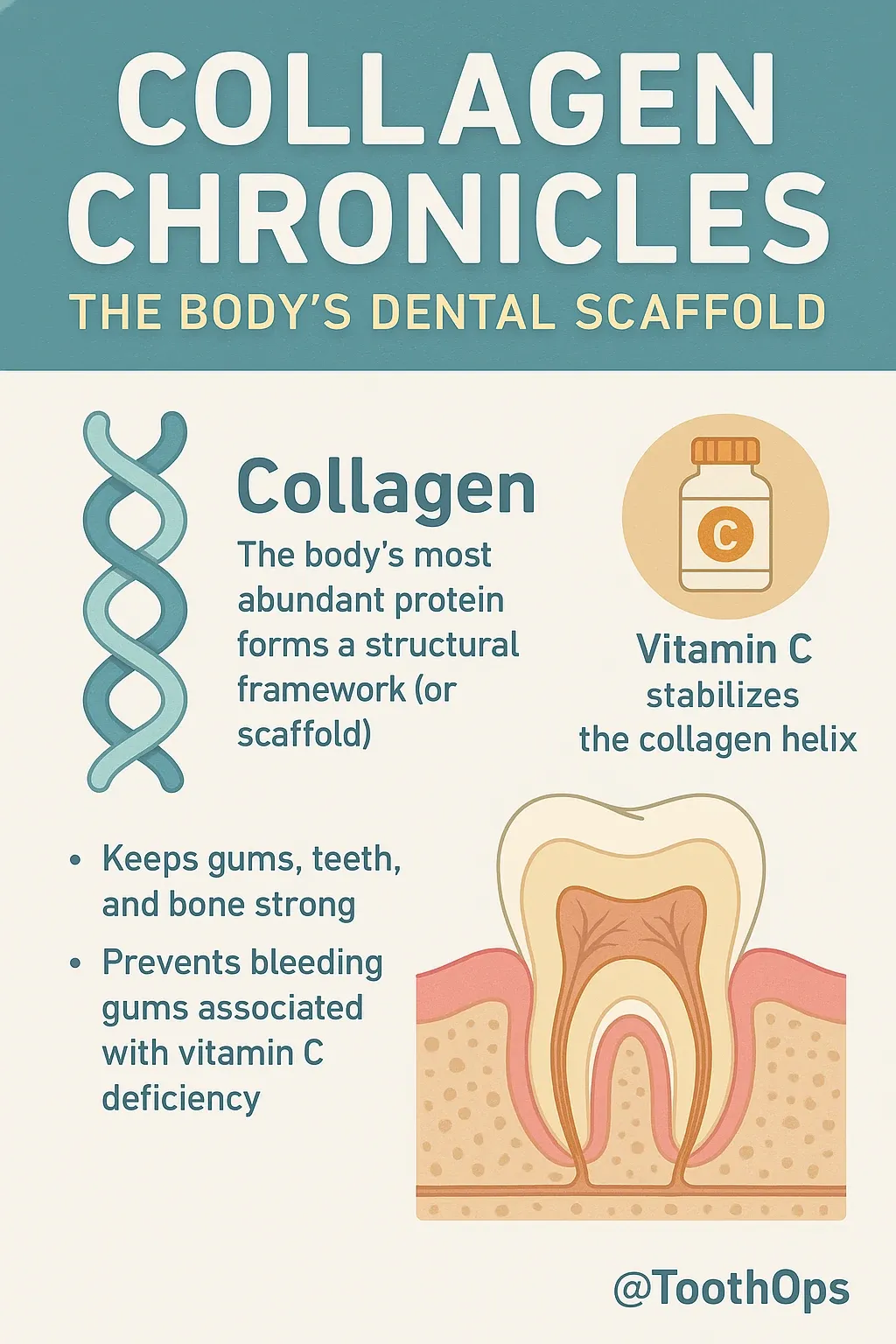
Why does vitamin C deficiency make your gums bleed? Let’s unravel the science.
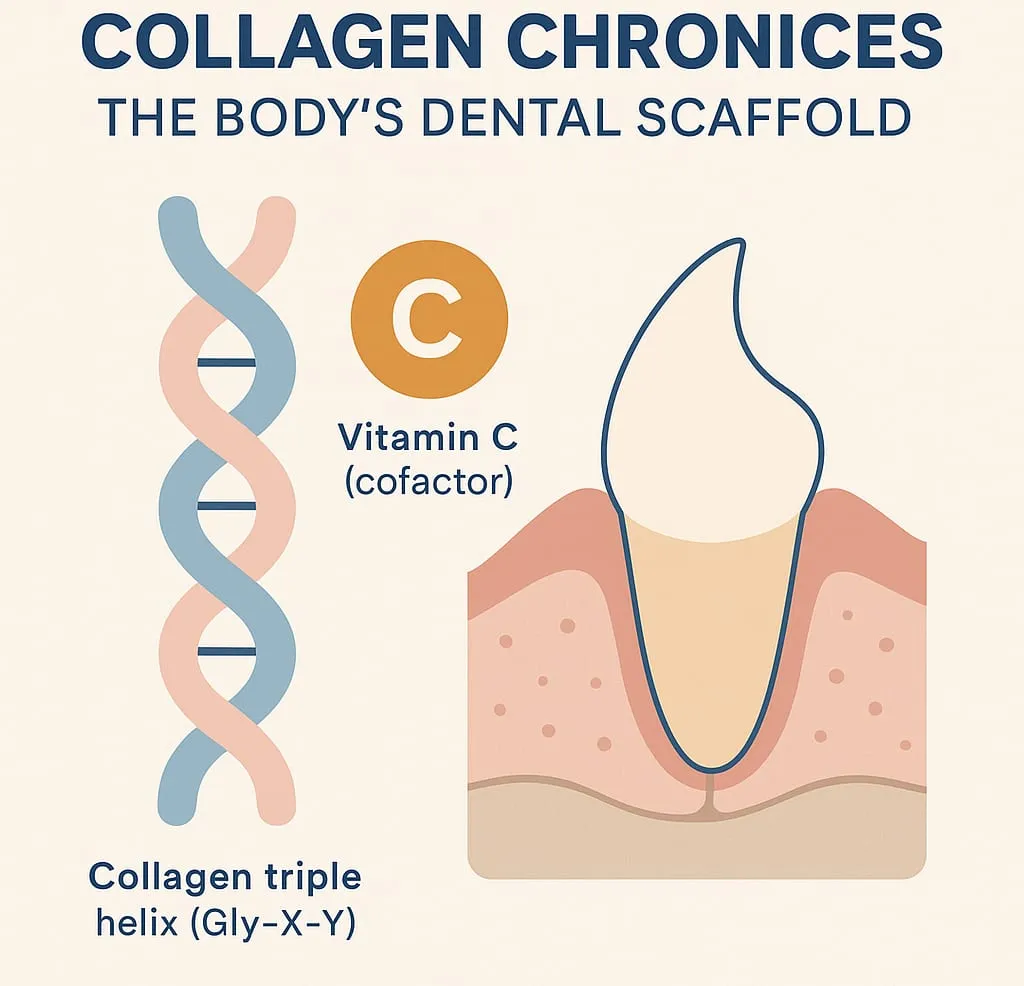
🧠 If your gums start bleeding when you brush, it’s not just about flossing habits — it could be a biochemical SOS.
The culprit? A breakdown in your body’s most important structural protein: collagen.
Collagen is everywhere — in your skin, tendons, gums, ligaments, bone, and even the tiny periodontal fibers that keep your teeth anchored.
When collagen fails, tissues weaken, wounds reopen, and yes — gums bleed.So let’s dive into how collagen works, why vitamin C is its best friend, and why your smile literally depends on it.
🧩 What Is Collagen, Really?
Collagen is the body’s most abundant protein, making up about 30% of all protein content in humans.It forms the structural framework — the scaffold — for connective tissues, including gingiva, periodontal ligaments (PDL), bone, and dentin.
At the molecular level, collagen is built from three long chains (called α-chains) twisted together like a triple helix — imagine three ropes braided into one.Each chain follows a repeating amino acid pattern:
Gly–X–Ywhere X is usually proline and Y is either hydroxyproline or hydroxylysine.
This pattern gives collagen its tight, stable structure — but here’s the twist: it doesn’t form properly without vitamin C.
🔬 Why Vitamin C Is the Unsung Hero
Vitamin C (ascorbic acid) acts as a cofactor for the enzymes prolyl hydroxylase and lysyl hydroxylase, which add hydroxyl groups (–OH) to proline and lysine.This process — called hydroxylation — allows collagen strands to form hydrogen bonds that stabilize the triple helix.
No vitamin C → no hydroxylation → unstable collagen → tissue breakdown.
📚 Fun fact: Without proper hydroxylation, collagen unravels at body temperature — literally melting like a broken zipper.
That’s why vitamin C deficiency (scurvy) leads to:
- Weak blood vessel walls → easy bruising
- Poor wound healing
- Swollen, bleeding gums
- Tooth mobility and loss (due to PDL breakdown)
🦷 Collagen in Dentistry — Why It Matters
In the mouth, collagen keeps everything connected:
| Tissue | Type of Collagen | Function |
|---|---|---|
| Gingiva | Type I & III | Structural support + tensile strength |
| PDL | Type I, III, XII | Anchors tooth to alveolar bone |
| Cementum | Type I | Interface between root and PDL |
| Dentin | Type I | Strengthens the tooth’s internal matrix |
| Bone | Type I | Framework for mineral deposition (hydroxyapatite) |
If collagen breaks down — whether from scurvy, chronic inflammation, or poor wound healing — gingival tissue loses integrity, leading to pocketing, bleeding, and mobility.
In short: healthy collagen = healthy attachment.
🩹 Collagen and Wound Healing
After dental surgery or injury, fibroblasts migrate into the wound site and start pumping out new collagen fibers.These fibers form a granulation tissue matrix, allowing new cells and capillaries to grow.
During healing:
- Fibroblasts produce type III collagen (immature scaffold).
- Over time, it’s replaced by stronger type I collagen.
- Vitamin C, zinc, copper, and iron are essential cofactors in this remodeling phase.
A deficiency in any of these nutrients slows recovery — which is why nutrition plays such a vital role in oral surgery outcomes.
💪 Hydroxyproline: The Unsung Hero
Meet hydroxyproline, the quiet MVP of your connective tissues.It’s unique to collagen — so much so that measuring hydroxyproline levels in the blood or urine can estimate total body collagen turnover.
Without it, collagen loses its triple-helix stability, and your tissues — from skin to gums — lose elasticity and strength.
🧠 Mnemonic: “No hydroxyproline, no hold.”
🧠 ToothOps Tip
“Collagen is your body’s rebar — without it, your tissues collapse.”
It’s what gives your gums resilience, your skin bounce, and your teeth a firm grip in bone.Vitamin C isn’t just an immune booster — it’s a structural engineer for your smile.
🦷 Practical Takeaways
- Eat a vitamin C–rich diet (citrus, kiwi, bell peppers, strawberries).
- Support collagen synthesis with zinc, copper, and iron.
- For post-surgical healing, combine good nutrition with hydration and rest.
- Early signs of collagen deficiency: gum bleeding, slow healing, easy bruising.
🌿 Final Thoughts
Collagen is the silent architect behind your smile — weaving strength, flexibility, and resilience into every tissue.It’s more than a buzzword in skincare — it’s the foundation of dental health.
So next time your gums feel tender, skip the panic and reach for an orange.Because when your collagen is strong, your smile is, too.
@ToothOps | Fuel Your Smile 😊
Stay tuned for more insights and educational content in our blog.
Disclaimer: Content is for educational purposes only and not a substitute for medical or dental care.
© 2025 ToothOps | All Rights Reserved