
🩺 ASA Physical Status Classification: What It Tells Us — and What It Never Was Meant to Tell Us
 ToothOps4 min read
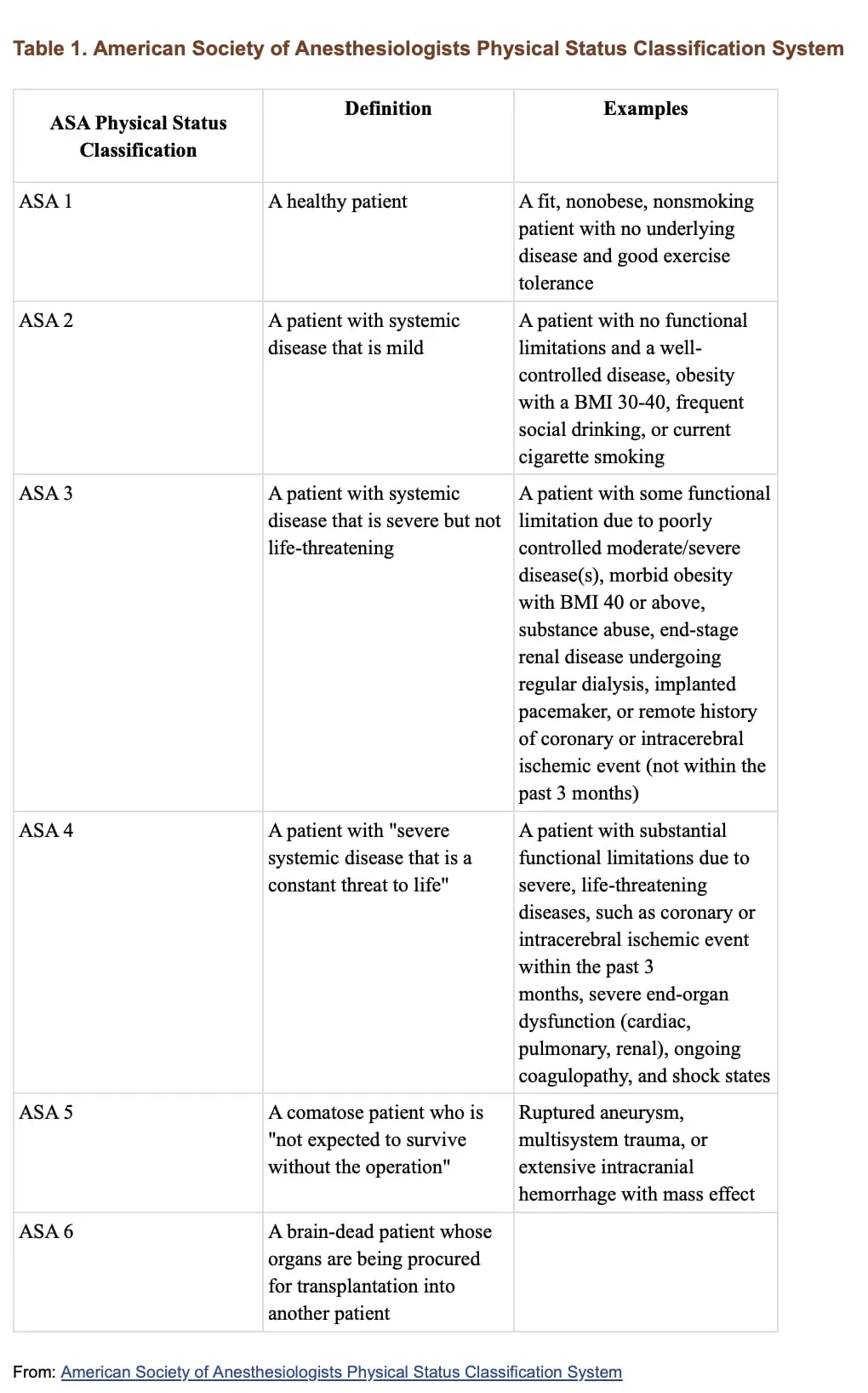
The American Society of Anesthesiologists (ASA) Physical Status Classification System is one of the most widely used tools in perioperative care — and one of the most frequently misunderstood.
You’ll see it in:
- Pre-operative assessments
- Dental sedation charts
- Hospital consults
- Board and licensing exams
Yet many people treat ASA as a surgery risk score or a go / no-go decision tool.
It isn’t.
This post explains what ASA actually measures, where it helps, where it falls short — and how to use it correctly in modern dental and perioperative care.
👥 Who This Is For And Why It Matters
Dental students & residentsUnderstand how ASA is tested — and how it’s supposed to be applied.
CliniciansAvoid common charting, communication, and decision-making errors.
Patients & general readersLearn what your ASA status means — and why it’s only one part of the picture.
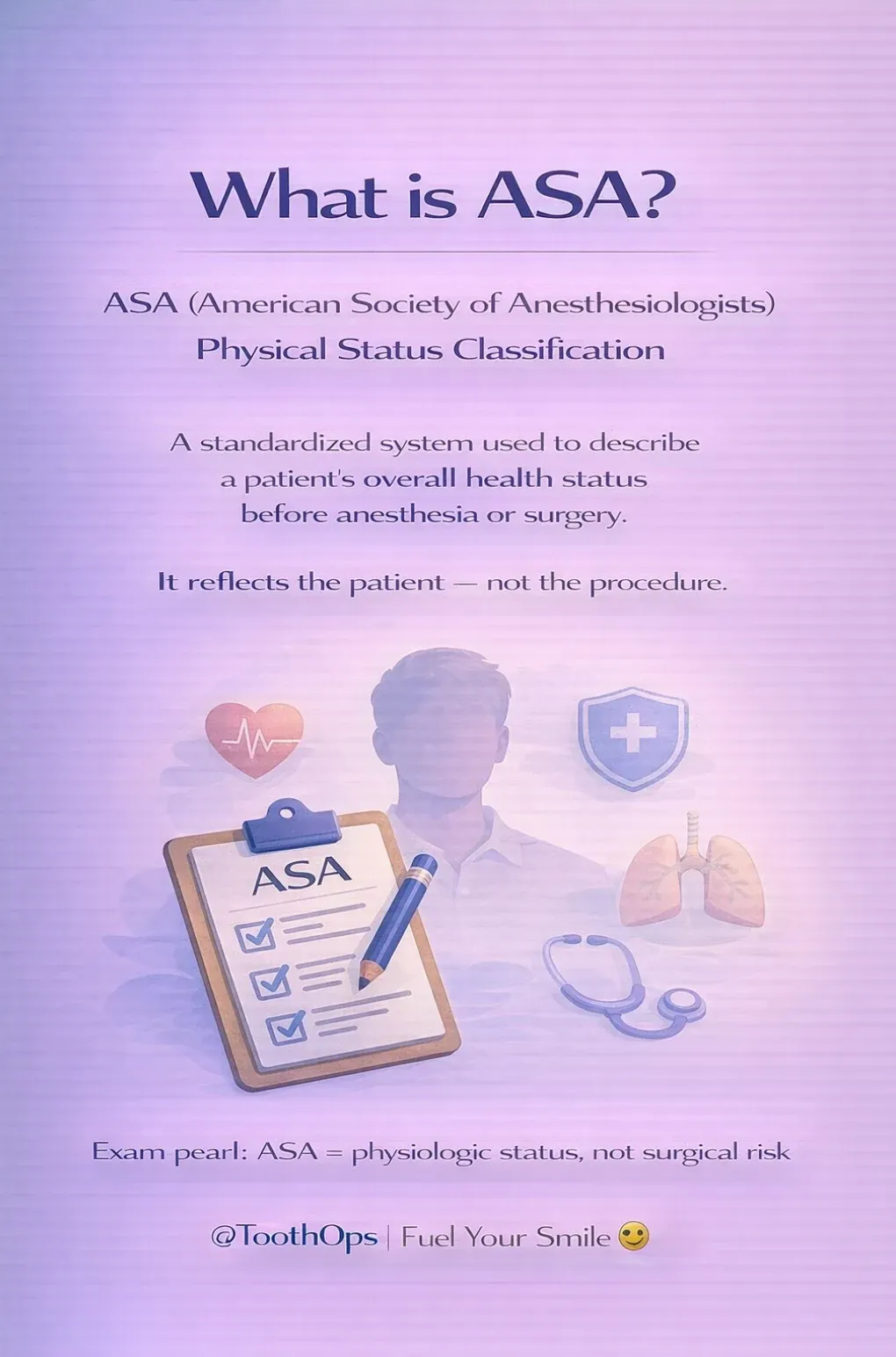
🧠 TL;DR ASA describes the patient’s baseline health, not the difficulty or danger of a specific procedure.
1️⃣ What ASA Actually Measures
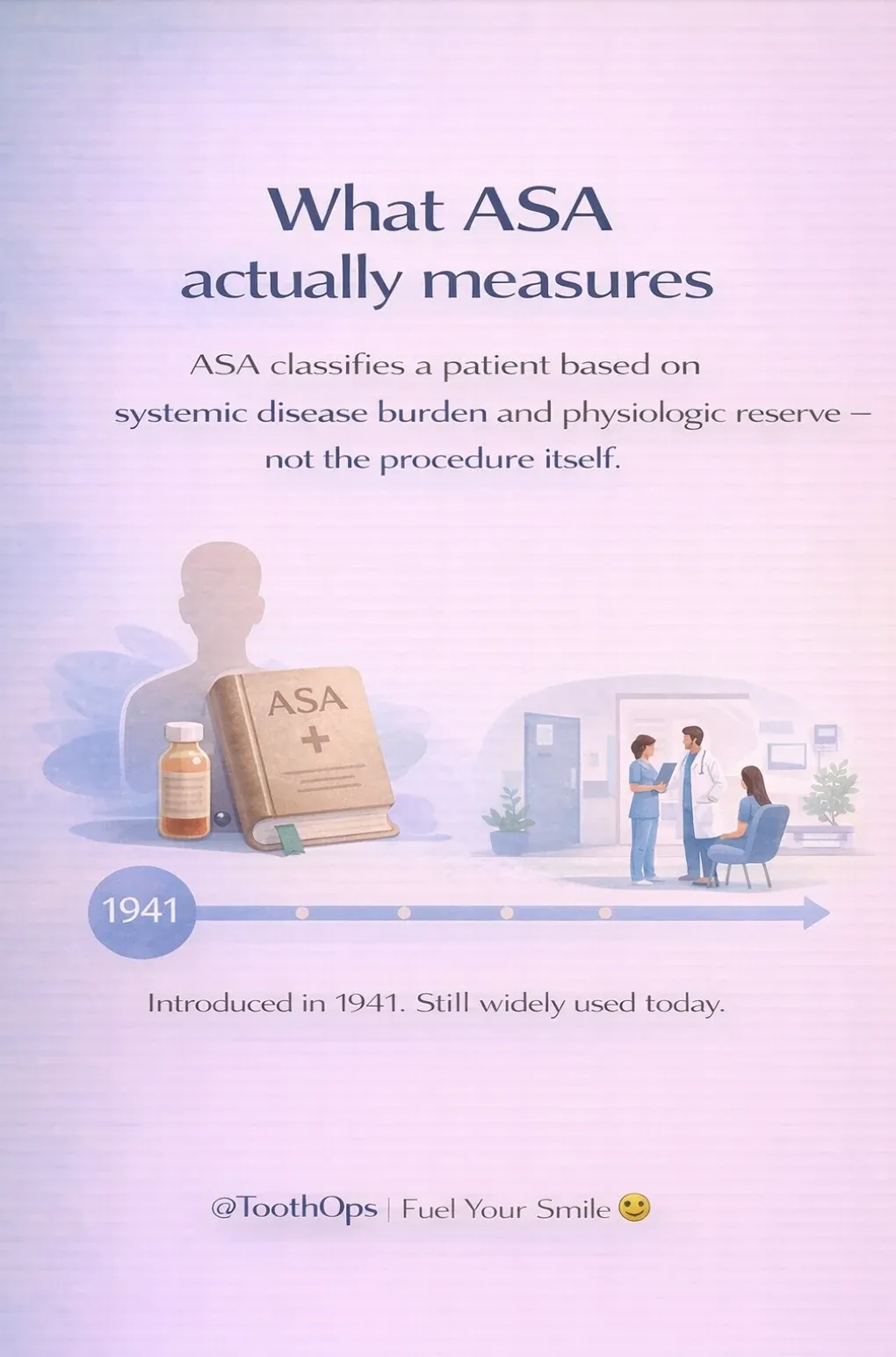
Introduced in 1941, the ASA Physical Status Classification System was designed to give clinicians a shared languagefor describing a patient’s overall physiologic condition before anesthesia or surgery.
ASA considers:
- Presence of systemic disease
- Severity of that disease
- Functional limitation caused by disease
ASA does not consider:
- Type or invasiveness of the procedure
- Surgical duration
- Blood loss risk
- Anesthetic technique
- Provider or facility resources
Think of ASA as a health snapshot, not a prediction.
2️⃣ Why ASA Still Matters (Despite Its Simplicity)
ASA remains widely used because it:
✔ Standardizes communication across teams
✔ Provides broad physiologic risk stratification
✔ Correlates with outcomes at a population level
✔ Is quick, familiar, and universally recognized
Its strength is not precision — it’s clarity.
3️⃣ The ASA Categories
ASA uses six ordinal classes, plus an emergency modifier:
- ASA I – Healthy patient
- ASA II – Mild systemic disease
- ASA III – Severe systemic disease
- ASA IV – Severe disease posing constant threat to life
- ASA V – Not expected to survive without surgery
- ASA VI – Brain-dead patient for organ donation
➕ “E” indicates an emergency, where delay increases risk to life or limb.
📌 Key point: A higher ASA class does not automatically prohibit treatment.
4️⃣ What ASA Is Not Designed to Do
This is where most confusion arises.
ASA does not measure:
- Procedure complexity
- Surgical stress
- Anticipated blood loss
- Patient frailty or resilience
- Postoperative care requirements
For example:
An ASA IV patient undergoing cataract surgery ≠ An ASA IV patient undergoing major abdominal surgery
Same ASA. Completely different risk.
5️⃣ The “E” Designation — Often Misunderstood
Adding “E” (e.g., ASA IIIE) means:
- The situation is emergent
- Delaying care would increase harm
It does not mean:
- The patient’s disease severity changed
- The patient became “sicker”
“E” reflects urgency, not physiology.
6️⃣ Why ASA Assignment Varies Between Clinicians
ASA classification involves clinical judgment — and that introduces variability.
Differences often arise with:
- Obesity
- Anemia
- Cardiac or pulmonary disease
- Functional limitation
This variability isn’t a failure of the system — it’s a reminder that ASA is a guide, not an algorithm.
7️⃣ Why ASA Alone Cannot Predict Outcomes
Although ASA correlates with postoperative mortality at a population level, individual outcomes depend on many additional factors, including:
- Age and frailty
- Disease optimization
- Procedure type
- Anesthetic plan
- Team experience
- Postoperative monitoring
ASA works best when paired with comprehensive clinical assessment.
8️⃣ What This Means in Dental Practice
In dentistry, ASA is commonly used to:
- Guide sedation planning
- Improve documentation clarity
- Communicate medical complexity
- Identify patients needing optimization or consultation
But ASA should support — not replace — clinical decision-making regarding:
- Setting of care
- Sedation modality
- Elective vs urgent timing
ASA provides context, not permission.

9️⃣ The Real Value of ASA
Used correctly, ASA helps:
✔ Align interprofessional teams
✔ Structure pre-operative discussions
✔ Identify higher-risk patients early
✔ Improve patient safety through communication
Its value lies in how it’s used, not the number itself.
🌱 Final Takeaway
The ASA Physical Status Classification System does not predict outcomes.
It describes patients.
High-quality perioperative care happens when clinicians integrate:
- ASA classification
- Procedure-specific risk
- Functional assessment
- Sound clinical judgment
That’s how decisions become safer, clearer, and calmer.
@ToothOps | Fuel Your Smile 😊
Stay tuned for more insights and educational content in our blog.
Disclaimer: Content is for educational purposes only and not a substitute for medical or dental care.© 2025 ToothOps | All Rights Reserved.